Sunday, 5 July 2015

Harness the Power of YouTube to Capture and Connect With Customers

YouTube offers an incredible marketing opportunity, as well as an online customer service channel. With it you can bring in new customers, build brand loyalty, and answer questions before they’re asked — all in the name of customer service.

The post Harness the Power of YouTube to Capture and Connect With Customers appeared first on AllBusiness.com.

10 Tips for Developing a Household Budget

A household budget is an effective way to keep track of your finances, avoid debt and overspending, and help you save money. The following are tips to develop your household budget:

1. Determine Essential Bill Expenses

When people think of household expenses, the first item that usually arises is paying the bills. Making sure the mortgage/rent, electric, phone, gas, and water bills are paid is essential, along with any monthly car payments. Gather all of your bills to work out how much you spend in one week or one month, and put aside enough money to cover them.

Credit card bills are also important expenses that need to be paid, because every time you miss a payment, you are charged interest and late fees, and your debt rises more. Do not forget to account for bills you pay quarterly or annually, such as insurance and taxes.

2. Calculate Food Expenses 

The next most important expense is your food bill. Whether you live alone or have a large family, food expenses can add up quickly. Figuring out weekly food expenses may be easier than figuring monthly. Devising a set menu you can stick to can also help you plan how much you are going to spend on food.

Alternatively, if finances are exceptionally tight, you can see if you are eligible for food stamps by visiting the U.S. Department of Agriculture, Food and Nutrition Service’s Supplemental Nutrition Assistance Program (SNAP) at www.fns.usda.gov/fsp or by visiting your local food banks, which are usually housed in churches.

3. Organize a Budget Spreadsheet

Organizing a spreadsheet can be an easy way to keep track of all your finances and help you budget more easily. Set up different columns for your food, bills, clothing, entertainment, and any other expenses you might have. Have one column for your projected expenses and one for actual costs. By setting up a spreadsheet, you can see at the end of the week where you are overspending and where you could cut back and save money.

4. Merge Your Income Effectively or Handle Your Own Finances

If you are married or living with a partner, decide whether or not you will combine your incomes. If you decide to do so, add your weekly or monthly incomes together, and begin your budgeting with the total amount available. If you decide to keep the incomes separate, then you should both budget individually and remain responsible for your own expenses and saving.

5. Eliminate Unnecessary Expenses

Especially if you are having financial struggles, try to note and add up all your discretionary daily expenses, such as morning coffee, magazines or newspapers, and gas money. If you add up these expenses over a week, month, or year, you will be surprised how much money you are spending on these items that you could otherwise be saving.

6. Set Aside Savings 

Don’t forget to include saving money as a part of your regular budgeting; set aside a certain amount of money each week or month to go into your savings account. If savings are treated as a regular, fixed expense, the account will probably grow more quickly than it would have otherwise.

7. Prepare for Emergencies 

An emergency fund is a must for most households. Unexpected events can happen at any time, so it’s important to always have some cash on hand in the event of an emergency. This amount does not have to be a large amount, but add to every time you budget; even $10 per week is a start.

8. Keep Track of Your Credit Report 

An important part of budgeting is to know your credit score and have records of your credit report. When you complete your household budget, having your credit report at hand will also help you to project your expenses. You can visit www.annualcreditreport.com/cra/index.jsp  to obtain a free copy of your annual report from each of the three major credit bureaus. 

9. Budget for Vacations 

Most people like to take a vacation each year, even if it only means a weekend at the beach. Accounting for your vacation fund is an important part of your budget, so that you will be able to save enough money to cover hotel, food, and entertainment expenses while you are away. If you class this item as part of your savings category, you can split your savings budget into different parts, such as vacation fund, emergency fund, school, and retirement.

10. Budget for a New Home

You can determine whether you can afford to buy a new home, and how much of a home you can afford to buy, by considering the dollars already accounted for in your current household budget. Online mortgage calculators such as the one at www.MortgageCalculator.com can help you figure out your monthly payments.

The post 10 Tips for Developing a Household Budget appeared first on AllBusiness.com.

Top 10 Money Mistakes That Retirees Make

Retirees need to be smart consumers if they are going to make retirement the best possible time of their lives. Avoiding these 10 mistakes can help.

1. Assuming That Expenses Will Drop

Most retirees assume that once they quit working, their expenses will go down, but this is not necessarily true. In fact, many people find their expenses remain the same or even increase after retirement.

When people have more leisure time, they tend to spend more money. Medical costs might add several hundred dollars each month to their cost of living; experts predict that by the year 2031, retirees will pay 90 percent of their health care costs. Retirees who decide to move may also find a higher cost of living in the new area.

2.  Spending Too Much Too Fast

In early retirement, some people are tempted to spend a big chunk of savings right away. The more frugal they are, however, the better off they will be. The less they withdraw from their savings, the more the remainder can continue to grow. 

3.  Underestimating Possible Health Care Costs 

As more Baby Boomers reach retirement age, health care costs are likely to skyrocket. Even though the average American’s overall quality of health is less than desirable because of improper eating and lack of exercise, people are still living longer than ever before. Therefore, since people will need more health care during their lives, the long-term cost of health care will likely rise.

One way a person can overcome long-term health care expenses is to purchase long-term care insurance to cover the expenses of long term care if necessary.

4.  Overestimating Retirement Accounts and Social Security 

When retirees think short-term, they often do not realize that inflation will cause their expenses to rise while their income remains fixed. Assume inflation will increase over the years of retirement. If retirees do not add inflation into their plan for retirement, they will find themselves living on a fixed income while prices continually escalate. This will decrease their buying power during the time in their lives when they should be enjoying themselves.

The government designed Social Security to help a person with retirement. The plan was to help a person save for retirement, not to cover all the costs of retirement. The money a retiree receives with Social Security will not keep up with inflation. Whatever money they receive will soon lose buying power, since the cost of living will increase, while retirement income and Social Security can remain fixed.

5. Cashing Out Old Retirement Accounts Early

Almost everyone who cashes in old retirement accounts early regrets it later. Instead of cashing it out, a good alternative would be to roll it over into an individual retirement account (IRA).

Unless retirees’ IRAs are their only income, they should wait to withdraw from it. A person must be at least 59½ years old before he or she can withdraw without paying a 10 percent penalty. A person would also have to pay taxes on this money, so it makes even more sense to wait a few years before withdrawing from this fund; during that same time, the money will continue earning interest.

The worst part of withdrawing this money early is a person they will never gain the advantage of having this extra income for retirement.

6. Selling the Home

After retirement, many people decide to sell the home where they have lived for many years, perhaps to be closer to extended family or to enjoy better weather. The key is not making the mistake of hastily selling and moving; instead, investigate the idea completely before taking the big jump.

Another possibility retirees might consider is staying in their current homes and obtaining a reverse mortgage. Anyone considering this should be cautious and thoroughly research the company they would be doing business with and all the financial details of the reverse mortgage.

7. Investing Entirely In Fixed-Income Securities

When people retire, they should invest in something that will give them income over the long term, in addition to adjust fixed income securities. A retiree should never put all of his investments into one item; he should seek to appropriately diversify his income portfolio.

8. Taking Social Security Benefits Too Soon

Two-thirds of retirees sign up for their Social Security, taking reduced benefits, before they are 65. If retirees wait until the age of 65 to begin receiving benefits, they will receive 20 percent more each year. This can be quite a large sum over the years.

9. Taking a Company Pension Distribution in Cash

When people take a company pension distribution in cash, rather than in payments each month, the government withholds 20 percent. To avoid this scenario, the money should be sent straight to an IRA; retirees can later withdraw the money in increments, as it’s needed.

10. Simplifying Estate Planning         

In most cases, retirees need more than a simple will to protect their estate.  Living trusts can avoid probate, and variable annuities and life insurance can pass assets automatically to heirs. Charitable trusts can also reduce estate taxes.

The post Top 10 Money Mistakes That Retirees Make appeared first on AllBusiness.com.

Friday, 3 July 2015

Marriage and Finances: What You Should Know Before You Say “I Do”

When you say “I do” to the one you love, you are also saying “I do” to sharing responsibility for your finances as a couple. Even if you both decide you would like to keep your finances separate, how you handle money once you are married can affect one another and the health of your marriage. So take the time before you say your wedding vows to discuss your current financial status and your financial goals for the future.

Figure Out How Much Debt You Both Have

One of the most important financial considerations when getting married is figuring out how much debt you both carry and how you plan to pay it off. Here are some questions to consider as you assess how to handle your debt once married:

  • Will you merge your debts and pay them off together?
  • Will you pay off your debts separately from your own earnings?
  • What happens should one of you lose your job and need help paying off past debt?
  • In the event you decide to have children and one of you stops working to care for them, how will that person’s debt be handled?

If you have a lot of debt between the two of you, you will need to devise a plan for paying it off. Some strategies include paying more than the minimum due each month, using cash only, lowering your spending, and increasing your income by getting a second or better-paying job.

For more ideas on how to get out of debt, check out the Federal Trade Commission’s article “Coping With Debt.”

How Will You Handle Your Finances Together?

As a married couple, you may share dreams for your future that will more than likely take money to fulfill. In order to achieve these dreams, you will need a solid financial plan.

In order to create a financial plan, you should assess your dual income, debts, expenses, and savings goals. With these numbers, create a budget that allows for fulfilling the dreams for your future. For help with personal budgeting, go to www.mint.com or www.pearbudget.com.

One option is to hire a professional financial planner who can help you establish a financial plan. Consult organizations such as the National Association of Personal Financial Advisors or the Financial Planning Association to find reputable financial planners in your region.

Joint or Separate Bank Accounts?

Part of creating a financial plan for your future is determining if you are going to merge your money and put it into joint checking and savings accounts, or if you are going to have separate bank accounts. This decision should be based on what works best for you both.

Some people like to manage their finances jointly and others prefer a more independent system of tracking their own money and contributing to the bills in an equitable way.

When deciding to have joint or separate bank accounts, consider who will be in charge of paying the bills. One of you may enjoy managing the finances and one of you may be happy to have the other handle them. Or you both may want to be part of the process. However you decide to handle your money, it is wise to discuss it before your wedding day.

Credit Scores Do Matter

Your credit score is a number — usually between 300 and 850 — that reflects how you have handled your finances as compared to the financial histories of thousands of other people. When applying for a loan or a mortgage, banks look at your credit scores to get an idea of how creditworthy you are. If you are applying for joint credit, which is often necessary for big purchases like a home, you both need good credit scores.

Even if your credit score is high, you could get turned down or only qualify for costlier credit if your spouse’s credit score is low. So if your goals include making large purchases together, you need to look at one another’s credit scores and work on making yourselves attractive to lenders.

The post Marriage and Finances: What You Should Know Before You Say “I Do” appeared first on AllBusiness.com.

The Top Five Kissmetrics Reports Every Ecommerce Marketer Needs

Today’s ecommerce marketers have a tough job. Their main objective: get the messaging out about the store and deliver sales. You have the website at your disposal and a mediocre advertising budget.

The challenge for you, as an ecommerce marketer, is how do you compete against a service like Amazon? They’re big, they can undercut your prices, and they can handle low margins while you cannot.

You need to optimize everywhere you can, including your funnel and your marketing channels, and you need to build a loyal customer base. Fortunately, Kissmetrics is here to help. Our software provides insights that can help visitors into customers. And once you get those customers, we provide data that can help you acquire more of the loyal ones.

Let’s see how.

1) Purchase Funnel – See Where You’re Losing Customers

Every website has a set of steps visitors need to go through before they can purchase. The Kissmetrics Funnel Report is used to help marketers identify the areas of their website where visitors depart. Once they identify those areas, they can then A/B test their way to growth.

Here’s how a funnel for an ecommerce site might look:

ecommerce-purchase-funnel

What we know from viewing this graph is that visitors have two big roadblocks to becoming customers. Of those who view the product page, only 33% convert to adding a product to their cart. And once they do add a product to their cart, only 13% of them end up purchasing. If you’re a marketer and this is your data, you know you can do better than a 13% conversion from cart to purchase. And if you do improve, you’ll end up getting more purchases for your company. Cha-ching!

To get you on your path to increased purchases, you’ll need to run A/B tests on the product pages and throughout the shopping cart checkout process (more on that later). You can create your A/B tests in whichever tool you use – Optimizely, VWO, etc. – and then track the results with the Kissmetrics A/B Test Report.

The cool thing about this report is that you can see how an A/B test impacts your entire funnel. So if you run a test on the product page, you can see how it impacts further on down the funnel, all the way to the purchase! You aren’t limited to testing only to the next conversion step.

You can also set up a funnel to view how people move through the checkout process. Let’s get into that now.

2) Funnel Report – See Where Customers Drop Off in the Checkout Funnel

You can break funnels into two categories – macro and micro. The macro funnels take a bird’s-eye view of your site, often viewing your whole site. The purchase funnel is a lot like that. It goes from the start of the funnel all the way to the end. A micro funnel allows marketers to zoom in and see a specific flow within their site. A funnel report on the checkout funnel is one example.

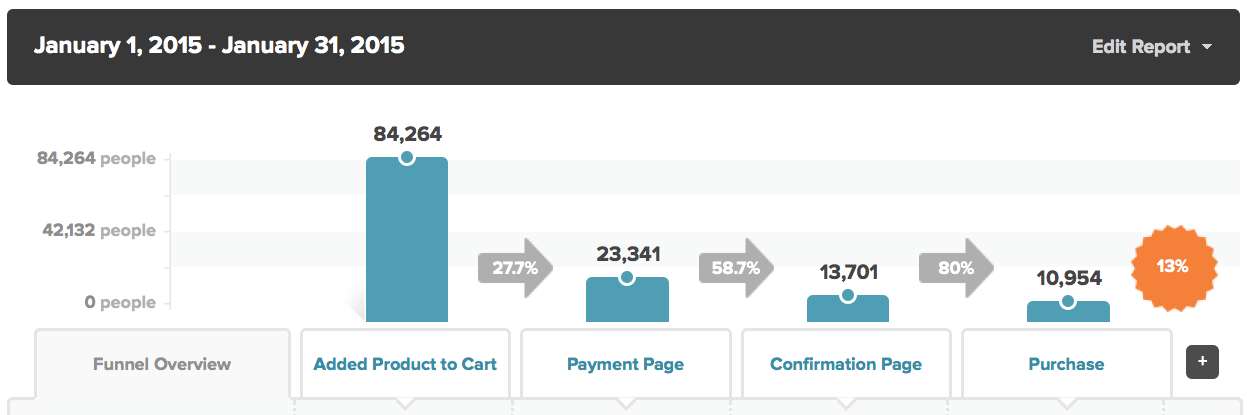
Here’s how it might look:
ecommerce-checkout-funnel

Looking at this graph, where would you say drop-off is occurring?

Without question, most people who end up putting a product in their cart don’t even advance to the next step in the funnel (the Payment Page). If we can increase the people who convert from the Added Product to Cart page to Payment Page, we’ll have a pretty linear increase in purchases.

So if you’re a marketer and you want to increase conversions (who doesn’t), here’s what you do:

  • Use the Kissmetrics Funnel Report to see where visitors are dropping off.
  • Run A/B tests on those pages. Track the tests in the Kissmetrics A/B Test Report. The more tests you run, the more winners you’ll find, and the more purchases you’ll bring.

With Engage from Kissmetrics, you’ll be able to put modals on your site that can increase conversions. A lot of our customers have experienced a conversion boost by using Engage.

The best marketers are able to drive loyal customers. Lucky for marketers, Kissmetrics has a report that shows marketers where their most loyal customers come from.

Click here to watch a short demo of the Kissmetrics Funnel Report.

3) Cohort Report – Find Customers Who Repurchase

Businesses live and die on their ability to attract and retain customers. To track customer retention, marketers can create a cohort report that shows them how often customers come back and repurchase products. They can even group them together and see which products or product lines have people coming back for more.

A cohort is a group of people who share a common characteristic or experience within a defined period. For example, people who purchased from your site during April are in a cohort because they all did one thing (purchase) during a defined period (April).

Taking this a step further, the Kissmetrics Cohort Report allows you to group people by any characteristic and then segment them by any property. Let’s see this in action.

We want to track repurchase rates (i.e., people who purchase, then purchase again). We can find those people, but what do we group them by? Time? Marketing channel? Product? Product category? As long as you’re tracking the property in Kissmetrics, you can segment people by it.

Let’s use marketing channel as our example. This segments people by the channel they came from. The higher the percentages (darker shade of blue), the better.

channel-purchases-cohort-report-kissmetrics

On the left side we get the number of people from each channel who have purchased. This is not a traffic report. We’re looking at purchases. We see that most of our purchases are from people in the Social channel. The right side (all the blue shaded cells with percentages in them) shows us how many of those people came back and purchased again, by month.

Social looks like it delivers a lot of purchases and repurchases. If we can acquire more people from this channel, chances are we’ll be acquiring loyal customers. The more targeted we can make our marketing, the more loyal customers we’ll attract. And businesses that win have loyal customers.

As mentioned above, we aren’t limited to grouping people only by channel. We can group them by product (see which products get the most repurchases), product line, any UTM parameter, time, etc. As long as you track it, you can get the data that matters to you.

Click here to watch a short demo of the Kissmetrics Cohort Report.

4) Revenue Report – See Which Products Bring the Most Valuable Customers

Your revenue is probably coming from dozens (hundreds) of sources. Maybe a feature on CNN got you a ton of orders, or you get a lot of purchasers coming from Google searches.

The Kissmetrics Revenue Report is used to segment your revenue and see which sources are bringing you the most valuable customers. Here is how it could look for a company selling clothes:

kissmetrics-revenue-report-ecommerce

We’re segmenting revenue by collection (aka product category). The In-House Generic Tees bring tons of revenue (over $630k) and customers (over 9,700). The other metrics (average revenue/person, lifetime value, and churn) tell us how valuable these collections are for our business. We want high numbers on average revenue/person and lifetime value, but low percentages for churn. (Churn represents the percentage of people who ordered from that collection but did not order again within a defined time period.)

Just like the Cohort Report in the above section, we aren’t limited to segmenting only by collection. We can also segment by marketing channel, so we can see which channels bring us the most valuable customers. By the way, the channels property works automatically in Kissmetrics. There are no custom rules or custom code needed.

Click here to watch a short demo of the Kissmetrics Revenue Report.

5) People Search – Find People Who Have Abandoned Their Cart

The biggest problem for a lot of ecommerce companies is customers who abandon their cart. They view a product, add it to their cart, but never return again. They’re missing out on a big opportunity if they don’t make an effort to re-engage these people. If marketers can get them re-engaged (through cart abandonment emails) they are giving themselves a better shot at recapturing these lost orders.

The problem for many marketers is they don’t know where to start to get a list of these people. The Kissmetrics People Search makes this process easy. All you have to do is set your criteria to get a list of people you are looking for. There is no need to bug engineers to run a SQL query.

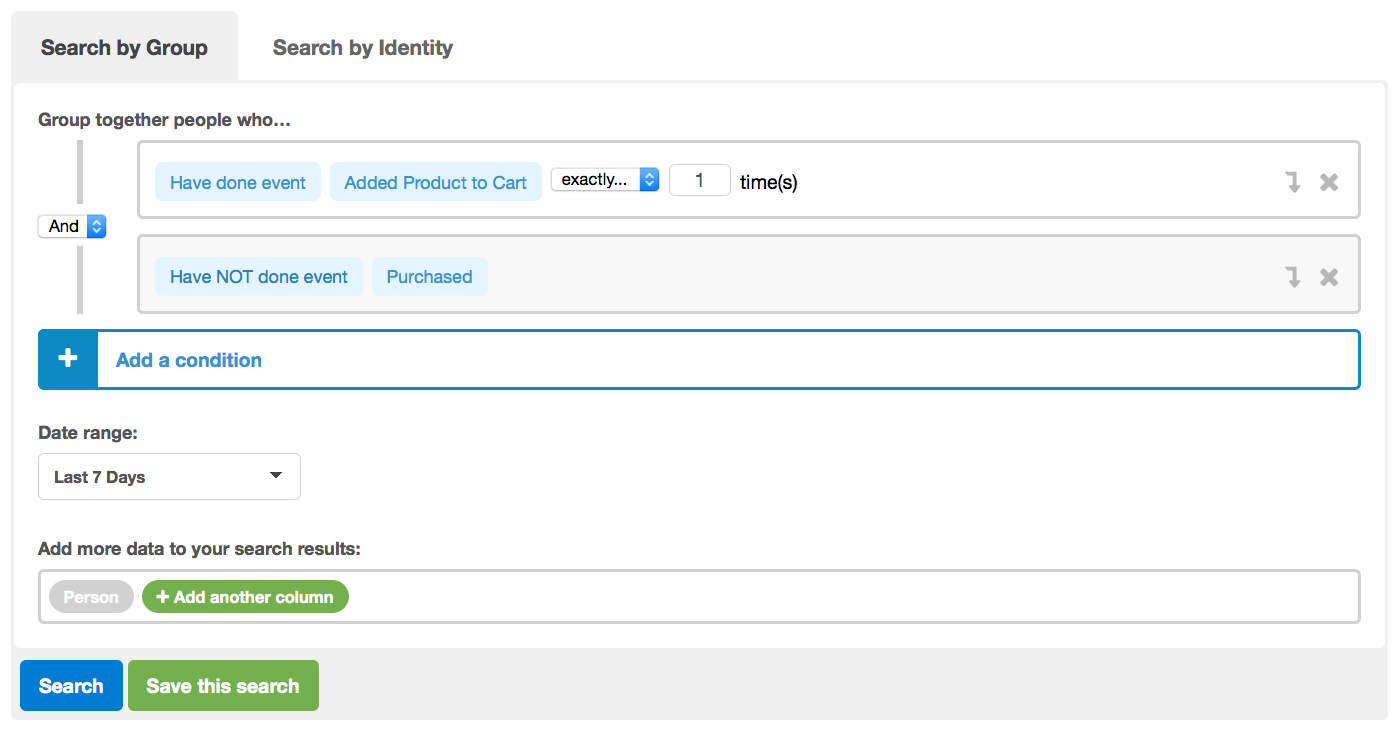
Here’s what our criteria looks like. We’re looking for people who have added a product to their cart but have not purchased. We want to see all the people who fit this criteria in the past 7 days.

people-search-add-product-to-cart-ecommerce

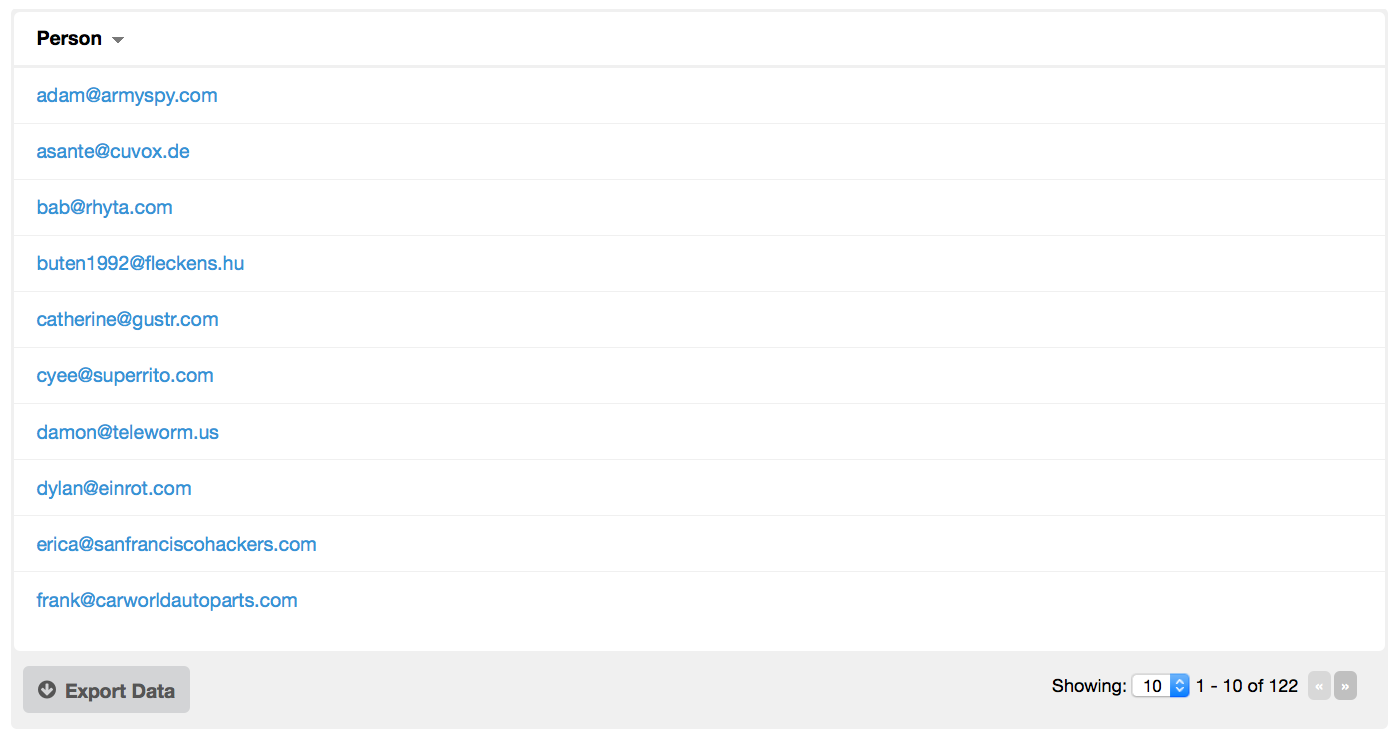
We click Search and get our list of people:

people-search-kissmetrics-cart-abandonment

There are a few things we can do with this list:

  • We can click on each person and get a Person Details report. This will show us all the events and properties the person triggered (i.e., what they’ve done on the site) as well as tell us the last time they were seen.
  • We can export the list to a CSV file and then upload it into an email service provider like MailChimp and send an email to each person to get them re-engaged and hopefully recover some lost sales.

Important note: You’ll get a list of email addresses only under certain circumstances:

Click here to watch a short demo of the Kissmetrics People Search.

Optimize Your Marketing with Kissmetrics

These are just a few examples of what Kissmetrics can do for ecommerce companies. Our reports are more than useless metrics – they provide insights into how users are behaving on your site. Once you see this data, you’ll know what needs to be improved. Once you see this data, you’ll know what needs to be improved.

Head on over to the Demo site and see how Kissmetrics works for ecommerce sites. Or better yet, schedule a personalized demo.

Ready to get straight into the action? Just click the button below to sign up for a free 2-week trial of Kissmetrics.

cta-6-11-2012

About the Author: Zach Bulygo (Twitter) is a Content Writer for Kissmetrics.

Wednesday, 1 July 2015

6 Problems Lucid Software Solves Using Kissmetrics

As Digital Marketing Manager at Lucid Software, I can really appreciate all the hard work that has been put into Kissmetrics. It’s a valuable tool for tracking, analyzing, and optimizing our marketing efforts, which include many day-to-day tasks that go above and beyond traditional metrics. Below, I’ve outlined six marketing questions Kissmetrics is helping us answer in ways you may not have considered before.

1. Where do I start with my reseller efforts?

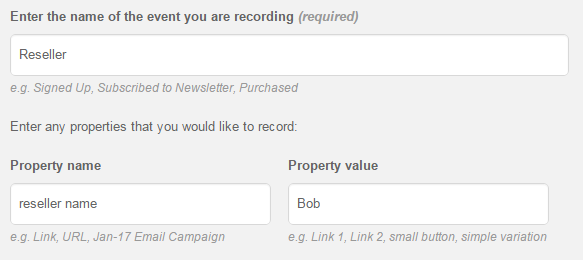
When you are just starting up a reseller program like we are, it may not make sense to start paying for a separate tracking solution right away. We are able to credit our resellers and affiliates for the customers that they send our way through their online presence. We don’t need to deploy a whole new solution for this—we simply use Kissmetrics to track the links we provide them.

reseller

Use Kissmetrics to power your own affiliate program

2. How do I tracking content marketing ROI?

Content marketing is all the rage these days. Just as popular as content marketing are the many articles that give advice on measuring ROI. Even if a marketing effort involves multiple pages, it is easy to quickly track the impact of the campaign as a whole when you’re using Kissmetrics. I was able to put a JavaScript tag on all the pages in question with one event. I also set up a property that tracks the page name for the possibility of future granular analysis. This allowed me to group and measure the performance of different KPI metrics like registrations and payments by related content.

3. Is increasing registration conversions impacting revenue?

In the SaaS world, it is very common to offer an evaluation period for your software so that the customer can ‘try before they buy.’ From a marketing standpoint, this can prove to be a challenge because you now have two metrics that you care about:

  1. Trial registration rate
  2. Payment rate.

It’s nice to know that Kissmetrics lets me tie back-end payment information that happens after the fact to the original trial registration. At the end of the day we are interested in the test version that drives the most revenue long-term, not just the version that converts the most people to trial. Kissmetrics makes it easy to keep those two versions distinct.

impacting-revenue

Kissmetrics is great at tracking A/B tests that actually drive revenue months down the road

4. Which of my customers should I be calling to do market research?

I am often interested in learning more about how a segment of our customer base uses our products, Lucidchart and Lucidpress, or how they first learned about us.

Since Kissmetrics ties anonymous visits to our customers once they login, I can go back in time and say “show me everyone that did X events or visited Y page.” I can then use that customer list to do outreach.

This proved very helpful to our team: we were able to effectively do our homework before we reached out, which means the people we were calling actually valued our calls.

market-research

Kissmetrics allows you to do very segmented market research with your own data – no spreadsheets or having to ask developers for data dumps

5. How do I manage my marketing efforts across multiple products?

When you have more than one product, it’s nice to be able to house all your testing and analytics in one place. I personally find this important, because ideas I test on Lucidpress might come from wins we originally got through Lucidchart testing. I can open a new tab and compare the set up on one domain, then quickly set up a test on a completely different revenue stream. Managing multiple domains also allows for another handy feature, which leads into my last question that Kissmetrics helps answer.

6. How can I test my analytics implementation before pushing it live?

Testing can sometimes mean lots of moving parts, so it’s nice to be able to incorporate testing implementation into your QA cycle. We have a development, staging, and production server.

With Kissmetrics we are able to take a look at whether events and properties are being recorded properly in development and staging before they ever get released to production. This is great for me because I can get more eyes on our tests before they go out. Writing the acceptance criteria for the QA team gives me another chance to make sure that all my ducks are in a row.

analytics-deployment

You can set up Kissmetrics on multiple servers – allowing you to make sure your testing and analytics solutions are working on development and staging servers

Bonus: What’s next?

When I sat down to write out some of the possibly lesser-known advantages of Kissmetrics, I limited myself to just the few benefits I could rattle off of the top of my head and use every day.

As a bonus, I want to mention that Kissmetrics is releasing new features on a regular basis. Whether it is robust regex support or their A/B test report, they are always focused on making their product more indispensable. Lucid Software has been a client for years now and we are excited to see what features they add next!

About the Author: Brad Hanks was the first marketing hire at Lucid Software, the creators of Lucidchart, a flow chart maker, and Lucidpress, an online design and page layout tool that makes brochures, among other things.

4 Ways To Be More Efficient At Work

While some people seem to be born with an innate sense of efficiency, most people have to work at increasing their on-the-job productivity. Here are four tips to be more efficient at work.

The post 4 Ways To Be More Efficient At Work appeared first on AllBusiness.com.