Saturday, 7 May 2016

App Development Tips for Businesses – Why You Need an App

To push your business forward and get it seen in 2016 means doing all you can to ensure you're found on as many devices as possible and are as accessible as possible. The app industry is often neglected by businesspeople who think it's just for techies or a sector that is hard to break into. But it doesn't have to be and whilst, yes, there are a reported 8.7m mobile app developers out there and over 75 billion app downloads taking place each year, business owners are missing out by not ensuring they get their piece of the action. Your business will benefit if it has its own app, as long as you ensure you approach it in the right way. So read on for some killer app development tips.


Why do you need an App?


You may be asking yourself whether you need a mobile app because you already have a responsive website and, therefore, people can find you on their mobile devices. However, an app serves a very different purpose. Apps offer a quick and effective interface for your customers, and they may be used for a different purpose than your website. Smart Insights found that 'the consumer preference for mobile apps which account for 89% of media time in mobile is as might be expected from the use of the most popular social network, email and news apps.'  Therefore there is a huge opportunity for your business to take advantage of this and become a media source in its own right, offering something different to your website but equally valuable. But do you know these app development tips?


As a start-up entrepreneur or small business owner you may be thinking that it simply doesn't apply to you, but as SellMyApp founder Stav Zilbershtein discussed with me: 'Mobile penetration is rising everywhere. This is already old news. People use mobile almost all of the time and they expect to be able to have access to any type of service / game they have on their computer via their mobile.


Any start-up should integrate mobile usage into its KPIs – this is simply a must nowadays.'


apps, app development tips, Business Apps, app development, application developers, how to's, how to, how to develop an app, app marketing


App Development Tips – how to get noticed


Before you have even designed your app you are bound to have lots of questions. If you have accepted that your business can benefit from an app then the next thing on your mind will probably be the competition. As the statistics mentioned already show, there are millions of apps out there and for yours to be a success you need it to stand out in some way.  This can be tricky to begin with but if you plan effectively within your budget and create an app, which has your user experience at heart then you can't go far wrong. Steve Young of App Masters also highlights how valuable professional guidelines written by the platforms you're hoping to penetrate can be, and says: 'make sure you follow Google's Launch Checklist to get your apps ready for the public'.


Another option is to get smart targeted installs – increasing your install rate should be something you build into your mobile app marketing strategy.


Let's Talk Money: Is an App a Good Investment?


From a financial perspective you want to invest in an app if it's going to make you money. That much is clear. But you also want to make sure that it isn't going to come at too considerable a cost.


Research in the 2015 What's My Worth Report by Millennial Media found that 72% expect ads to be able to enjoy free app content and so leveraging mobile apps and designing a free app which has in-app purchases may help to boost the potential return on your app. Another alternative is to provide your customers with 'free content for life' on the basis of a single one-off fee. This is a technique that has been tried and is found to be effective, and beyond this it is a chance to get creative.


Making a profit from apps does take time and you have to be in it for the long run – so you need to take advantage of these app development tips if you want your idea to make money and grow your business. From a technical point of view, Stav Zilbershtein also suggests it may be possible to 'buy source codes as a base for your app / game and save a lot of money and resources if you have the right team to customise it for you.'


If you're committed to seeing your app succeed and you have a PPC budget then it makes sense to divert some of this towards app installation campaigns and your overall mobile marketing strategy. It will take time – no app development tips worth their salt are quick fixes – but it will be worth it.


All the evidence suggests that customers want an app and will use an app heavily, should it add value to their needs, so it is in your best interests to provide them with one.


A Look at the Technical Side of Things


As already mentioned a big worry that comes with creating your own business app is the technical side of things. Just how 'techie' do you need to be? The answer is: not really. Any app development tips telling you otherwise should be avoided or, at best, treated with a hint of cynicism. If you have a good idea, a lot of creativity and the chance to experiment, chances are you can get the basis of your app together quite quickly and it is always possible, as already mentioned, to buy things such as the basic source code for an app that you can build your app around. Once you start looking into it more closely you'll realise it's much more straightforward than you think.


Another thing you may come across when looking into app design is a process known as reskinning. So far as app development tips go, this could be your solution to getting your app idea to marketing quickly and efficiently. This is a process of taking a complete source code of an app or game and then changing its graphics and sounds for launching onto the market. Essentially, use existing code as the framework for your idea and then tailor it to what you want. apps, app development tips, Business Apps, app development, application developers, how to's, how to, how to develop an app, app marketingIt is a great way of accelerating the launch of your idea and an easy way of quickly generating a return on an app design. It also means you can benefit from the original popularity of the app and rebrand it to suit your business. Reskinning is a positive trend in the market as it is encouraging developers to become smarter and more creative.


It's also important to remember that, like any online project, an app isn't something you just make and leave. It is an ongoing commitment that will evolve with your business and the majority of apps make big updates at least once every six months, with regular bug fixes taking place more often. If you take into account user feedback and react to it effectively then you will know when the time is right to make changes.


You may think an app is just another thing to worry about but the benefits it can offer your business are huge. Once you start experimenting and get your app onto the market, you'll be pleasantly surprised by how your users respond.


Good Fortunes to you; I hope I have helped your approach and mind set to marketing and business.


The post App Development Tips for Businesses – Why You Need an App appeared first on AllBusiness.com

The post App Development Tips for Businesses – Why You Need an App appeared first on AllBusiness.com.


Friday, 6 May 2016

App Development Tips for businesses – why you need an app

To push your business forward and get it seen in 2016 means doing all you can to ensure you're found on as many devices as possible and are as accessible as possible. The app industry is often neglected by businesspeople who think it's just for techies or a sector that is hard to break into. But it doesn't have to be and whilst, yes, there are a reported 8.7m mobile app developers out there and over 75 billion app downloads taking place each year, business owners are missing out by not ensuring they get their piece of the action. Your business will benefit if it has its own app, as long as you ensure you approach it in the right way. So read on for some killer app development tips.


Why do you need an App?


You may be asking yourself whether you need a mobile app because you already have a responsive website and, therefore, people can find you on their mobile devices. However, an app serves a very different purpose. Apps offer a quick and effective interface for your customers, and they may be used for a different purpose than your website. Smart Insights found that 'the consumer preference for mobile apps which account for 89% of media time in mobile is as might be expected from the use of the most popular social network, email and news apps.'  Therefore there is a huge opportunity for your business to take advantage of this and become a media source in its own right, offering something different to your website but equally valuable. But do you know these app development tips?


As a start-up entrepreneur or small business owner you may be thinking that it simply doesn't apply to you, but as SellMyApp founder Stav Zilbershtein discussed with me: 'Mobile penetration is rising everywhere. This is already old news. People use mobile almost all of the time and they expect to be able to have access to any type of service / game they have on their computer via their mobile.


Any start-up should integrate mobile usage into its KPIs – this is simply a must nowadays.'


apps, app development tips, Business Apps, app development, application developers, how to's, how to, how to develop an app, app marketing


App Development Tips – how to get noticed


Before you have even designed your app you are bound to have lots of questions. If you have accepted that your business can benefit from an app then the next thing on your mind will probably be the competition. As the statistics mentioned already show, there are millions of apps out there and for yours to be a success you need it to stand out in some way.  This can be tricky to begin with but if you plan effectively within your budget and create an app, which has your user experience at heart then you can't go far wrong. Steve Young of App Masters also highlights how valuable professional guidelines written by the platforms you're hoping to penetrate can be, and says: 'make sure you follow Google's Launch Checklist to get your apps ready for the public'.


Another option is to get smart targeted installs – increasing your install rate should be something you build into your mobile app marketing strategy.


Let's Talk Money: Is an App a Good Investment?


From a financial perspective you want to invest in an app if it's going to make you money. That much is clear. But you also want to make sure that it isn't going to come at too considerable a cost.


Research in the 2015 What's My Worth Report by Millennial Media found that 72% expect ads to be able to enjoy free app content and so leveraging mobile apps and designing a free app which has in-app purchases may help to boost the potential return on your app. Another alternative is to provide your customers with 'free content for life' on the basis of a single one-off fee. This is a technique that has been tried and is found to be effective, and beyond this it is a chance to get creative.


Making a profit from apps does take time and you have to be in it for the long run – so you need to take advantage of these app development tips if you want your idea to make money and grow your business. From a technical point of view, Stav Zilbershtein also suggests it may be possible to 'buy source codes as a base for your app / game and save a lot of money and resources if you have the right team to customise it for you.'


If you're committed to seeing your app succeed and you have a PPC budget then it makes sense to divert some of this towards app installation campaigns and your overall mobile marketing strategy. It will take time – no app development tips worth their salt are quick fixes – but it will be worth it.


All the evidence suggests that customers want an app and will use an app heavily, should it add value to their needs, so it is in your best interests to provide them with one.


A Look at the Technical Side of Things


As already mentioned a big worry that comes with creating your own business app is the technical side of things. Just how 'techie' do you need to be? The answer is: not really. Any app development tips telling you otherwise should be avoided or, at best, treated with a hint of cynicism. If you have a good idea, a lot of creativity and the chance to experiment, chances are you can get the basis of your app together quite quickly and it is always possible, as already mentioned, to buy things such as the basic source code for an app that you can build your app around. Once you start looking into it more closely you'll realise it's much more straightforward than you think.


Another thing you may come across when looking into app design is a process known as reskinning. So far as app development tips go, this could be your solution to getting your app idea to marketing quickly and efficiently. This is a process of taking a complete source code of an app or game and then changing its graphics and sounds for launching onto the market. Essentially, use existing code as the framework for your idea and then tailor it to what you want. apps, app development tips, Business Apps, app development, application developers, how to's, how to, how to develop an app, app marketingIt is a great way of accelerating the launch of your idea and an easy way of quickly generating a return on an app design. It also means you can benefit from the original popularity of the app and rebrand it to suit your business. Reskinning is a positive trend in the market as it is encouraging developers to become smarter and more creative.


It's also important to remember that, like any online project, an app isn't something you just make and leave. It is an ongoing commitment that will evolve with your business and the majority of apps make big updates at least once every six months, with regular bug fixes taking place more often. If you take into account user feedback and react to it effectively then you will know when the time is right to make changes.


You may think an app is just another thing to worry about but the benefits it can offer your business are huge. Once you start experimenting and get your app onto the market, you'll be pleasantly surprised by how your users respond.


Good Fortunes to you; I hope I have helped your approach and mind set to marketing and business.


The post App Development Tips for businesses – why you need an app appeared first on AllBusiness.com

The post App Development Tips for businesses – why you need an app appeared first on AllBusiness.com.


Thursday, 5 May 2016

3 Ways Automated Lead Nurturing Can Supercharge The Sales Cycle

So you've launched an inbound campaign and started to attract good leads. That's great, but it's just the start. Now you have to keep those leads happy, while gently leading them through the buyer's journey to sales-ready qualification. If your sales cycle is a long one that's not always easy.


Sending leads inappropriate content and interrupting them with unsolicited sales calls is increasingly ineffective. Instead, to increase close rates, avoid wasted sales time and reduce the sales cycle, leads should be nurtured with appropriate content to ensure they understand the value of your solution before sales teams contact them.


Many marketers may think they already run effective lead nurture campaigns. But using automated lead nurture as part of an inbound campaign ensures all leads get quick responses and are automatically sent the right content for them. No lead is forgotten and no content wasted.


Challenges of Long Sales Cycles


According to Gleanster Research, 50% of qualified leads aren't ready to buy. They might be open to education, and delighted that you can identify their pain points. But actually signing up for your solution? They're not there yet, and may not be for a while, depending on the length of your sales cycle.


That means sectors with long sales cycles, such as the SaaS and software industries, which have an average cycle of 3-18 months (and there's some suggestion that B2B sales cycles are getting longer across the board), face huge challenges in keeping leads interested and moving them smoothly through the sales funnel.


lead-to-customer-funnel


They might lack appropriate content to last the length of the sales cycle, or simply fail to notice leads wandering off the path. Equally, they might bore leads with repeat content, or lose them in bottlenecks.


The upshot can be lost leads and a lot of wasted effort by both marketers and sales teams. The wrong content discourages leads from moving along the sales path. Sales teams engage with leads at inopportune moments, wasting everybody's time.


Automated lead nurturing tackles these challenges.


What is Automated Lead Nurturing?


We know that lead nurturing works. A DemandGen report finds that nurtured leads produce, on average, a 20% increase in sales opportunities versus non-nurtured leads.


But traditionally, nurture is labor intensive. The average buyer's journey is complex, and the content that helps move them through the sales funnel from awareness (of a problem), to consideration (of solutions), to decision (of what solution to buy) needs to be expertly honed and perfectly timed.


Random one-off emails to your database won't cut it in a competitive world, especially during a long sales cycle. Talking up the detailed benefits of your solution to someone who is only vaguely aware of a problem is pointless at best. By the same token, emailing simplified educational material to a highly educated lead desperately seeking a solution is potentially counterproductive.


Automating lead nurturing, on the other hand, allows for the systematic tracking of lead engagements with your content and site, and accurate pinpointing of that lead's stage in the sales cycle. That means you can drip feed appropriate content at the right time – leads are never forgotten and opportunities never missed.


awareness-consideration-decision-buyers-journey


Forrester Research finds that companies who excel at lead nurturing generate 50% more sales ready leads at 33% lower cost. Automated lead nurturing, done properly, is the gold standard in its field.


The 3 Pillars of Automated Lead Nurturing


Many marketers already automate some of the nurturing process, but it is the combination of three key points that make automated lead nurturing especially powerful.


  • Nurturing. You likely do this already and send your leads content, from blog posts to infographics to case studies. But according to Pardot's State of Demand Generation study, 77% of buyers want different content at each stage of their research. Targeting your content formats and focusing on the lead's buyer's journey stage is vital, and creating automated email workflows makes the process easier.

  • Segmentation. When leads interact with your content, tracking their responses in detail allows for segmentation. Leads are divided into appropriate contact lists, likely by niche or pain point. Without an automated workflow, the next round of emails would be adjusted manually. But with an automated process, emails can be drip-fed to designated contact lists, delivering relevant information at the right time.

  • Grading. Marketing automation lets you pinpoint exactly where a lead is in the sales cycle, so your contact lists – and the content sent to them – is constantly refined and updated. Contact lists can be divided and subdivided again, targeting content with pinpoint accuracy. Grading leads based on their interactions with all marketing efforts allows you to move them smoothly through the sales funnel. When they reach a designated threshold (based on a points total) suggesting sales-ready status then – and only then – are they passed to sales.


3 Ways Automated Lead Nurturing Supercharges Your Sales Cycle


At its simplest, automating the sales process means being able to track and use a lot more data than would otherwise be possible and use that information to more accurately segment and target leads, speeding their path through the sales funnel.


More specifically:


  • Your sales team doesn't waste time educating leads about your product and service. A fine-tuned nurturing machine means leads are informed already, and won't have been passed to sales if they haven't been nurtured through to the decision stage.

  • At the outset, automated lead nurturing takes time to set up. You need to create relevant content to support your segmented workflows, set contact frequencies and make sure you have a lead grading system to move leads from one stage in the process to another. But once your campaign is established, it will continue to work for you, and give your marketing and sales teams time for other tasks.

  • Automation means bottlenecks are quickly identified and easily rectified. Automatic reporting can show where in the funnel leads are getting stuck, and it allows you to develop your content accordingly. In a nutshell, content is continually honed to address sales barriers and smooth the path to purchase.


If you haven't automated your lead nurturing process there's every chance your sales team is wasting time on leads that aren't sales ready, while irritating potential customers with mistimed and irrelevant contact.


Automated nurturing gently leads your targets through the sales funnel, breaking down barriers to sales with timely, appropriate content. The result? Your sales team spends far more time on sales-ready leads, supercharging your sales cycle.


About the Author: Alex is Director of Strategic Internet Consulting, a London-based inbound marketing agency with a raft of major public and private sector clients. Alex helps businesses large and small generate qualified leads via inbound marketing and sales, social media and open source web development. He tweets at @StrategicIntC.


Do What You Love? Entrepreneurs Spill the Truth About Starting and Running Businesses

When my family relocated to Florida a number of years ago, it was in part because my husband loved fishing and thought he wanted to make a living working on the water.


Soon he was testing the adage: “Do what you love and the money will follow.” He secured his captain's license, set up a fishing charter business, and soon learned that the business of fishing was quite different from the sport of fishing. Needless to say, when he fishes now, it's for pleasure, not work.


One of the biggest shocks for entrepreneurs is that when they start a business to do what they love, they often find out they don't get to do what they love as much as they'd like.


“I didn't realize how many different disciplines I'd have to learn quickly and competently,” says J. Colin Petersen, President and CEO of J – I.T. Outsource. “I had to become a marketer, PR guy, recruiter, bookkeeper, janitor, tech, counselor, coach, sales guru, logistics manager, purchasing, and fulfillment expert–the list goes on.”


Kyle Taylor, founder of The Penny Hoarder, got into blogging because he likes the “science and analytics behind blogging.” But massive success forced him to confront the truth about running a business. “The one thing you really love doing may not be what you get to work on all day,” he warns. “You'll find yourself in all kinds of meetings, from PR to advertising to tech. You have to be prepared to wear multiple hats at all times.”


In addition to the role of CEO, many entrepreneurs often find they must also fill the roles of:


  • CMO (marketing, selling, advertising, and public relations)


  • CFO (learning how to manage cash flow, ensure employees get paid on time, researching small business loans and financing options, securing funding)


  • HR exec (hiring, firing and managing employees, researching, and choosing benefits)


If you are thinking of starting a business, you'll want to keep in mind that those roles will have to be filled, either by you or someone else.


Do What You Love, Or…?


“What has surprised me–and what I still struggle with–is seeing the reality of being an entrepreneur beyond what's in the media,” says Dimitri Zakharov, CEO of Impact Enterprises, a social outsourcing company that provides digital jobs for skilled youth in Africa. He's helped build the company to 60 full-time employees in Zambia.


“With a lean team, everyone has to be a jack-of-all-trades, which means taking on responsibilities way beyond your usual capacities,” he observes. “Most companies don't have thousands of customers and are struggling to grow at all. It's really very mundane, stressful work with little guarantee of success. But the idea that you can build something meaningful keeps you going.”


When starting a business, it's also easy to forget that ultimately someone has to sell what you have to offer, and at least in the initial stages, that someone may be you. I thought, when I was starting my own business, that my job was going to have a lot more exciting new roles I would be filling,” explains Mark Tuchscherer, co-founder and president of GeeksChicago.com. “My job is a lot of sales and trying to generate new leads. I love not having a boss, but I never thought I would become such a sales guy.”


Expect to Get Your Hands Dirty


“I discovered that in order to be a successful entrepreneur, I had to be willing to get my hands dirty. That means picking up the phones and talking to customers, learning to code, or even taking out the trash,” says Ross Cohen, co-founder of BeenVerified.com. “As a co-founder of a startup, there is no single job that is ever above or beneath you. For a long time, my job on a day-to-day basis was really just whatever resources we were lacking on that day. I've done everything from designing our website in Photoshop to coding our conversion funnels in html/css. Some days I was the sales force, and others I was the customer support team.”


Yet despite these challenges, or perhaps because of them, entrepreneurs learn how to adapt.


“One positive part of being an entrepreneur is you do get a lot more flexibility, but if something goes wrong or you need to step in and help with issues, your workday can be a lot longer,” says Tuchscherer. “The buck always stops with you, and you need to be the main person around when needed for problems. This can make your schedule a little chaotic and unreliable.”


For some, taking on multiple roles can even be energizing. You may not always do what you love, but you can learn to love what you do.


“Going into entrepreneurship, I knew I would learn and grow a lot but I didn't realize it would happen this fast! I love it. Everyday I'm becoming more knowledgeable and qualified than my peers stuck in an office,” says content marketer Edward Sturm. “The amount that I've learned, both about my craft and about myself, over the past year has been nothing short of staggering. From a business perspective, I'm doing things I didn't know I could do, and from an emotional perspective, there's very little that makes me feel anxious, and my level of equanimity in all situations has skyrocketed.”


The post Do What You Love? Entrepreneurs Spill the Truth About Starting and Running Businesses appeared first on AllBusiness.com

The post Do What You Love? Entrepreneurs Spill the Truth About Starting and Running Businesses appeared first on AllBusiness.com.


Wednesday, 4 May 2016

These 7 Habits Will Help You Inject Innovation Into Every Part of Your Business

Business owners know that competition is fierce to gain adequate market share. To maintain positive and profitable business growth, companies must develop a clear understanding of what they are-and what they are not.


Building an innovative workplace can be elusive for a business, especially if workers are uncertain if there will be repercussions for making mistakes. However, smart leaders can see the value in failure, and will encourage creative thinking on all company levels.


Note: when we speak of innovation, we are including product innovation, process improvements, executing organizational change, and improving employee engagement.


To sustain innovation in your company, practice these seven habits:


#1: Start with the people: find champions and develop a team.


Leaders who take the time to bring the best talent into their organizations, know the rewards. However, finding talent with innovative abilities is challenging.


“The key is to recognize personality traits in candidates that correlate with innovation,” says Rod Pyle, author of Innovation the NASA Way. The character traits needed for innovation include imagination, inspiration, knowledge, boldness, persistence and, occasionally, a contrarian mind-set. These traits provide the tenacity to excel in creative thinking.


How do we accomplish this?


  • Conduct personality assessments.

  • Establish workplace teams based on SWOT analysis results.

  • Make sure leadership embraces the goal of infusing innovative thinking into your work process.


#2: Define the company's direction.


Defining your company's purpose and long-term vision allows your workers to focus their attention on innovative strategies. Using employees' time and energy wisely is your company's best return on investment. Clearly defining the ultimate role of innovation will set the future trajectory of your organization and clarify how everyone is working towards the same goal. With a clear vision, people prioritize which new ideas upon which to focus.


How do we accomplish this?


  • Review your company's progress and confirm that the company vision is relevant and achievable.

  • Confirm that each business function is aligned with the current vision.

  • Review a timetable for accomplishing established business goals.


#3: Maintain consistent communication messages on all levels.


Communication between you and your employees must be consistent on all levels of employees, and it must be honest and respectful. Smart leaders know that trust starts with them, and by modeling open, honest communication, honest communication by your employees will be reciprocated.


You should also share information regularly and encourage open dialogue. This is especially helpful when news is not always good news. Getting into the habit of having regular, ongoing dialogue is essential for trust and for a willingness to try new things.


How do we accomplish this?


  • Establish a communication vehicle and timetable to share new problem solving strategies.

  • Design meetings with a clear agenda that includes an opportunity to brainstorm one innovative idea.

  • Incorporate updates for each of the business functions that can be shared company wide.


#4: Instill a structured thought process.


Through a structured thought process, you can measure tangible results. There are four concrete steps to the innovative process which include (1) defining the essence of the problem, (2) embracing constraints, (3) generating quick-test and select ideas, and (4) executing.


How does this process work?


  • Generate a prototype example by asking each business function team to show how to improve their work process.

  • Have each team delineate their answers to each of the four steps.

  • Share the results from each team to debrief; note where there are commonalities and differences.


#5: Find success in each stage of the innovative process.


Companies that embrace innovation within their culture, find ways to motivate and sustain that attitude. If your organization values integrated solutions, you will need to find employee recognition strategies that allow your workers to identify how their efforts and values are aligned with those of the company.


Employees will be motivated to go above and beyond the set requirements of a project when they believe their voices are being heard and they are being recognized for their efforts to further the company's mission.


How do we do this?


  • Establish a recognition program based on employee input.

  • Establish benchmarks for each step of a project and celebrate when a benchmark is successfully achieved.

  • Provide “After Action Reviews” (AARs) for each stage that is completed to learn from challenges.


#6: Be willing to make a mistake.


Trial and error is a part of being innovative. Anyone working on new ideas needs to know that you have their backs. When projects fail, and they will, workers who learn and move on will become more innovative.


Risks will be taken when employees are encouraged to innovate and learn from failures. However, employees will become risk adverse if they are unsure of what you expect, or are not given room to practice their own style of work.


How do we build for success?


  • Execute well on a few good innovations and complete AAR's to inform future projects.

  • Abandon the belief that any competitive advantage can be sustained without innovation.

  • Build capacity in the workforce to innovate repeatedly and consistently.


#7: Cut out products and services that are not working.


Products that people don't buy and processes that are becoming cumbersome should be eliminated so that your staff can embark on fresh ideas and productive activities. More important than financial resources, time is a finite resource and people need to be engaged to be contributing to the bottom line.


This means you must be aware of obsolete ways of doing things. An innovative culture is an optimistic culture. The belief that employees can create new solutions will lead to a motivated workforce-people don't like feeling like they're wasting time.


How do we keep moving forward?


  • Focus on the front-end of operations for new ideas; focus on the back-end for their implementation.

  • Realize that innovation is enabled by connection of strategy, process, structure, and capability.

  • Realize that innovation is the creation of new value and new satisfaction for the customer.


Innovative results are guaranteed when companies combine great talent with the right capabilities.


The post These 7 Habits Will Help You Inject Innovation Into Every Part of Your Business appeared first on AllBusiness.com

The post These 7 Habits Will Help You Inject Innovation Into Every Part of Your Business appeared first on AllBusiness.com.


Tuesday, 3 May 2016

Why Your Marketing Planning Process Is A Mess (And How To Fix It)

If you're part of a marketing team, you know that trying to wrangle all of your projects can be about as frustrating as playing dodgeball blindfolded. Your landing pages need updating, your content calendar is behind schedule (again), and you've been trying to launch that new product video since the Dark Ages. Oh, and sales needs more leads. Yesterday.


Why is it so tough to get a handle on everything? That's where Scrum comes in.


In this post, I'm going to show how Scrum can help you transform your marketing processes from a quagmire of frustration into a streamlined bastion of ingenuity that would make even MacGyver proud.


What the heck is Scrum?


Scrum is a rugby term that refers to a closely-knit huddle of burly men who are bludgeoning each other for possession of a leather-covered ball. Scrum is also a learning-based project-management approach. It helps teams focus on priorities while remaining responsive to new circumstances. While it's commonly used in software development, you can apply it to any discipline. Especially marketing.


rugby-scrum

Don't worry, Scrum for marketing is slightly less brutal.


You can read entire books about Scrum, but there are two principles that I want to outline here:


Principle #1 – Responsiveness


Traditional project management says that you should plan every detail of an initiative ahead of time. Once the planning phase is complete, your team simply executes against the plan. Simple, right? Sure – except real life isn't like that. And those plans you worked so hard on can suddenly become obsolete.


Scrum eschews that approach. Instead of spec-ing out your new website in minute detail in advance, you'll break a project into smaller chunks – tweaking your plans at each stop along the way. This is why Scrum is called an agile approach. Sanity is now within reach!


Principle #2 – Constant improvement


Wouldn't it be great if your team got better every week? With Scrum, your team regularly and intentionally improves its processes. You'll be like HAL 9000 from Space Odyssey: 2000 – you'll use what you learn to get smarter and will soon want to take over the world (except unlike HAL, you'll use your powers for good).


Scrum even helps you measure your output to see how much you're improving, which I'll show you how to do in a bit.


Key Terms of Scrum


There are key concepts of scrum that you should be familiar with first:


  • Backlog – a list of things your team wants to get done at some point

  • Sprint – a period for working on selected projects (and only those projects). Typically 1-2 weeks.

  • Daily Stand-up – a brief daily huddle where your team checks project status

  • Retrospective – a review period at the end of each sprint

  • Product Owner – the person who decides what's added to the Backlog and each Sprint

  • Scrum Master – the person responsible for enforcing your team's Scrum processes


Scrum in 30 Seconds


Here's a 30-second overview of how to use Scrum:


  • Build a backlog of every marketing idea sitting in that geeky brain of yours.

  • Create a sprint plan of the projects you want to complete by the end of your first sprint.

  • Conduct daily stand-ups to share project status and resolve roadblocks.

  • Hold the Retrospective to identify process improvements for the next sprint.

  • Incorporate your improvements into the next sprint. Revel in the glory as your team levels up.


Applying Scrum to Marketing


Great, so what do these principles look like in practice? Keep reading for a step-by-step breakdown of how to get started.


The Backlog – Because Even Ironman Needs Help


Just like Ironman needs Jarvis to keep track of everything, you need a repository for all those amazing ideas swimming around your head. Enter the backlog.


jarvis
(Image Source) Even the best superheroes (like your marketing team) need tools to help manage information.


There's just one maxim you need to know about the backlog: an unkempt backlog is worse than no backlog. If you don't nurture your backlog, it will soon turn into an overgrown, abandoned parking lot of ideas that would look right at home in a post-apocalyptic zombie movie.


Get a handle on your backlog with these steps:


  • Label each idea with an estimate of how much value it will add to your company. We use game changer, improvement, and nice to have.

  • Add another label that indicates of how much effort might be required. We put everything into three buckets: epic, project, and task.

  • With those labels, it's easy to see which projects will add the most value to your company and take the least amount of time. Tip from Mr. Obvious: do those first.

  • Cap the number of items allowed in the backlog. This will help keep things from getting out of hand. We limit ours to about 40.

  • Finally, don't allow just any idea in the backlog. Some projects should never be done. The Product Owner should lead the decision for what should be included.


To give you a sense of how this looks for a marketing team, here are a few items from our own backlog:
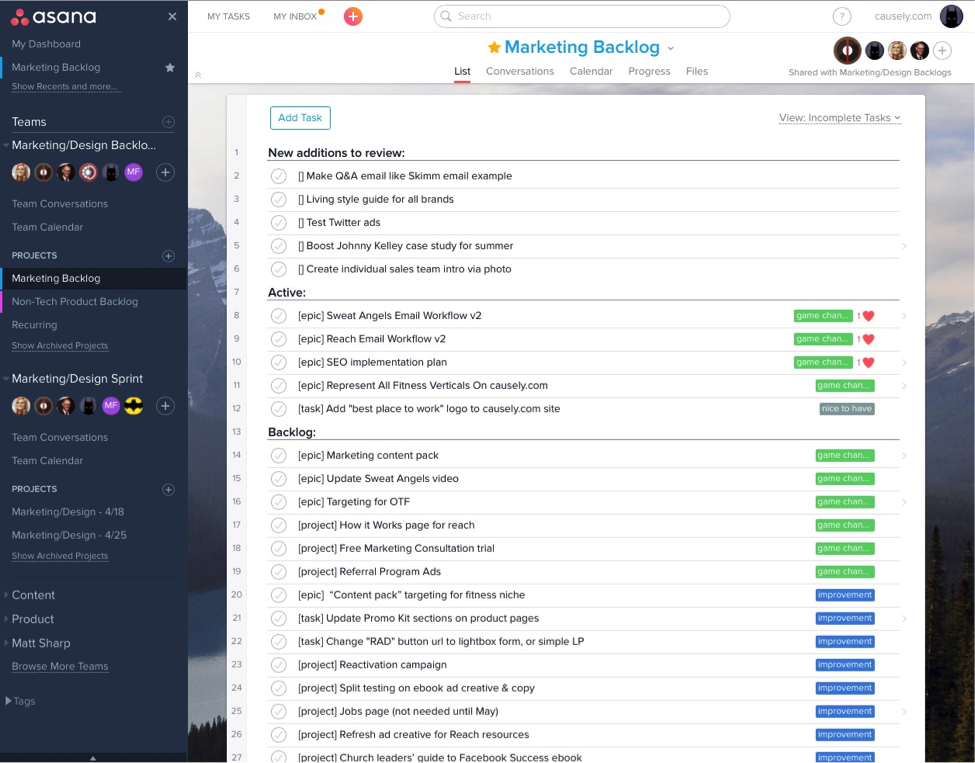

marketing-backlog-scrum


To keep everything tidy, segment your backlog into these three sections:


  • New Additions To Review – anyone can add ideas here. But they aren't added to the proper backlog before they're vetted.

  • Active – anything we're actively working on (surprise).

  • Backlog – all the vetted ideas live here, like eager puppies waiting for adoption.


Now that you've got your backlog defined, roll up your sleeves, take a swig of coffee and build your first sprint plan…


The Sprint Plan – One Leg of An Epic Journey


Think about a sprint like planning for an epic journey across Middle Earth. It would be silly to plan every stop in advance. There are too many unknowns that could impede your progress: orcs, elves, and even giant talking trees.


Instead, you'll focus on just the first day. If you're departing from the Shire, you might target Bree as your destination. All you worry about on day one is getting to Bree. You can map out stops for second- and third-breakfast, debate over which type of beer you're going to drink at day's end, and even estimate your arrival time pretty accurately.


The following day you'll focus the next destination, and things can progress smoothly from there (at least until the Eye of Sauron notices you).


OK… each leg of your journey? That's what each of your sprints is like.


bilbo-baggins-the-hobbit
(Image Source) Little known fact: Bilbo Baggins is Middle Earth's top expert on landing page optimization.


To build your sprint plan, you focus on a select group of projects – not everything in your backlog. Here's how to get started:


  • Identify a project in the backlog that adds a high level value for a relatively low amount of effort.

  • Define the scope of the project. Ambiguously defined projects are the enemy of progress.

  • Ask yourself, “can my team complete this project within one sprint?” If not, break down that project into smaller chunks.

  • Estimate the effort required to complete that project. Scrum uses a concept called story points for this. The more effort required, the more points given. The first time you do this, your guesses are going to be off a bit. That's OK. You'll get more accurate over time. Nerd tip: use the Fibonacci sequence for story point values: 1, 2, 3, 5, 8, 13, 21, etc.

  • Repeat steps 1-4 until your gut tells you that your team's at full capacity for the sprint. Or until your team starts yelling at you. Now that your sprint plan is full, any remaining projects in your backlog will have to wait until a future sprint.

  • Assign an owner to each project in the sprint. The project owner keeps eyes on the project and makes sure it actually gets done. They may work on it directly and/or require help from others.

  • Take a look at the projects assigned to each person. Does everyone have a roughly equal balance of work? Is anyone overburdened? If so, adjust the sprint plan accordingly.


There are two signs that you've done things correctly: everyone has a clear idea of what they'll be working on, and you've planned just enough work to keep everyone productive during the sprint.


marketing-sprint-plan-in-asana
What our sprint plan looks like about halfway through the week.


Here Are Some Things That Keep Us From Messing Up Too Often


Our first sprint plans were like slow jogs in untied shoes. Some 50 sprints later, we're like that guy who annoys his friends by telling them about every marathon he's run.


Here are some tweaks we've made along the way:


  • Create a separate document for each sprint. Don't let one sprint plan merge into another, or you won't be able to measure anything.

  • Break each sprint into stages. This will help you see which projects are crying themselves to sleep at night from lack of attention. Here are the stages we use:

    • To Do – everything goes here at the beginning of the sprint

    • Defined – once all sub-tasks are added

    • Create – someone is actively working on the project

    • Review – the project is mostly done, but needs someone else's eyes on it

    • Implement – hold on to your butts, this project is about to go live

    • Done – At the top of your lungs, shout “Now witness the firepower of this fully armed and operational battle station!” Or just mark the project as complete.


  • Add an Impromptu tag to any projects that were added after the sprint begins.

  • Try Waiting On [Name] tags. If your name is Biff and you see a bunch of Waiting On Biff tags, you're holding back the rest of the team!


sunglasses-marathon-runner
(Image Source) When you get awesome at sprint planning, you get to wear sunglasses to work.


The Daily Standup – Team Cheer Required


This is your opportunity to get a status report from your team. Each person will share three things: what they did yesterday, what they plan to do today, and what they need from others to move forward. If there are any roadblocks, they're addressed here.


For example, let's say a blog post can't be published because the creative isn't ready. Instead of scrambling at the last minute, you'll have the chance to solve the problem ahead of time.


The daily standup is also a good time to bring up “impromptu” projects (unplanned work that needs to be added). Maybe you discovered an error in an email workflow that needs to be corrected ASAP. During the standup, you can raise this issue, identify someone to tackle it, and adjust the sprint plan accordingly.


Bonus: come up with a cheer your team can break on at the end of each sprint. Yes, the rest of your company will roll their eyes at you but that's half the fun.


The Retrospective – Hitting A New High Score


Remember assigning those story points to your projects at the beginning of the sprint? (Those were the estimates of how much work each project would take.) This is your chance to see how many points your team actually got done. Here's how:


  1. Take a look at all your completed projects for the sprint.

  2. Add up the story points for each. This is a rough estimate of how much you got done.

  3. Repeat the process for three or four more sprints.

  4. Take the average number of story points you complete. That's your baseline for how much work your team can handle each sprint.


With your baseline established, you'll easily be able to see when your team under- or over-performs. Which brings us to the real point of the retrospective: constant improvement. Here's how to lock it in.


rocky-flexing-bicep-sweater
(Image Source) Exactly how you'll feel (and look) when you lock in an improvement for your team.


First, ask each person on your team to share what went well during the sprint. Perhaps someone found a way to reduce the time needed to build a landing page by 20%. By sharing this knowledge with the team and making it part of everyday practice, you can lock in that improvement going forward.


Next, ask everyone to share what problems they encountered. This isn't a chance to blame others – it's an opportunity to find better ways of getting things done. Keep talking about the challenges you faced until you identify potential solutions.


Finally, add the implementation of those solutions to your next sprint. For example, maybe your marketing campaigns take forever to get completed because everything is done ad hoc. For the next sprint, add a project to create a clear campaign process for your team.


If you can come up with just one improvement per week, your team could make 50 process improvements in a year. And guess what? Those improvements will add up big time. Not only will you get more story points done, you'll progress from being Rocky the noob boxer to Rocky the Apollo Creed-decimating prize fighter.


Two Apps That Your Marketing Team Needs to Try


Asana – Unicorns Are Now On Your Team


While there's no “best” app for Scrum, we've found that Asana works really well for both managing the backlog and planning sprints. It allows us to keep everything in one place and it's great for handling sub-tasks.


Other tools to consider are Trello, Basecamp, and even Google Docs. Heck, some teams even use a whiteboard and sticky notes.


Bonus reason for using Asana: rainbow-generating unicorns that fly across the screen when you complete a project. Does your current project management software provide unicorns? I didn't think so.


Slack – Your Life Is Now Complete


Slack isn't just another glorified messaging program – it's so good that you may be tempted to name your first child after it. We use Slack's channels feature to help us sort through messages. For each project in a sprint, we create a new Slack channel. Any messages related to that project go there. When the project is complete, we archive the channel and never have to see it again.


causely-slack


One of our Slack channels for the marketing team. Here we're planning content for a new product demo video for one of our programs.


But Read This Before You Start


Scrum isn't a panacea. In fact, it will probably be pretty messy when you start. But if you put in the effort, you'll see your team grow like the Hulk (minus the rage, purple pants are optional). Not only will your team produce more, but they'll enjoy their jobs more. Better planning = less stress = happier people.


So if you decide to try Scrum with your marketing team, stick with it for at least a month before you decide if it's right for you. And make sure to get your team on board first. I suggest having everyone on your team read Scrum: The Art of Doing Twice the Work In Half The Time by Jeff Sutherland and J.J. Sutherland before you begin.


Already use Scrum with your marketing team? If so, I'd love to hear how it works for you. If you have any tips to share, please add them in the comments below!


About the Author: John Rougeux is Co-founder and CMO at Lexington, KY-based Causely. His company helps businesses and organizations generate referrals by supporting world-class charities through its Sweat Angels, Check-In Angels, and Reach programs. Chat with John on Twitter at @johnrougeux.




Monday, 2 May 2016

Why the Traditional Marketing Funnel is Sabotaging Your Conversion Rate

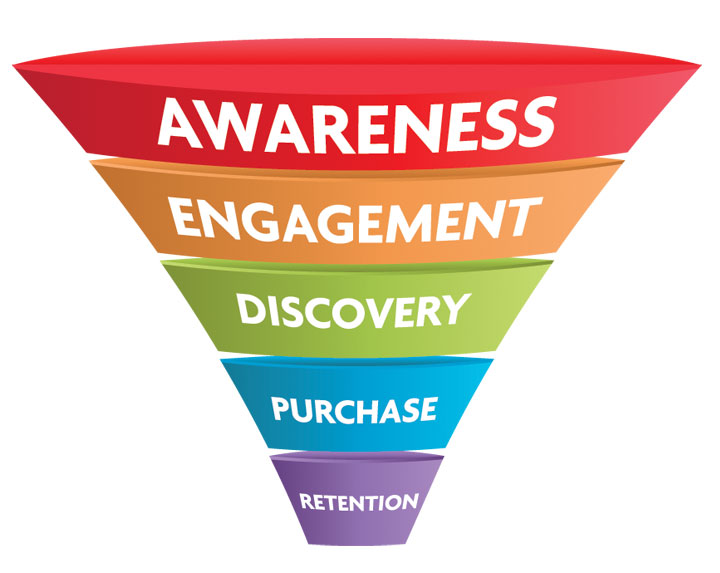
The sales funnel. It all seems so smooth and simple, doesn't it? Lots of prospects come in through the top, only to move in various, predictable stages like “Awareness” and “Discovery” only to come out the bottom as loyal, committed customers.


Except the reality of today's sales and customer experience process is anything like that.


Things like brand advocacy, social media, and even our own experiences have changed the way we market to others. Why then should we stay stuck in this rigid, old funnel structure?


We shouldn't – and today's article will show you why.


According to the Harvard Business Review, there are a myriad of ways that people learn of and interact with a product. There are even times when customers don't come through the top of the funnel, but rather somewhere in the middle.


FunnelA typical marketing funnel starts with more customers in the “Awareness” stage and ends with fewer in the “Retention” phaseLet's say you were in the market for a new pair of running shoes. A friend recommends a specific brand and links to them on Facebook. On their page you can see user comments and testimonials as well as active discussions. You've just completely passed the Awareness and Discovery parts of the funnel and moved on to Engagement and likely even Purchase – because a recommendation from someone you trust is that valuable to you.

On your way to purchase these shoes, the company recommends some specialized insoles to help cushion your feet. Great idea. Now you've instantly moved from consideration to purchase. It's also possible that you could go back and forth between funnel stages while you evaluate different products or brands.


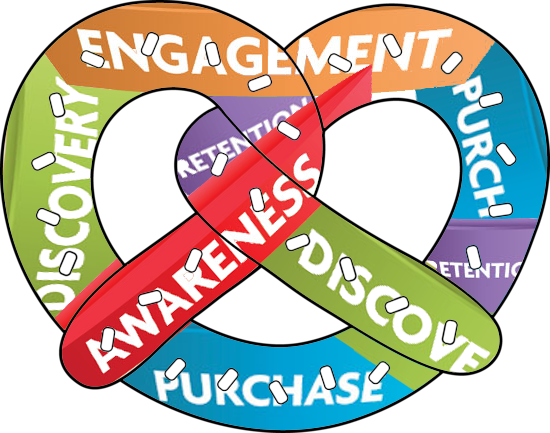
And with networks like Twitter, Facebook and Pinterest always available at the tap of a button, the traditional sales funnel we all know and refer to ends up looking more like a pretzel, with twists, turns and overlaps at every corner.


pretzel-marketing-funnelUsers will often double-back on their decisions, or switch between two points instantly


Moving the Focus from Transaction to Relationship


According to Antonio Lucio, Chief Brand Officer at Visa, the end goal is to shift priority from the transaction to the customer relationship. To that end, Visa has created the “Customer Experience Journey” which looks at the process from transactions being a part of the customer relationship rather than the customer relationship being viewed purely in terms of transactions.


He gives the example of a family planning a trip from the U.S. to Mexico. Visa has mapped out the whole experience:


  • Family gets ideas on where to go from TripAdvisor

  • Family gathers suggestions from friends on Facebook

  • Family decides to get cash from an ATM to pay for their cab

  • Family pays for their hotel via their Visa credit card

  • Family shares photos of trip with friends back home via Instagram


You may see this list and think “Well, Visa is part of only one of these options” – which is true when you're looking at each one as a transaction.


But step back a moment and look at the bigger picture. Every one of these points is conducive to building and nurturing the relationship with the customer. The transaction itself is just a small piece of the puzzle and not the end goal. According to Lucio, “[w]hen you change from decision to engagement, you change the entire model.”


So What Does This Have to Do With Conversion Rate?


Here again, if you're looking at the funnel purely from a revenue point of view, or spending too much time focusing on transactions, the customer experience gets lost in the shuffle. It becomes too much of a focus to think only of the numbers and not of the people driving them. If you zero in on numbers alone, you miss out on so much more. Just look at brands like Tesla Motors on Facebook. Do you think there are nearly 1.5 million Tesla owners?


tesla-motors-facebook-pageTesla Motors has nearly 1.5 million followers – not all of them customersNot yet – but these people admire what the company has been able to build and the values they stand for. All of those things feed back into the brand itself and create the customer experience. Even digital products and services like SaaS and mobile apps can benefit from this adjusted funnel. As the Harvard article explains, with traditional funnels, marketing is a separate entity. With SaaS and other platforms, the marketing and the service go hand in hand.

Marketing with SaaS


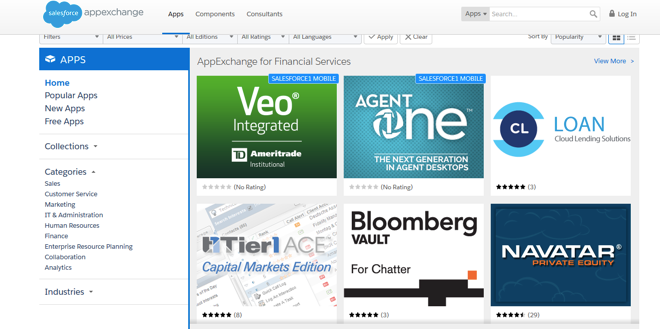
The Salesforce AppExchange, for instance, doesn't just look at the process as “how do we market this?” but rather, “how do we add value to this so that the things we recommend market for us?” Many of the apps profiled here weren't made by Salesforce, but Salesforce and the apps it works with form a kind of symbiotic relationship where both parties win.


salesforce-app-exchangeNot all apps featured on the AppExchange were built by Salesforce, but all of them use it to enable their own customer experience journeysAnother example is Google. What started out as solely a search engine has branched out to become a search engine, email service, word processor, storage service and countless other services, all entwined under a single brand umbrella. Every service plays well with other services – making it faster and easier for us to create, communicate and share. And our brains thrive on faster and easier.


Sure, there are other search engines out there, even other companies that have just as much influence as Google. But they don't integrate in a way that makes our experience faster, easier or better. When was the last time you found exactly what you needed within seconds, using Bing?


The Bottom Line on Funnels and Conversion Rates


As the Harvard article says, the traditional funnel isn't going away anytime soon. There are still products and services out there that gain new customers this way. But to overlay and apply that to our more open, two-way communication world is just trying to fit a round peg in a square hole. It's not flexible, not adaptive, and just doesn't work – leading to poor experiences for everyone.


When you look at marketing as the multi-faceted beast it is, you'll be able to create your own funnel “roadmap” that incorporates all the steps you need to engage and empower your customers in a way where everyone wins.


What are your thoughts? Have you thrown out the traditional funnel in favor of another sales model? Which one did you choose and how did it work for you? Tell us your thoughts in the comments below.


About the Author: Sherice Jacob helps business owners improve website design and increase conversion rates through compelling copywriting, user-friendly design and smart analytics analysis. Learn more at iElectrify.com and download your free web copy tune-up and conversion checklist today! Follow @sherice on Twitter, LinkedIn or Google+ for more articles like this!