Friday, 8 July 2016

How Much is Bad Data Costing Your Company?

In a world of big data, bad data is becoming more and more commonplace. Part of the issue is fueled by the technology we use to help manage and organize that data. In our rush to be more on-demand, personalized and data-science-powered, we've embraced cloud computing, mobility, social collaboration and enhanced analytics. Every scrap of every shred of customer data is valuable. But in doing so, we've also let our data quality control lapse.


And when departments are clamoring for numbers despite the inaccuracies, it leads to a ripple effect of poor decisions based on those errors. But just how much is it really costing us? And what can we do to stop poor data hygiene before it spreads? Let's take a closer look:


A Company Problem – Not Just an IT Problem


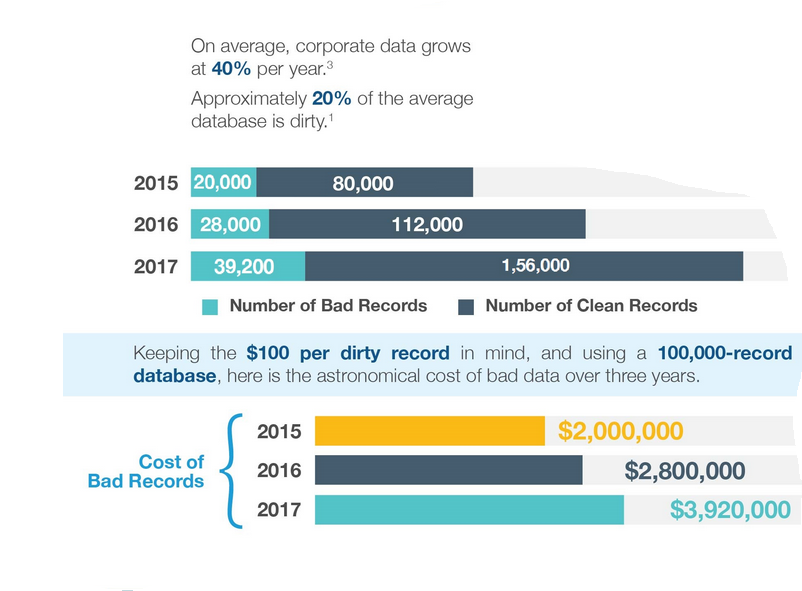
Even just a few years ago, in 2013, the looming spectre of bad data was apparent. Gartner surveyed a wide range of companies in its study and learned that data quality costs them over $14 million dollars a year. Now imagine how much more connected we are today and you can see how the problem could compound exponentially.

bad-data-cost


Source: Ringlead


Many companies, in an attempt to wrangle departments to make sense of it all, place the task of organizing and managing all this information squarely on IT's shoulders. But bad data affects more than just servers and databases – it affects everyone. In this day and age, it is very much a business problem.


And that's not even factoring in the cost beyond customer data. A few inaccuracies in customer names or details is one thing. But oftentimes, depending on the company culture in relation to data upkeep, it can affect other areas of business as well – productivity, security and making cost effective decisions.


In short, this is not a problem we can continue to throw money at and hope it goes away or works itself out.


What Exactly Is “Data Quality”?


Before you begin to get a handle on the data itself, it's important to understand what “it” is. According to another Gartner study, data quality is examined by several different points, including:


  • Existence (does the organization have the data to begin with?)

  • Validity (are the values acceptable?)

  • Consistency (when the same piece of data is stored in different locations, do they have the same values?)

  • Integrity (how accurate the relationships between data elements and data sets are)

  • Accuracy (whether the data accurately describes the properties of the object it is meant to model)

  • Relevance (whether or not the data is appropriate to support the objective)


That's a lot of information to try and clean up “by hand”.


A Portfolio of Options


To help meet the rising urgency of this challenge, there are many data cleansing solutions available. These companies typically look at the big picture of data quality and help to standardize records as a whole. They often source data internally and externally to help maximize relevance and consistency across the board.


As with the other tools in your business arsenal, it's a smart idea to have a portfolio of options available for your data cleansing needs. You may only need a one-time data cleanse to keep your information up-to-date, or you may need ongoing work. Ideally, you'd only need a one-time data quality cleanup if you're migrating to another system or doing a mass marketing campaign. Otherwise if the information isn't tended to often, it can deteriorate and compound problems considerably.


For particularly large or error-prone data sets, a data quality cleansing tool may be set up to run automatically. These types of systems can either cleanse data at specific intervals or notify managers and staff in cases where ongoing data quality monitoring is important.


What to Look For in a Data Quality Solution Provider


Because there are so many options available, and more tools being created all the time, it can feel overwhelming to try and narrow down your options when you're not even really sure what you need. No matter what you ultimately decide, the proposed solution absolutely must be able to:


  • Be able to deliver an immediate impact and noticeable improvement based on the company's current data hygiene state

  • Leverage both real-time information and historical details – customers, staff, products, techniques and processes

  • Have a rock-solid foundation to be able to use new technologies such as predictive analytics, forecasting and modeling

  • Scale and adapt based on the volume, speed and variety of data while keeping everything valid and consistent


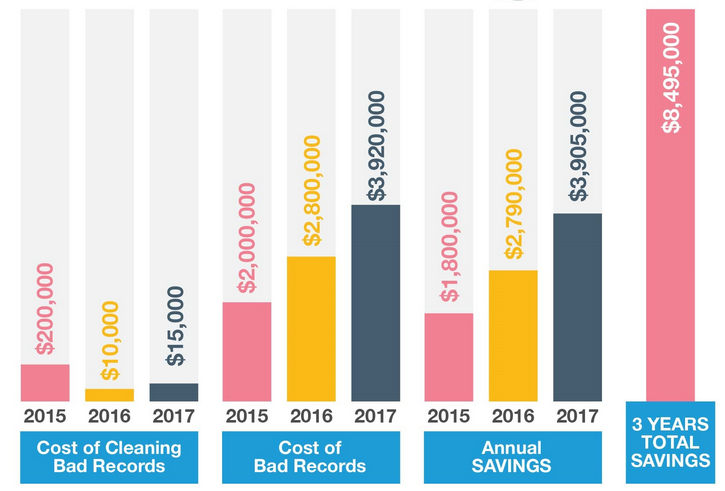
And just as the cost of bad data can continue to multiply year over year, the savings from having accurate data are just as big (if not more-so), as noted in this chart from RingLead:

cost-savings


Source: Ringlead


What a Difference Clean Data Can Make!


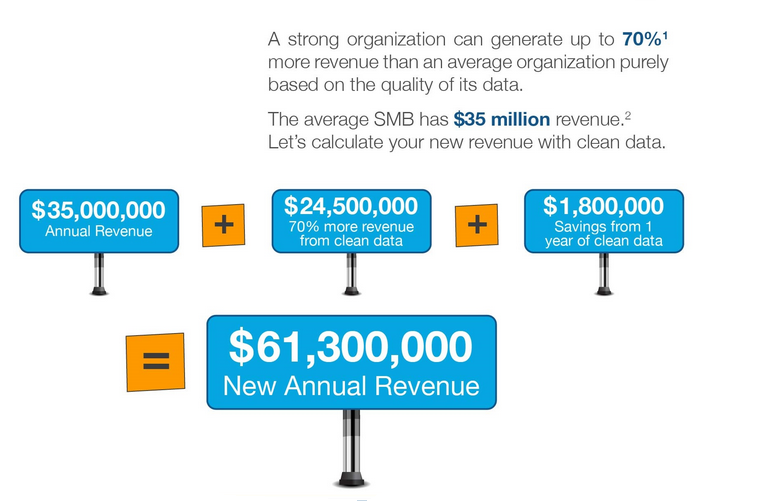
Of course, cost savings are one thing, but oftentimes management (and other executives) don't just want savings – they want to see a direct correlation in terms of revenue as well. The real question is, how much can clean data make for us? Here's a hypothetical (albeit very realistic) example from the same Ringlead chart:

clean-data-savins


And in addition to revenues and savings, the benefits of clean data go much farther. With greater data reliability comes greater credibility and a stronger decision-making foundation backed by data. Reports become more accurate. Customers respond to more accurate personalization. All departments enjoy greater productivity and efficiency. It's a cycle of wins.


So as you can see, a few inaccurate records or non-standardized entries don't seem like a big problem, but as your business scales, more and more information becomes fragmented and fraught with issues. Costs escalate. Efficiency plummets. But by the same token, by spending a little now, you reap far greater benefits over time. And any campaign started or improved based on solid, reliable information is one you can look to time and time again for greater insights and metrics that count.


Do you use a data hygiene strategy in your own company? How has it worked out for you? Have you seen better performance as a result or is the jury still out when it comes to making an impact? Share your stories with us in the comments below.


About the Author: Sherice Jacob helps business owners improve website design and increase conversion rates through compelling copywriting, user-friendly design and smart analytics analysis. Learn more at iElectrify.com and download your free web copy tune-up and conversion checklist today! Follow @sherice on Twitter, LinkedIn or Google+ for more articles like this!


Are You Ready to Be an Independent Worker?

Whether you call them independent contractors, consultants, freelancers, self-employed, or business owners, the number of independent workers in the United States is on the rise. And whether you're already an independent worker or considering joining their ranks, you'll be interested in the latest findings of an ongoing study of independent workers by MBO Partners.


The independent workforce is going through a weeding-out process, reports America's Independents: A Rising Economic Force. As unemployment has declined to 5 percent and with more new jobs being added, self-employed people who found the role of independent worker didn't really fit their needs are returning to the world of traditional employment. In the past year, the number of full-time independent workers declined by 5 percent, to a total of 16.9 million Americans. However, the number of part-time independent workers (defined in the report as fewer than 15 hours a week) held steady, at 12.4 million.


Why are people choosing independent work? Both full-and part-time independent workers in the survey say they want more freedom, flexibility, and control over their lives. Part-time independent workers' primary reasons for working independently are to supplement their income (61 percent), but 4 percent also do so to pursue a passion or interest. As with full-time independent workers, part-timers are not choosing this role because they can't find work: More than seven in 10 say working independently is their choice.


Money is a motivator as well: Almost half (47 percent) of independent workers in the survey say they make more money working on their own than they could in a traditional job. This year, 17.9 percent of full-time independent workers earned more than $100,000 annually–an increase of 50 percent since 2011. The average gross income for all full-time independent workers grew 30 percent since 2011.


The independent workforce is also getting younger. Many Millennials (defined in the study as people aged 21 to 36) start their careers as independent workers. In fact, Millennials account for 40 percent of the full-time independent workforce-greater than their representation in the labor force in general, where they make up 34 percent of workers.


One big reason for the growth in independence: Being independent has become less risky. There is more infrastructure in place to support the independent worker-technology, co-working spaces, and free or affordable apps to help enable independent work are all a factor in the growing independent workforce. In addition, with more businesses hiring independent contractors, being an independent worker has become a more acceptable career opportunity. No wonder more than three-fourths (76 percent) of independent workers believe that independent work is just as secure or more secure than traditional employment, and 13 percent of Americans who aren't currently independent workers are considering becoming independents in the next few years.


While the conventional wisdom used to be that independent workers took this path because they couldn't find traditional employment, the survey debunks that myth. The average full-time independent in the survey has been independent for 10.5 years. Looking forward, a whopping 70 percent of independents in the survey say they plan to either stay independent (63 percent) or expand into a larger business (15 percent).


What's the future of independent workers? MBO Partners predicts that the number of both full-time and part-time independent workers will increase by 16.4 percent, reaching 34.1 million, or 29 percent of the workforce, by 2021.


Are you considering becoming an independent worker, freelancer, contractor or self-employed? You'll be happy to know that most of those who have chosen this life wouldn't change a thing. Nearly two-thirds of full-time independents rank their satisfaction as a very high; 22 percent rank their satisfaction as 10 on a scale of 1 to 10. Clearly, the rewards, flexibility and control gained by independent workers more than make up for the challenges and risks.


The post Are You Ready to Be an Independent Worker? appeared first on AllBusiness.com

The post Are You Ready to Be an Independent Worker? appeared first on AllBusiness.com.


Thursday, 7 July 2016

Stop Overspending Time and Money on Marketing Techniques That Don't Work

I hate to see money wasted on outdated online marketing techniques.


It's not just about money, but also about time and resources that could be used in a better way. Marketing budgets are often tight, and you just can't afford to spend them on strategies or things that don't work.


To help you cut waste and make your marketing strategy more effective, I've created a list of six most common ways small and medium sized businesses lose their budgets online. Here's how to stop overspending time and money, and turn those losses into gains.


1. Using “Guaranteed SEO Services”


SEO is not an exact science and getting results overnight is a myth. Google's algorithm has become smarter and smarter in the last years and there are no easy shortcuts. It's commonly known that Google uses hundreds of ranking factors, but the truth is that no one knows precisely what all of those are. With time, you get to learn what techniques work better, but anyone that offers guarantees to rank a site on the 1st position for a particular keyword is a scammer.


Google warns people not to buy SEO services from companies or freelancers that guarantee to rank 1st for any given keyword. Here's Google's take on guaranteed SEO:


google-seo-firm-warning


If you are not experienced, you might be tempted to choose an SEO company that guarantees you'll rank first for your main keywords over a company that doesn't offer this guarantee. Makes sense, right? But it doesn't.


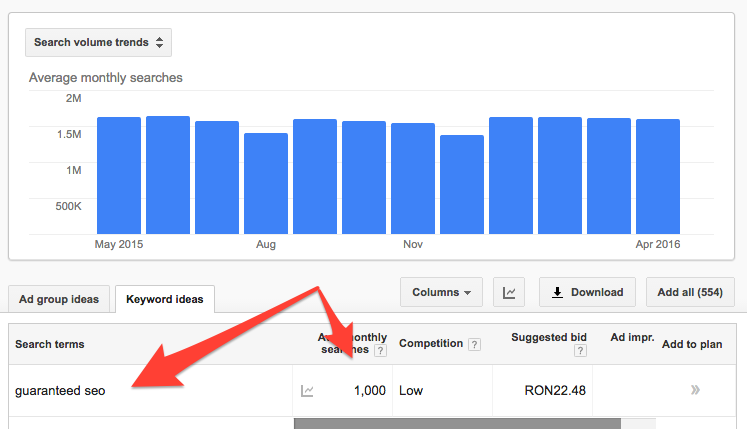
The SEO companies that offer such guarantees are commonly formed by black hat SEOs that are not fully committed to making your website successful. They are just fine with taking your money for 3 or 6 months, and don't care so much that eventually you'll leave disappointed. That's because at least 1000 of potential new clients search in Google each month for “Guaranteed SEO”. They can easily find another naive person to sell them guaranteed SEO services and replace your contract.


search-volume-trends


Be very picky and skeptical when choosing an SEO firm. If you don't know where to start, Moz has a list of recommended SEO companies.


2. Buying Social Media Followers


The number of followers you have on social media is simply pointless. What matters is the engagement and how many real users see your posts. It's not like in your childhood when it mattered if you or your brother had a bigger portion of goodies. Many fall into the trap of believing that the more followers their business has, the more trusted and reputable it will be.


You should never buy social media followers. Neither on Facebook, Twitter, Pinterest or whatever social media platform you choose to use for your sites. Bought “followers” are fake and besides being a waste of money, you can also end up having your account suspended.


3. Not Measuring The Success And ROI For Your Marketing Campaigns


All businesses and industries are different and therefore what works great for some, might not work as good for others. For example, social media can be a golden nugget for sites in the entertainment or technology industry, but for a business that sells forklifts will not be as important. Just because a channel works great for most sites doesn't mean that you should block your resources on something that's not suitable for your type of business.


To succeed with online marketing, you have to analyze and measure the success of all your campaigns and then focus most of your attention on the channels that give the best return of investment. Use an analytics tool like Kissmetrics to see where your site traffic is coming from and check how the visitors are funneling through your website.


It's critical to measure how well your marketing campaigns are performing and know what you should prioritize for the future. If social media doesn't work well for your site, you can focus more on creating quality content, or maybe launch a better advertisement campaign.


The most common mistake marketers tend to do is not to measure their campaigns and sources of conversions on a regular basis. It's not enough to check what works best for your site once and then take decisions upon what you've discovered on that analysis. Each week, marketers should check what worked best and how the conversions are going for each channel. Marketers can do all of this within Kissmetrics.


4. Content Marketing Done Wrong


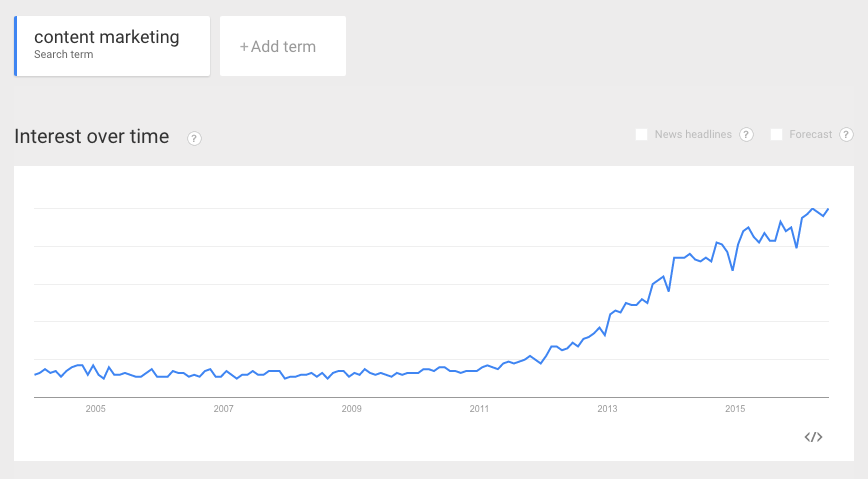
The interest for content marketing has grown to unexpected levels in the last years. It's estimated that the whole industry is worth roughly $190 billion and it will grow to $300 billion by 2019.


content-marketing-interest-overtime


Content marketing is about creating content in the form of videos, articles, infographics, images, slideshows, etc. With the industry growing so quickly, the competition is also becoming stronger and stronger. Quality is the differentiator between a good and a bad content marketing campaign.


The main reasons why most of your content marketing campaigns fail is because:


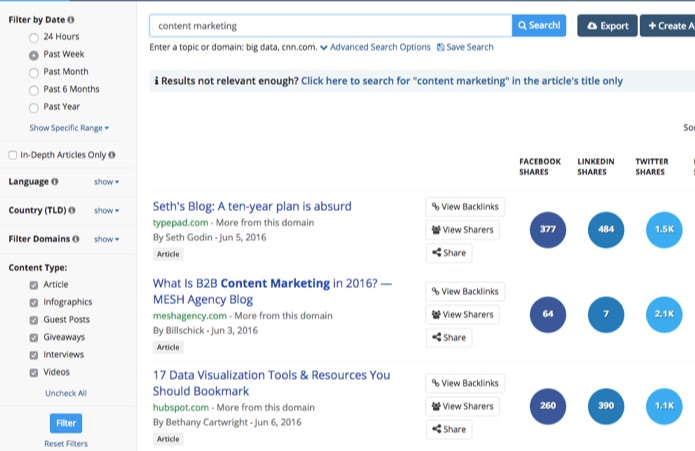
  • You don't write about topics that people are really interested in. Sure, it's your blog and you can write about whatever you want, but if you are aiming to get more visitors, you have to research your topics. With the help of BuzzSumo, bloggers can find what content from other sites is performing great on social media. It's a simply way to finding what works best for your competitors and what gets the most shares. The tool gives you access to an endless resource of topic ideas.

    content-marketing-buzz-sumo


    It's also a good idea to check what key phrases people use to do searches in Google. For that, Google's keyword tool can be very handy.

  • You don't promote the content campaigns you have created. It's not enough to write an article, video or build a great infographic and then move on. Just because you've clicked the “publish” button, it doesn't mean that your job is over. Not even close. You can't just create some content, and hope that it will go viral. Things don't work that way. Chances are nobody will ever find your new piece of content, unless you try to promote it. Do outreach and try to promote the content through influencers.

  • You content marketing campaign has no value. You see low-quality content marketing campaigns everywhere. If the content you've created doesn't bring value to the reader, don't bother publishing it. Instead of posting 10 useless articles or videos, try to make one that will stand out as the best in the niche.

    It's the same with guest blogging. There's no point to write for sites that have no authority and no one has heard about them. Don't spend your time and budget to write for several low-quality sites, but instead aim to be a contributor on the big sites in your industry.


5. Not taking backlinks seriously


Backlinks are important not just for SEO, but they can also send relevant referring traffic, help you build partnerships, bring you customers, and measure the success of your online marketing campaigns. Sadly, many tend to ignore backlinks and rarely check the ones of their site.


If you are running a content marketing campaign or simply doing outreach to promote your website, besides checking analytics, it's also important to check your site's backlinks. That's so you can know whenever a site links back to you and see how successful was your outreach campaign. If your content marketing campaigns are not generating quality links, you might have to reconsider your strategy.


Here are several reasons why everyone should pay more attention to backlinks:


  • Backlinks are the main ranking factor for Google and Bing and they will continue to be for the coming years. A site that has good backlinks will rank higher for more related keywords and get more traffic from search engines.

  • Bad backlinks acquired naturally or because someone has built them to your site can drag your site down in the SERPs. It's important to know whenever your site gets new backlinks or otherwise all your SEO efforts will be pointless and you'll end up wasting time and money.

  • Backlinks can tell you when a blogger sends a link to your site. You can thank them for recommending your site, and perhaps build a partnership with them.

  • Backlinks can show what websites are referring the most traffic to you, and you can try to get more of the same.

  • If you are buying ads through banners, it's important to know if the advertiser removes the backlink.


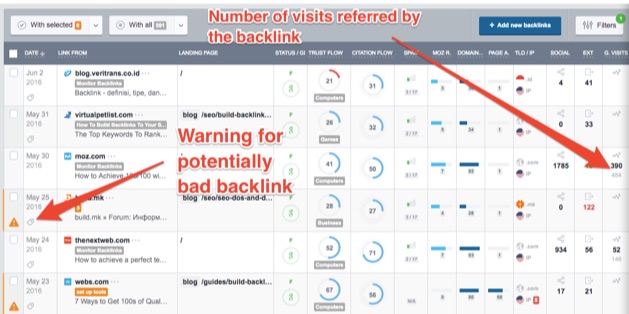
To be up to date with all your site's backlinks, you can use the SEO Tool Monitor Backlinks, which sends you an email whenever your earn or lose links. Besides the email alerts, the tool shows more than 15 different metrics for each backlink, to help you easily see in a glance their SEO quality. Another useful feature is the warning sign that is showed for links that have questionable metrics.


seo-tools-monitor-backlinks-screenshot


To prevent organic traffic loss, it's advisable to often check your site's backlinks. SEO is one of the best online marketing channels that can generate traffic, even if you are in a boring niche. If you've hired someone to do SEO for you, you still have to check your site's backlinks. Don't sit back and think that everything will be alright. Your business responsibility is still in your hands and you are the only one that's going to lose in case something goes wrong.


One of the worst mistakes people tend to do about backlinks is thinking that they need hundreds or thousands of links to rank high in Google. All that matters is QUALITY. The number of links you have is not important and you shouldn't be obsessed about it. It's best to have 10 quality links rather than 1000 backlinks from unknown sites.


6. Outsourcing To Bad Companies


As your online business starts to grow, you can start to consider outsourcing some of the tasks to a specialized company. You can outsource social media, content marketing, SEO, advertising management, etc. Whatever you outsource, don't forget that you are still in charge and you can take over if the results are not the ones you expect.


There are numerous cases where companies are outsourcing services to a bad content marketing or SEO firm. However, they keep using their services. That's because when outsourcing, companies tend to rely solely on the reporting provided by the outsourcing firm.


If your results are not close to your expectations, and you have a feeling that your money are being wasted, take action before it's too late.


Conclusion


It's hard to succeed with online marketing without measuring all your channels correctly. Set your KPIs and don't be afraid to change or stop working on a channel that's consuming too much financial and time resources.


Be very doubtful when choosing to work with an outsourcing company and continue to use your own tools to measure the success of their campaigns.


About the Author: Felix Tarcomnicu is an Internet marketer with a strong passion for SEO and social media. You can follow him on or Twitter @FelixTarcomnicu for similar articles.


Kanban Can Help Take the Stress Out of Sales

Before founding Pipedrive, I often battled the stress that comes with disorganization.


At the time, I was a trainer and handled my own sales. I had to work on so many different tasks each day that it was hard to prioritize them. Handling meetings, calls and emails was difficult, often stressful. I had a pile of business cards, random sticky notes and an overflowing inbox. It could be a challenge to stay calm enough to enjoy the work and simultaneously be productive. I tried to feel better by telling myself that stress just comes with the job.


At the time, I organized tasks by aligning business cards in three or four columns on my desk. Each column contained cards with similar tasks; for example, the cards on the right reminded me about prospects waiting for written proposals. I worked through these business cards, accepting new ones, and delegating the ones that had to be delegated. After a while, I needed to include more columns than my desk could hold, so I used sticky notes on my wall. I didn't know it then that I was using a kanban system.


Kanban is an organizational system that's part of the Japanese just-in-time framework. It was developed by Toyota in the 1940s to help the company move manufacturing inventory quickly. Back in the '40s, teams of employees would deliver kanban cards (“kanban” loosely means “card” in Japanese) to one another, to signal that one team had a surplus of inventory and was ready to push it out to the employees on the factory floor, who were putting a car together.


Kanban has since been adapted beyond factory work. It functions somewhat differently as a project management framework, although cards are still used. Take Trello, for example, or my own product, Pipedrive, a sales kanban tool. Both are digital kanban tools intended to manage multistep processes. Both, like my desk, use columns of digital cards to show a project's progress.


They work this way: A project enters a pipeline, is assigned a card and moves through stages. The number of workflow stages differ depending on the project. The simplest kanban board might have three stages:


  • To Be Completed

  • In Progress

  • Done.


On Pipedrive, a sales team might have several workflow stages:


  1. First Contact

  2. Meeting

  3. Estimate

  4. Proposal Presented


Because the board is available to a team, everyone can quickly see what stage a project is in.


Kanban helps salespeople concentrate on the task at hand because the system focuses only on the work that's in progress.


I can't claim that we consciously based Pipedrive on kanban - we discovered kanban as a method about a year later after we had launched - but the principles are the same. When we were building Pipedrive, we felt that salespeople needed a tool that would help them prioritize work while rewarding them with a feeling that things are under control.


Sale reps are able to enjoy their work when they're focused, but for a salesperson to stay focused, he must be organized. To be organized, he must have a system. Being focused means that the salesperson is doing the most important thing he can at each given moment while not being worried about other things on a to-do list.


We can have a human tendency to waste a lot of energy by dwelling on things that are not happening right now. At Pipedrive, we believe that being focused on just one thing at a time is not only more productive, but also is way more enjoyable than multitasking.


The post Kanban Can Help Take the Stress Out of Sales appeared first on AllBusiness.com

The post Kanban Can Help Take the Stress Out of Sales appeared first on AllBusiness.com.


Wednesday, 6 July 2016

Get Inside Your Customer's Head: Understanding Why People Buy What They Buy

By Phillip Adcock


Human beings are remarkably similar to one another. We all have the same physical form, the same skeletal and muscular structures. The differences between us are minor-facial features, mental makeup-but very important.


Psychologists have identified key personality traits that distinguish human minds from each other. These traits are measurable and each person has a different combination of each of them. A lot can be learned about a person by how they score on these traits or fitness indicators as identified by Geoffrey Miller in his book Spent.


Almost every non-essential purchase that shoppers make–whether in the supermarket, online or in a department store–is bought for the purpose of increasing one or more of their personal fitness indicators. People buy certain products believing that ownership of the items will alter how other people perceive them and to improve their lives.


And, to some extent, it works. If you buy an expensive watch under the assumption that people who see you wearing it will assume you are intelligent and have good taste, this will have a measurable effect on your self-confidence and self-esteem.


Marketers can use information about these six traits to their advantage by demonstrating how people will react to customers who are wearing, consuming, or using a particular brand.


1. General Intelligence


General intelligence, the first key trait, is essential to appearing as a functional and desirable member of society, whether as a group or in a romantic pairing. This can increase society's perception of a person as mentally and physically healthy and of high genetic quality.


We are constantly targeted with advertisements for products to make us appear more intelligent, whether they are brain foods, smart drugs (or brain-boosting vitamins), or smart toys for children. Ironically, many of these intelligence-boosting products also carry a high price tag-as we care about our social status, we are often happy to pay more for a status symbol such as an expensive watch.


2. Extraversion


Extraversion is the degree to which someone is outgoing, talkative, and socially confident. People with a high level of extraversion tend to enjoy leading, being active, and exerting self-confidence, meaning they often attract people to them and yet stand out from the crowd. The principal behind extraversion is the need to be seen in order to have a greater chance of being selected, much like mating dances for birds.


People may exhibit extraversion-or what they hope is extraversion-by wearing bright-colored clothing to project an outgoing personality that's not normally ascribed to them. This is often seen in films where the “plain” actor or actress dresses differently and then is suddenly perceived as popular and beautiful.


3. Openness


Openness is a trait that requires a balancing act; it relates to the curiosity, novelty-seeking, broad-minded aspects of people. We all have a natural comfort level of openness and tend to seek others of a similar nature. People with higher levels of openness than us are seen as threats, bizarre, eccentric, or even mad; those with lower levels are often viewed as dull or tedious. This has an evolutionary basis-we have to be open enough to form social groups but not so open that we become disruptive.


Many retailers and brand marketers try to demonstrate that as a result of buying a particular brand, we will seem more open and therefore become the center of attention. A lot of purchasing, however, has to do with fitting in. Having the only red sports car in a parking lot full of sensible black cars is a way to stand out, but potentially also brings the risk of being labeled as a loose cannon. The idea is not to just simply fit in, but to find a specific way of being distinctive without standing out too much.


4. Conscientiousness


Conscientiousness is the key to establishing long-term relationships, whether romantic or platonic. It is tied to reliability, integrity, trustworthiness, and punctuality. It is also one of the more recently evolved psychological traits, reflecting the self-control exerted by the frontal lobes of the brain over the impulsive, short-term instincts of the brain's limbic system. We tend to believe that those with the greatest apparent level of conscientiousness will make better long-term mates, providing more for the family unit and taking better care of offspring.


What we view as conscientious varies depending on our individual beliefs, whether it is personal grooming, ethical banking, or providing a healthy diet for our families. Marketers compete with each other to promote products that add to our conscientiousness trait, even if the perceived benefits are actually false, such as with many “healthy” breakfast cereals.


5. Agreeableness


Agreeableness is the basis of human altruism and social progression and, like openness, is desirable at different levels in different situations. While highly-agreeable people are amicable and good team players, they are also less likely to be leaders or to come up with outstanding ideas; in comparison, less agreeable people tend to be perceived as more dominant.


Therefore, some products are marketed to make us seem more agreeable and others are marketed to give us an edge over our colleagues or to follow the stereotype that less agreeable people are more sexually attractive. The more “agreeable” products tend to fall under the category of altruism or gift-giving, such as multipacks to be shared, for example.


6. Emotional Stability


Emotional stability is the ability to withstand pressure and recover from emotional setbacks. We tend to have a strong desire for other people to see us as emotionally stable, shopping for products that we think may improve our emotional stability (such as the recent rise in mindfulness products) or demonstrate to others our emotional stability.


Shoppers are often triggered to make purchases based on situational instability. For example, a shopper on a diet who shops on an empty stomach may see a cake at the bakery and buy it because their blood sugar level has dropped and their insula is crying out for sugar.


The Central Six Fitness Indicators Can Alter Purchasing Patterns


Shoppers often become reliant on particular products for reassurance, meaning that they are likely to become repeat purchasers and develop long-lasting brand loyalties. Products like luxury cars and watches, for example, may become products that shoppers rely on for reassurance of status. By maintaining the luxury image of their brands, marketers can perpetuate their product's desirability as a fitness indicator.


These purchases aren't only psychologically necessary for status-they are actually necessary. Success requires the trappings of status–a person will quickly lose status if he's driving a '97 Ford Fiesta and his peers are all driving new Mercedes.


About the Author


Post by: Phillip Adcock


Phillip Adcock is the founder and Managing Director of the research agency Shopping Behaviour Xplained Ltd, a shopping research organisation using psychological consumer insight to explain and predict how customers will behave. SBXL operates in seventeen countries for hundreds of clients including Mars Chocolate, Tesco, and B&Q.


Company: SBXL

Website: www.sbxl.com

Connect with me on Facebook, Twitter, and LinkedIn.


The post Get Inside Your Customer's Head: Understanding Why People Buy What They Buy appeared first on AllBusiness.com

The post Get Inside Your Customer's Head: Understanding Why People Buy What They Buy appeared first on AllBusiness.com.


Which Channels Do Customers Trust for Branded Content?

You know that when it comes to getting an unbiased, credible, and trustworthy review of a product or service, you're most likely to turn to family and friends.  But what about branded content? Are blogs a reliable source of information? Can social media be trusted? Where are people getting their brand information and how much of an influence do different media channels have?  Let's take a closer look.


What Is Branded Content?


Previously, the idea of “branded content” was so new and innovative that it didn't really fit into any single category. It's not the same thing as advertising, but it is anything that makes people think about or associate with a brand. Confused yet?  Here's a better way to simplify it.


Avi Savar, creative head and founder of Big Fuel, a social media and brand growth firm defines branded content as the difference between “people stories” and “product stories”.  He explains, “Traditional advertising is about delivering features, benefits, and a USP through a product story, and then finding creative ways to connect that to people.”


He continues by saying that, “Branded Content is sort of the reverse of this. It's about starting with people stories first, so what are the things that can help brands connect with the hearts and minds of their audience, and then thinking about how you can creatively link that to your product.”


One example of branded content in action is the following video ad from Chipotle. This ad actually won an award for its creativity and was designed to align Chipotle with responsible agricultural practices in the consumer's mind, rather than cheap burritos.


Chipotle wants people to envision them as more than just “cheap burritos”


Other well-known examples of branded content include the famous Volvo epic split campaign, which in addition to getting the “Wow!” factor from a wide audience, gets its core audience (truckers) to ask “How can those trucks go in reverse so smoothly like that?” Another is the Dove Real Beauty campaign, where a sketch artist drew images of women based on how they described themselves versus how others saw them.


Although, in the example of Dove, the campaign originally aired in 2013, it's still being viewed today and with nearly 67 million views and over 75,000 users subscribed to Dove's YouTube channel, anyone can easily look at this branded campaign and see how it touched people's emotions.


Branded Content and Media Outlets


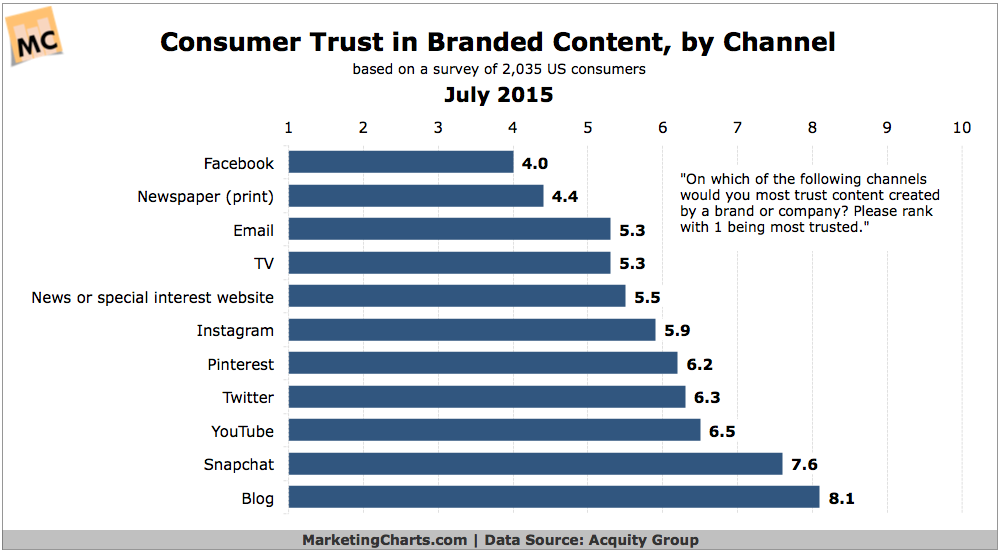
Acquity Group looked at which media outlets customers were more inclined to trust when it comes to branded content. As it turns out, some sources have a surprising amount of credibility:


AcquityGroup-Consumer-Trust-Brand-Content-by-Channel-July2015


Facebook comes out on top, followed by print newspapers, email and television. Rounding out the bottom are Snapchat and blogs.  It's worth noting that according to the study, younger respondents aged from 18-30 were more than twice as likely as baby boomers (aged 52-68) to give Facebook the top rank among branded content.


In case you were wondering, older consumers gave the newspaper their most trusted vote. As for advertising influence, TV and social media alike were near the top, while older Americans found print and direct mail of greater influence.


Who's Doing the Sharing?


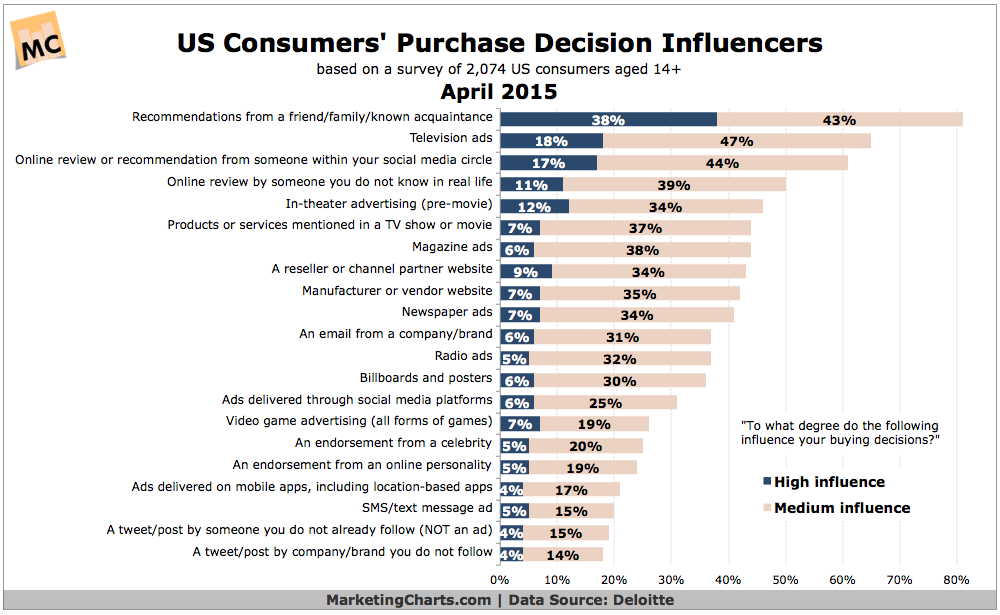
Now, before you rush off to create a cavalcade of Facebook ads featuring your company's branded content, you should know that people are far less likely to share a post directly from the company itself. Instead, they're most likely to share a product link when it's recommended by family or friends:


Deloitte-US-Consumers-Purchase-Influencers-Apr2015


Family, friends and acquaintances hold high sway over consumers' purchasing decisions


What kind of “brand content” Facebook posts are we most willing to share. The all-encompassing “funny video” still gets the most shares, but it's closely followed these days by content that is designed to support a cause or organization.


With branded content, you're essentially borrowing the customer's time and thanking them by making them feel something – laughter, insight, amazement.  Although the ads referenced above are designed to make you think, the company behind them is secondary to the story they're sharing.


And if more people become invested in that story, they'll want to tell others, and the cycle continues.


Now you're probably wondering, “branded content sounds great – but how do I make the most of it?”


Content marketers are already struggling to squeeze ROI out of their campaigns in a way that's meaningful to managers and executives alike, so here's how to start making branded content work for you:


Getting Started with Branded Content


First off, Facebook only allows branded content from verified pages – meaning you'll need to have that coveted “blue checkmark” next to your name (or a grey checkmark if you're a business) in order to take advantage of this type of promotion.


The link above describes how to go about verifying your business account on Facebook, or if you're an individual, how to see if you're eligible to be verified.


Once you're verified, you can get started with branded content by going here.  Nearly any type of content can be tagged as branded content, including photos, videos, text (with and without links), live videos and more.


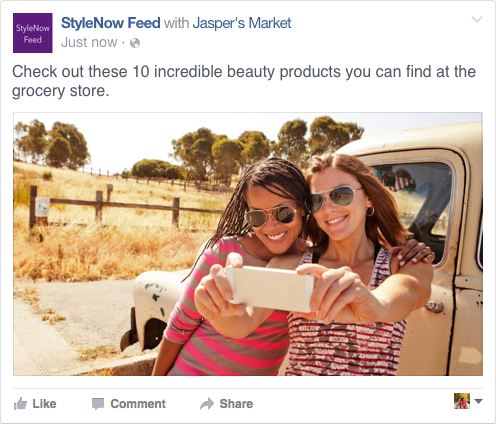
How do you know it works? Because you'll see not only the company name being mentioned, but also the key “with” – and then those tagged in the post:


live-example


Now, any time the post is shared, those tagged in it will also benefit from the exposure. It's a win-win.


What's The Difference Between Branded Content and @Mentions?


Excellent question! The difference between branded content and your typical @Mention is that the brand which posted the page gets analytical insights that wouldn't ordinarily be available in an @Mention.


It's important to mention here that if you're tagged, you'll still get to see the post's organic and paid engagement, sort by organic versus paid or fans versus non-fans – and otherwise see much of the same data as the owners of the branded content themselves. So although it's not specifically coming from your page, you'll still get to see a lot of the details that a simple mention wouldn't have.


Now, tie this kind of content leverage in with your own UTM parameters and conversion goals and you'll be able to see precisely how well your branded content is performing and converting.


Squeezing Every Drop of Trust and Credibility Out of Branded Content


Let's face it, you're already creating content. Why not take to the channel consumers trust the most and make your content work even harder for you?  You'll be getting vastly more exposure when coupled with influencers in your industry and getting people to take action on your content in ways that a typical ad just can't match.


What are your thoughts on using branded content? Has your company used this method effectively to increase trust, brand recognition and awareness among your target audience? Share your thoughts and impressions in the comments below


About the Author: Sherice Jacob helps business owners improve website design and increase conversion rates through compelling copywriting, user-friendly design and smart analytics analysis. Learn more at iElectrify.com and download your free web copy tune-up and conversion checklist today! Follow @sherice on Twitter, LinkedIn or Google+ for more articles like this!


Monday, 4 July 2016

5 Ways to Target Millennials With Text Message Marketing

If you've spent any time at all around Millennials, then you know how much they love texting. Millennials rely on texting for just about everything-so much so that, a recent survey by OpenMarket reports, 75 percent would rather give up using their phones make voice calls them to text.


Why do Millennials love texting so much?


  • 76 percent say texting is more convenient and allows them to communicate on their own schedule

  • 63 percent say texting is less disruptive than voice calls

  • 53 percent just say that they'd rather text than call

  • 19 percent say they never check their voice mails.


What does this mean to your business? There's a huge opportunity to reach out to Millennial customers via text message marketing. For instance, according to the survey, three-fourths of Millennials say text reminders are helpful, but only 30 percent get them from businesses that they patronize.


Text message marketing uses SMS text messages to reach out to customers with information and offers. While text-based marketing may sound intimidating, there are lots of different services out there that make it easy for small business to create and send text messages to their customers. (Some to check out include EZ Texting, Mozeo and SlickText.)


Here are five ways you can use text messaging, not only for marketing purposes, but also for customer satisfaction and even for getting paid.


1. Send product offers, discount codes or coupons. This is the type of text message that most Millennials in the survey want to receive; nearly two-thirds (62 percent) currently get this type of text message. You can use geo-fencing technology to deliver offers to customers when they get within a specific distance from your business. Or, get really sophisticated and use geo-conquesting technology, which sends customers offers from your business when they get close to a direct competitor's location. This can be highly effective in luring customers away from your competitors.


2. Send account activity reminders. About 60 percent of Millennials in the survey already receive this type of text message. You can remind customers when a payment is due or alert them when a payment has been processed. This not only helps you get paid faster, but also keeps your business top-of-mind with customers and shows them you're on top of technology.


3. Send order status updates. Some 56 percent of Millennials in the survey currently receive text messages with order alerts or delivery notifications. You can ease customers' minds by letting them know that an order placed is in process, due for delivery or ready to pick up at your store. This works great for e-commerce businesses, but can also be used by any business where customers place orders in person.


4. Send appointment reminders. Slightly more than half (51 percent) of Millennials surveyed get this type of text message from businesses. Sending reminders by text saves you time and manpower (no more calling customers with reminders of upcoming appointments), helps prevent excessive wait time at your business due to late customers, and ensures that you're always operating at full capacity without any wasted downtime.


5. Send surveys. Last but not least, you can send text messages for customer satisfaction surveys-22 percent of Millennials receive this type of message from businesses. You can either send a link to a longer survey, or do a really simple survey where the customer just texts back a response to one question. The former option is probably preferable to older customers, while younger ones will likely prefer the brevity of the text-based survey response.


Text messaging is already the default means of communication among Millennials and Generation Z (the generation right after the Millennials). Put your business ahead of the competition by learning to market to these valuable customers in their own language-a language that will only become more widely used in the coming years.


The post 5 Ways to Target Millennials With Text Message Marketing appeared first on AllBusiness.com

The post 5 Ways to Target Millennials With Text Message Marketing appeared first on AllBusiness.com.