The post SearchCap: Gboard update, Google local reviews & more appeared first on Search Engine Land.
Please visit Search Engine Land for the full article.


It's hard for digital marketers to ignore headlines claiming, for example, “How Kraft Gets Four Times Better ROI From Content Than Ads.” That's certainly an impressive figure - four times better ROI! - but those who take it at face value risk missing the bigger picture.
More critical readers of that headline might ask: What mix of inbound and outbound marketing helped the Kraft brand, over its 100-year history, arrive where it is today? Would Kraft's ROI on content be as strong as it is, if not for their decades of advertising? Or, does this comparison even make sense in the first place?
The comparison does “make sense”, unfortunately. It's unfortunate that inbound and outbound marketing are so often framed as competitors racing for the higher ROI, but that comparison persists. And in one sense, given how their tactics differ, it's logical and convenient to view inbound and outbound tactics as two separate ballgames.

Inbound and outbound have been discussed as inbound versus outbound ever since digital inbound marketing surged in popularity in the early 2000s. While it's true that many traditional outbound marketing tactics (e.g., cold calls, email blasts) have fallen from favor, these techniques can still be effective.
Today's savvy consumers still respond to outbound marketing efforts when they're used intelligently, aligned with inbound content and supported by quality data analysis.
The ideal marketing strategy recognizes the strengths and weaknesses inherent in both marketing “directions” and thoughtfully combines both into a cohesive message with a comprehensive reach. Inbound and outbound should be considered teammates-not competitors.
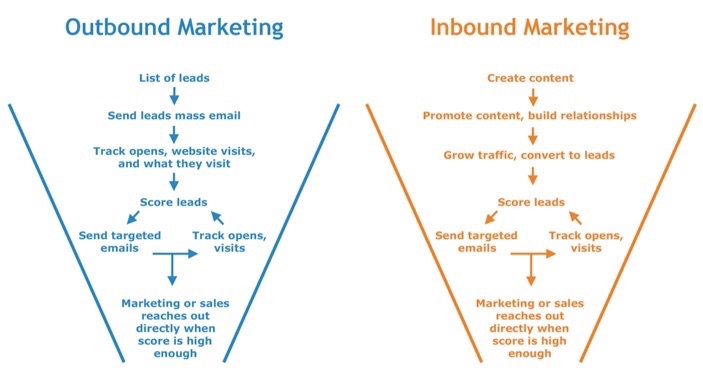
Highly segmented markets and fringe cases aside, most businesses get the best return when they present a singular, coherent marketing message. Mixed messages -even just messages that aren't obviously connected- can confuse consumers, leading them to seek competitors with more clearly positioned alternatives. Plus, for maximum efficacy, marketing initiatives should gain momentum over time, e'g', new marketing campaigns should build upon old marketing campaigns. The alternative is to continually start over from square one.
Some marketers make the mistake of associating the outbound marketing tactics used today with those of a few years ago. This is unfair. Email marketing, as just one example, has advanced a great deal in recent years. We spoke with Steven Coufal, Senior Media Relations Specialist at Gartner, to learn more about the advancements in email marketing:
“It used to consist primarily of large scale, one-off email blasts, but now the technology has moved to the point where marketers can hyper-target small subsets and even individuals with very focused content tailored to their specific interests,” Coufal says.
Another professional marketer, Tim M. describes his old method in a review of his new marketing platform, “The other missing link was the ability to do email campaigns specifically designed for segmented target audiences.” With the newer email marketing platform, he continues, “we no longer have a one size fits all message that doesn't really work.”
Coufal gave us a rundown of how intelligent email marketing can be woven into the bigger marketing picture. “Say a prospect signs up for your email list and you begin to track them,” he explains. “Your marketing software scans their social media accounts to learn they are a female, in the 24-39 age range, a working-professional, living in London. It recognizes that she's in the target demographic for your company's new line of trench coats. She then gets opted into a specific email stream that promotes the styles and options known to be popular with her demographic.”
Not only can the message be tailored to the individual, it can be adapted to the individual's actions. Continuing with the above example, “Through your website tracking, you see your prospect visits a page, but winds up not buying a trench coat. Instead of simply reminding her about the coat in another email, a modern email marketing platform would let the follow-up email offer a 20% coupon, increasing the chances of a sale,” Coufal says. “It's this kind of microtargeting that can make outbound marketing so effective.”
And these tools have never been more available, affordable or plentiful. Even single-purpose platforms such as RedCappi, Emma and other email marketing software tools are helping users implement precise segmentation and tracking of individual outbound efforts. Many reviewers praise more advanced platforms, such as Salesforce Marketing Cloud, because they centralize these (and many other advanced features) into a single, integrated inbound and outbound marketing platform.
While availability and affordability are both great, the very plentiful selection of options creates challenges. Ken M offers this wise advice, “Take the time to look at all the options. I almost made a decision early in the process because I just wanted to get the task done and move onto my normal duties. I am glad I took the time to be thorough.”
With the time you take, make sure to spend some looking at the range of options. Don't overlook analytics tools such as Kissmetrics. These can be integrated into a company's existing marketing platform, modernizing the strategy and execution of outbound efforts while providing the data needed to continually refine them.
Calculating the ROI of inbound and outbound separately makes for compelling headlines, but it also suggests the two methods are in competition. But marketing isn't a zero-sum game where the winner takes all. Instead, marketing efforts should be made to cooperate. And with today's wide selection of advanced and affordable inbound/outbound marketing platforms, there's no reason both can't cross the finish line together.
About the Author: Craig Borowski is a Market Researcher at Software Advice, a Gartner company, providing analysis and recommendations for software buyers. A former Sr. Editor of TIME magazine, he now covers technology and changing trends in the CRM market, with a focus on customer service, marketing automation and the impact of technology on CRM strategy.


Have you ever seen one of your favorite products shut down? I have personally seen products that are beautiful and useful yet they have a hard time finding customers. What is happening here?
Developers and non-marketers like to believe that the best products will always win and that if “you build it, they will come” but life isn't like the Field of Dreams movie.
Peter Thiel, investor and co-founder of PayPal, even said this in Zero to One:
“The conventional thinking is that great products sell themselves; if you have a great product, it will inevitably reach consumers. But nothing is further from the truth.”
Once you build a great product, you need the right distribution for it. I'm using the word distribution as a “catchall term for everything it takes to sell a product”.
Lucky for you, there's hundreds of potential distribution channels that you could try. Blogging, Adwords, and Facebook Ads are just a few examples but what some people don't realize, is that there's 1 or 2 channels that will outperform all the other ones combined. This is an example of the classic 80/20 rule.
The 80/20 rule “states that, for many events, roughly 80% of the effects come from 20% of the causes.” In the distribution world, it means that 20% of all distribution channels will drive 80% of the results e.g. traffic, leads, new customers, etc.
This means that finding the “20%” of distribution channels for your business isn't just profitable but required for success. After all, we are all in a race against the clock which is usually when we run out of money or time.
To better understand the impact that one great channel can have, we need to look at the music industry. The most important question for music labels is this:
What distribution channels will ensure that songs become a hit? The answer to this question is radio.
Radio stations are crucial in creating awareness for upcoming hits and have been for years. Music hits depend on familiarity and radio provides this at scale. John Seabrook, who wrote The Song Machine: Inside the Hit Factory said this about the power of radio:
“Big Radio is still the best way – some would argue, the only way – to create hits. If the song seems to be playing everywhere at the same time, all at once, it is perceived to be a hit and becomes one.”
The effectiveness of radio stations has even led to criminal investigations against music labels who tried to purchase more playing time for their songs. The role of radio has changed over the last few years especially with new channels like Spotify, Pandora and YouTube, but this is an example where one channel outperformed all the other ones.
Distribution channels are also affected by customer segments. A channel like Adwords might work on one segment but fail miserably on a different segment. A great example of this is the early history of PayPal, back in 1998. PayPal experiment with a few different customer segments including Palm Pilot users.

These users were savvy and loved technology. Seems like a great fit for a startup that wants to send money through the internet right? As it turns out, these users were spread out all over the country making them hard to reach.
PayPal then decided to go after the Power Sellers in eBay. This segment had a high need for PayPal especially since the alternative at the time was to use checks. They happily embraced PayPal and were crucial in helping them “nearly double their user base every 10 days”.
Sometimes it can be hard to grasp how consistent exponential growth looks like so here is a chart that shows what your customer base would look like if you were able to achieve a 7% weekly growth.

This type of growth is possible if you are able to find the most effective distribution channel and the best customer segment for your business.
Since you don't have the time and resources to try every possible distribution channel, we need a way to filter through the available options and narrow down to the ones that could be profitable.
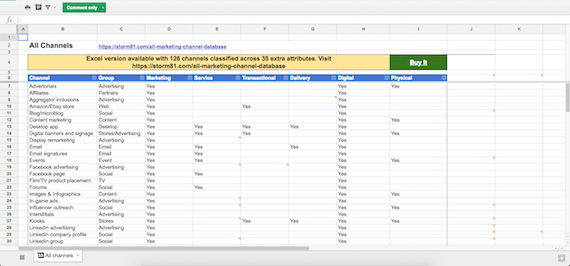
While every channel is slightly different, we can use two metrics to find the best channels for us. These two metrics are:
You can click through on each link to understand and calculate each of those metrics. Once you do that, come back to this article.
Imagine that your CLV is $400. This means you could spend up to $399 in CAC (this is a simplified example) and still make a profit. Your CLV provides an estimate of how much you could spend while also limiting which distribution channels you can use. Some channels have a low CAC e.g. digital advertising while other channels have a higher CAC e.g. inside sales team.
The graph below, from Zero to One, provides guidelines on typical CLV and corresponding distribution channels.
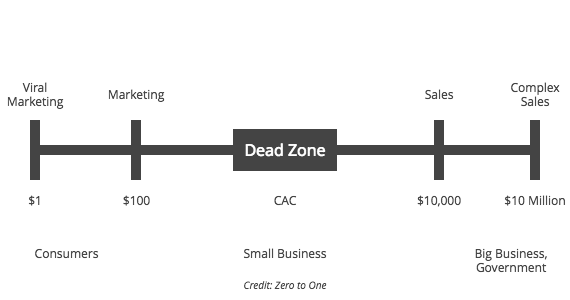
Of course, it is possible that AdWords won't work for you (cost per click in your industry may be too high) and perhaps you can make a sales team work with a low CLV. The point of this exercise to is to filter down from 100 options into a handful of channels that are likely to work.
With a handful of distribution channels, you can now run experiments and test different campaigns. There's a great article on what it takes to create a growth machine but the main point is that you need an established process that will make it easy to test different ideas.
Make sure to also explore different customer segments and see how each one affects your distributions channels. Testing customers segments is driven primarily by one question:
Who wants to buy my product and how can I best reach them?
Don't overestimate the impact that one channel can have on your business and how it can help you grow faster. Finding the best distribution channels might just be the thing that saves your company.
About the Author: Ruben Ugarte helps venture backed startups use analytics to make better decisions through his blog at Practico Analytics. You can also reach out to him on Twitter @ugarteruben.


If you work at a nonprofit, you might not think you're in sales. Your passion and livelihood is working with rescue dogs, military veterans, or foster children. And how is that sales?
You are asking for people's money or time. That is selling. You are in sales no matter what the cause is.
The sales process for a nonprofit is longer than if you were selling an ordinary product or service. Why? The buying cycle is different.
Consider an animal shelter. A shelter's prospects can be donors or perspective pet owners. However, getting donations has its limitations. Think of individual donors. Are most people's donations already budgeted? Probably not. What about corporations? Donation cycles are often tied to budgets. If you want a corporation to become a sponsor, there will be a deadline for submitting a proposal. You're not going to be successful if you missed this year's deadline which was likely some time last year.
Your other prospects might be individuals who can adopt pets. Think about yourself. Can you adopt a pet right now? It's unlikely, and even if you wanted you, you might have to convince other family members.
You should recognize that your prospecting process for a nonprofit might be a little longer than for products that are needed immediately and wanted.
Too often the people working for a nonprofit have a passion for the cause. They make the mistake of thinking that everyone else has the same passion for the cause. The problem is they don't realize that their job in selling is to uncover that passion in others if it exists. More important is helping others who lack the passion to see why supporting the organization is necessary.
And that's what selling is.
Think about an organization which is having a fundraiser and honoring a local leader. Let's say the leader accomplished certain things during his tenure in office–perhaps he increased budgets to promote cancer research. A potential donor could be someone whose family was impacted by cancer.
You would not be selling a donation for the fundraiser. You would be selling the ability of the donor to honor the memory of his family member. You would be selling the pride of knowing that other families could be spared the pain of a sick family member. You would be selling hope.
What do these reasons have in common? They are selling emotions; you are unlikely to make a sale for a nonprofit unless you connect with your prospects' emotions. What do your prospects care about? That's what you need to learn before you can sell.
Consider yourself lucky if you call someone and they immediately have a connection with your cause; they happily donate their time or money. That's unlikely to happen.
Think about any other sale. You would never call on a prospect once a year and start the sales call with the equivalent of “Do you want to buy?” Instead, you would build relationships with your prospects so that they want to help you and donate to your cause.
That means you must establish and maintain meaningful contact with your prospects. Meaningful means you initiate contact by phone and not email, especially if you're local. The telephone is more personal.
The objective of the first phone call is to have a second phone call or a face-to-face meeting. During your cal, demonstrate that you know something about your prospect so he will want to meet with you.
You could call and say, “I've admired the work you've done in the community and wanted to meet with you to see if our work at the ABC organization might interest you. Our work in cutting-edge medical research is benefiting a lot of children in need.”
Contrast the telephone call strategy with an email that may or may not make it through a spam filter, get opened, and read. An email which says, “I'm the executive director of the ABC organization and want to meet with you to show you the work we're doing,” does not demonstrate a focus on your prospects and why they should want to take the time to meet with you.
Nonprofits do wonderful work in our communities; however, they can't do their work until someone sells the idea of supporting them.
The post If You Work in a Nonprofit, Guess What? You're in Sales appeared first on AllBusiness.com
The post If You Work in a Nonprofit, Guess What? You're in Sales appeared first on AllBusiness.com. Click for more information about Maura Schreier-Fleming.


Chatbots are the latest in a long line of tech trends to sweep through the marketing world.
One use and it's delightfully obvious why.
Ranging from fun and whimsical to straight-up commercial, chatbots present interesting new potential for companies to reach and engage customers.
Facebook messenger bots specifically present one of the brightest areas for marketers, tapping into their huge network and built-in advertising features.
However despite the promising outlook, you might be better served by ignoring this trend (for now).
Here's why.
Chatbots magically combine pattern matching (low-level artificial intelligence) to present options to users instantly based on a number of predefined rules.
Based on your real-time responses, a chatbot will work to get you closer to finding exactly what you're looking for. That intent-driven nature makes it especially promising for marketers, showing a glimmer of hope similar other intent-based (not to mention, high converting) platforms like search engines.
Chatbots on Facebook messenger have been begun popping up everywhere the past few months, with help from platforms like Motion.ai and Smooch.io that help bridge the technological gap for the masses.
Expanding into Facebook's existing advertising infrastructure is mouth-watering. For example, you're able to integrate existing SMS messaging campaigns to Facebook Messenger accounts with phone number tracking.
There's also the potential for these chatbots to replace 800-numbers and other awful customer service experiences in favor of a real-time, at-your-fingertips, information retrieval system.
That's not even taking into account the massive potential that is WhatsApp (and its 1 billion monthly users), which Facebook owns, but doesn't currently allow this technology.
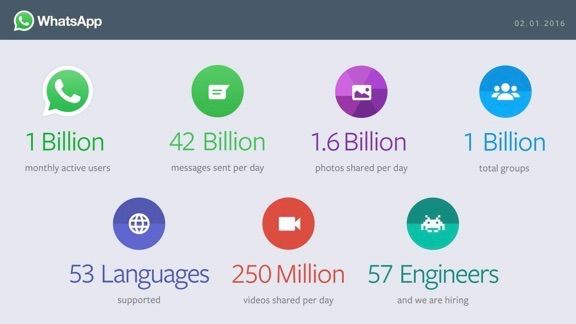
Some companies are already tapping into these benefits, as Andrew Tate highlights excellently on AdEspresso.
HealthTap allows you to speak directly to a doctor. Well, not exactly. It will start by showing you recommended answers from doctors to similar questions made in the past. Depending on your results, you can then send the question out to a real, live doctor to get an answer.
Spring gives you personalized shopping recommendations. List of questions for styles, price range, type of clothing and more to eventually whittle down its answers. This wonderful little chatbot does all the hard work for you, removing the need to browse for hours on end.
And one of the most cited examples 1-800 Flowers, where you can make a new order with a simple message. Enter the location for drop-off, and you can browse their options to make a purchase immediately. (although it's worth noting that you currently can't process credit card payments within Messenger).
Awesome stuff. No doubt.
But here's the problem.
Despite their awesome potential, chances are, you should NOT worry about chatbots right now.
In what seems like decades ago (ok, it was only about five years), Forrester Research analyzed over 77,000 consumer orders and released The Purchase Path of Online Buyers.
The goal was to determine which channels were responsible for the most buyers (not subscribers) to help marketers decide where to invest their precious resources.
The results were surprising exactly how you'd expect if you've been doing this for awhile.
Social accounted for less than a percent of sales (although in fairness, there's undoubtedly a host of attribution problems).
Otherwise, Search (both Paid and Organic) was the top driver of new sales. Email was at the top for repeat customers.
Fast forward a few years and McKinsey found that things had… well, not changed at all.
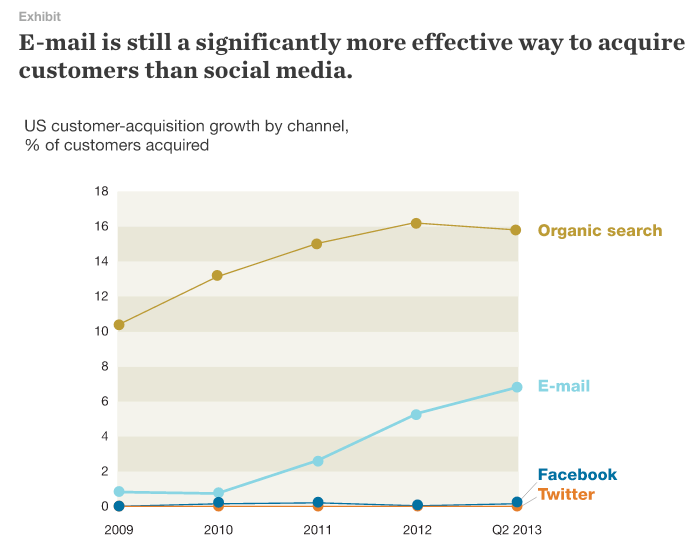
The way people purchase today has become increasingly more complex, with multiple touch points and many different channels used along the way. Many marketers struggle with getting a handle on understanding their own customer journeys.
The point though, is that there are a few fundamental things that should be working flawlessly before spending time, money and attention chasing the latest trend (despite how promising this particular one is).
Here are a few examples.
Why do people leave your site?
Somewhat surprisingly, it could be how sloooooooooow pages take to load. If an eCommerce site fails to load within three seconds than half of its traffic will bounce.
Then there's also poor design and navigation issues, too many competing or cluttered offers, and a mismatch between what got people there, and what's on the page. Along with a ton of other reasons.
What's the reason you should forget about Facebook messenger bots for the next few months?
Opportunity cost.
McKinsey also found that despite the majority of visitors opening your email on mobile devices, many of the landing pages people are being sent to still aren't responsive.
(Not to mention, just because a website is 'supposedly' or technically responsive, doesn't mean that the mobile experience doesn't suck.)
To make matters, 61% of those people with bad experiences won't return. While 40% will go straight to your competition.
That means not only are your landing pages costing you lost sales. But they're also serving as your competitor's best advertisements.
Fixing those landing pages should be important. Priority #1 in fact when you go in on Monday morning. It should at least place well ahead of dabbling in new social features which may, or may not, pan out.
Based on data and experience, you know – beyond a shadow of a doubt – that improving landing pages will result in greater conversion rates (and thus, more revenue).
You just haven't done it yet.
Because, to-do lists. Emails. Meetings. Etc.
Every good little marketer uses email. It's like PB&J at this point. But, it too is under some strain.
Competition is at an all-time high (and only getting worse), so getting your messages to stick out from the other junk in people's inboxes is a tall order.
Then there's deliverability issues, which email service providers getting ever-more sophisticated to noticing (and filtering out) your promotional emails.
A handy and helpful solution is marketing automation, that relies on timing, relevancy and personalization to cut through the crap.
On the plus side? It works. Delivering twice as many leads compared with your typical spray-and-pray approach.
The downside? Only 13% of marketers are using it. 13%!
Despite the fact that marketing automation can send you 451% more leads. Or increase average sales 34%.
Case-in-point: a whopping 85% of B2B marketers are not satisfied with their marketing automation efforts. Even despite marketers ranking it at the top of a latest survey from Smart Insights of digital activities with the greatest impact.
Wait. Why? Too busy Snapchatting or Instagramming to worry about increasing revenue?
But it gets better.
Let's see what happens if we combine the activities found in Exhibit A & Exhibit B.
Williams-Sonoma saw a 10x lift in response rates when they sent triggered emails based on specific things people were just looking at on the website.
(Pro tip: Williams-Sonoma is also a great place to score free coffee at the mall using their Nespresso display.)
Personalized campaigns “consistently and overwhelmingly beat” static ones after analyzing 650 multi-channel marketing campaigns.
HubSpot analyzed 93,000 calls-to-action (with “hundreds of millions of views over 12 months”) and found that ones targeting specific user actions resulted in a 42% improvement over standard ones showed to everyone.
This is the same approach remarketing takes, personalizing ad creative while capitalizing on impeccable timing to show people exactly what they were just looking at. At a 46% reduction in cost compared to normal ads to boot.
Want a trend to follow? There's your trend!!
Chatbots are undoubtedly one of the sexiest trends to watch develop.
Facebook messenger bots up the ante, initially promising a huge opportunity with their massive audience and built-in advertising features.
However…
What keeps getting pushed down your to-do list already? How many activities have you neglected (or ignored) that could (and more predictably) increase revenue over the next 30 days?
Poor mobile landing pages? Tired, boring email campaigns? Static website calls to action?
If you're working with Coca-Cola, go get you some Facebook bots!
If you're like the rest of the 99% of us and you're (a) already overwhelmed, (b) spread too thin, (c) understaffed, (d) on too tight of deadlines, with (e) not enough money to spend, maybe it's time to double down on the fundamentals.
Fix the underperforming stuff you're (most likely already) aware of. Increase sales.
Then go play with some Facebook bots.
About the Author: Brad Smith is a founding partner at Codeless Interactive, a digital agency specializing in creating personalized customer experiences. Brad's blog also features more marketing thoughts, opinions and the occasional insight.


The first rule of marketing is to be where your customers are-and today, that's on their smartphones. A survey by Deloitte reports the average American checks his or her smartphone within five minutes of waking up every day. That's just the beginning: On average, we check our phones between 46 and 74 times a day.
I can relate. I start my day by checking email, the weather forecast, news, Twitter, and my calendar on my smartphone before I do anything else. With all of us spending so much time on our phones, if your business's website, email, and marketing efforts aren't mobile-friendly, you're missing out. Unfortunately, a whole lot of small businesses are missing out on the potential of mobile marketing. In a survey of small businesses earlier this year by Yodle, 48 percent of respondents admitted their websites aren't mobile-optimized.
Why is a mobile-friendly website so vital? Last year Google announced that more searches are conducted on mobile devices than on desktop computers. And this year, Google began ranking mobile-friendly websites higher in search engine results (a change referred to in mobile marketing circles as “Mobilegeddon”). Just think about how you search for businesses these days. I know I always start on my smartphone, and so do most of your customers. The younger the customer, the more reliant they are in their smartphones, but even customers in the older demographics are moving to mobile-first.
Having a mobile-optimized website will boost your business's ranking in search results. Just as important, it ensures that when a prospective customer actually clicks through the search result to your website, they can read it on their smartphones and take action, whether by giving you a call, pulling up directions to your business or placing an order.
Mobile-optimized websites aren't the only area of mobile marketing where small businesses are lagging, however. In the same Yodle survey, respondents admitted that just 14 percent of them create mobile-friendly emails. Why is mobile friendliness essential to email marketing success? Currently, email is more likely to be read on mobile devices than on desktop computers, according to statistics from Litmus. Some 55 percent of email is now opened on mobile devices.
Like a lot of people, I start the day by quickly skimming my email inbox on my smartphone, deleting those I have no interest in, flagging some emails to read later and opening the most interesting ones right away. Chances are most of your customers and prospects do the same. Not only must you your email marketing messages be easy to read on a smartphone–with lots of white space, quick-loading images and to-the-point text-they should also include links to mobile-friendly landing pages. That way, if readers do what you're hoping they do and take action, they won't get stuck in a hard-to-read website and give up.
Finally, very few small businesses are taking advantage of an increasingly popular mobile marketing method: SMS (text message) marketing. Just 11 percent of small business owners in the Yodle survey are currently using SMS marketing. However, given how reliant most people are on their smartphones, it stands to reason that being able to reach customers when they're near your business-or your competitor's business-and text them special offers and deals can give you a competitive edge. For example, if someone who's signed up to receive text messages from your business is near your restaurant around lunchtime, you could text them a discount code or “buy one get one free” lunch offer good for the next few hours. A quick online search will uncover many SMS marketing tools that can make it simple and affordable to reach out to your customers with text messaging.
Small business owners in the Yodle survey report that “getting noticed over the competition” and “finding and targeting new leads” are the hardest parts of acquiring new customers. Mobile-friendly marketing, from your website to your emails to your text messaging campaigns, can help with both of these challenges.
The post 3 Reasons Mobile Marketing Is a Must for Your Small Business appeared first on AllBusiness.com
The post 3 Reasons Mobile Marketing Is a Must for Your Small Business appeared first on AllBusiness.com. Click for more information about Rieva Lesonsky.


Whether you're a bootstrapped startup or a well-known company, you likely have one (or more) people on your team in charge of analytics. These are the people who wrangle all that big data into meaningful insights that help propel the company forward. They're the ones who make sense of all the input arriving from all the disparate tools and filter it into discussions, split testing ideas, sales hooks and other angles that help improve conversion rates.
So if they're so crucial, why am I suggesting you dump them?
Because if they are the all-encompassing heart of data at your business, they're doing more harm than good in the long run.
Now before you grab your digital torches and pitchforks, hear me out. I want to preface this article by saying that yes, analytics people are valuable – critical, even – to your business' success. But no matter how varied their experiences or how unique their perspective, all of the insights you're moving on and data you're collecting are still being filtered by one or even a handful of people.
On the surface, there's no harm in that.
It's when that person leaves, or changes departments, or gets promoted that you start to run into problems. Suddenly, this person who was the linchpin of the entire analytics action team has left everyone else scrambling to pull and/or make sense of the numbers and charts.
On the opposite spectrum, there's the “analytics fortress”. It's virtually impregnable and understandable only for a select few. There are whispers and rumors about the treasure trove of data it contains, but few have ever seen it first-hand. And while that may seem like rock-solid job security on the surface, it's a giant red flag for the organization doing the hiring. Remember, they want the system to be set up so that it's easy to understand, pull from and analyze. They won't hesitate to hire someone who can help them re-configure it to be more open, accessible and cross-functional.
Getting a better handle on your analytics starts with putting the information out there and letting your various teams, departments and decision makers brainstorm the possibilities while gradually guiding them on integrating more of the data into their everyday tasks. One step at a time, and gradually, everyone becomes proficient.
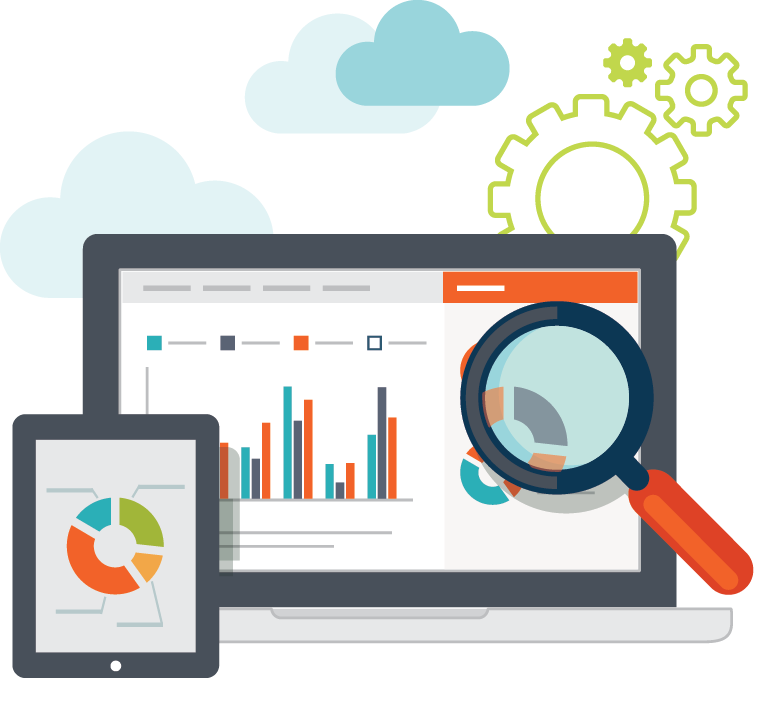
Did you know that analytics, as a field of study, is less than five years old? That means it's still at the proverbial not-eating-paste stage of its life. Because there are so many advancements being made in the field and new tools being developed, it's easy to think that you're falling further and further behind. But the fact is, with the right dashboard and the right information at your fingertips, you can make course corrections in real-time for the betterment of the campaign or project as a whole.
What this kind of new-found power will do, however, is put a big dollop of transparency on everyone. Mistakes (and successes) will be visible. Scrutiny and the sizing up of campaign results will happen. But nobody's perfect and everyone's learning. You can't afford to let your mistakes hold you back, but by the same token, you can't afford to rest on your laurels either. Always moving forward. That's what it means to be data driven.
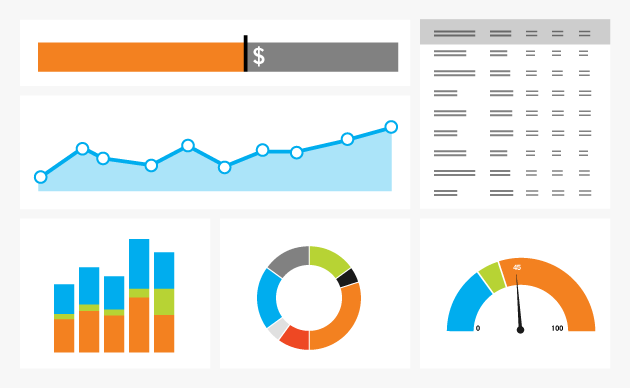
Every business wants someone with a brilliant analytical mind to swoop in, corral the data and turn it into a nice, neat and meaningful slideshow where everyone gets to bask in hefty sales figures and pretty charts. In a perfect world the numbers speak for themselves and the subsequent actions obvious.
Sadly, it doesn't work that way. And companies who forge ahead with this mindset are terribly misguided. But because transforming into a data-driven company is such a new process, it can be overwhelming to know where to start or even how to go about it. You may already even have people in place, such as those who oversee proper compliance, those who fix broken or duplicate data, or even those who build monetization models. But data-driven isn't a person so much as a way of doing business.
That means you want your company to have a strategic, forward-thinking mindset. It's very much a cultural shift. People should easily be able to reference and use the information collected to make improvements and add value to the customer experience. That means being able to make decisions that are practical for today as well as far-reaching for tomorrow.
The fact is, your campaigns will always improve over time whether you've got one person running it or 100. Why pin all your insights on a single person when you can make analytics a group effort instead? Have a process in place that turns your company from reactive to proactive when it comes to data-driven insights. Oftentimes, there's a pervasive thought throughout companies that analytics “is not my job” or that the only time it's useful is determining the success or failure of a campaign after the fact.
If data isn't the foundation of every marketing decision made by each and every person, then you're not truly a data-driven company. Teach others how to use the data not just when it suits them, but as part of the overall company culture – in planning, prioritizing, during the progress of a campaign, and throughout optimization up to launch and beyond. Above all, analytics should never be used to tout one person's idea as better than another's. Through all this data, everyone is learning whether something works, whether it doesn't, or whether it merits more study.
Every single piece of information is a potential lesson.
So now that we know what's needed, how do we turn this information into action? Here are a few steps to integrating a more data-driven flow into your workplace:
Remember, analytics is going to be new to many, many people. So it's understandable that there would be some uncertainty or outright trepidation in getting accustomed to it. Furthermore, company culture shifts don't happen overnight, so gradually easing into this new form of doing business helps ensure that everyone is on the same page and understands what's expected of them as it relates to their role in moving the company forward using data insights.
With that being said, however, it's always a good idea to learn from those who have successfully migrated over to a more data-driven mindset. Has your company embraced its data-driven roots? How did the process go? What parts were easiest to get people acclimated to and where did you struggle? Share your insights with us in the comments below!
About the Author: Sherice Jacob helps business owners improve website design and increase conversion rates through compelling copywriting, user-friendly design and smart analytics analysis. Learn more at iElectrify.com and download your free web copy tune-up and conversion checklist today!


