Sunday, 27 December 2015

Countdown to 2016: Hot Small Business Trends for the Coming Year

Series sponsored by Microsoft

What better time than the beginning of a new year to embrace new concepts, ideas, and markets in order to propel your small business forward, or get the push you need to launch a new company? Here are the small business trends you should pay attention to in the coming year.

The first thing you should know is that demographics matter when it comes to marketing—and it’s not as cut and dry as it used to be. Today, people of the same age and gender have less in common than they used to, and people of different ages and genders share more in common than they previously did. So think about the similarities among the generations when marketing your products. Can you sell the same goods to women that you currently market to teens?

Don’t forget the kids either. Gen Z (Americans born between 2001 and the present day) spend more than $44 billion of their own money, and they influence another $500 billion in sales. They are the most ethnically diverse generation ever in America, and prefer shopping online at sites that also have physical locations. According to Advertising Age, they’re “true digital natives—the first generation born in a digital world. Businesses should act digitally native too, creating a seamless and strong overarching brand experience in-store, digital, and mobile.” In fact Ad Age says it’s “shocking” how few retailers reach Gen Z, leaving lots of opportunity for entrepreneurs to be their marketers of choice.

Millennials Matter

But there’s no group with more market influence today than Millennials, also known as Gen Y. The largest demographic group ever born in this county, America’s 83.1 million Millennials (born between 1982 and 2000) are having a huge impact on many industries. Look for an increase in the number of weddings as the bulk of Gen Y starts approaching the average age for getting married (27 for women, 29 for men). The $79 billion wedding industry touches so many businesses, such as restaurants, florists, caterers, bakeries, tourism, hair and makeup stylists, retailers selling wedding attire, gifts, stationery, jewelry, and many more. It is vital entrepreneurs targeting brides and grooms be tech-savvy, since 93 percent of those planning weddings use online resources to do so and 61 percent use their mobile phones to access those businesses, so make sure your website is mobile-friendly.

Millennials are also impacting home décor in a different way than older generations. They want smaller, functional homes—in fact, 77% want a home with technological innovations. And after the weddings and homes come babies. In 2014 there were 3,985,824 babies born in America, very close to 4 million, which marks an official baby boom year.

If you want to reach Millennials, the best way is to email them. Over 40 percent say they prefer being contacted via email, rather than social media (5 percent) and text messages (2 percent).

But Millennials are important in another way to small business owners—as potential employees. This trend has years to go, so there are some things you should know about Millennial staffers.

As Cindy Bates, Vice President of Microsoft U.S. SMB group, wrote on her blog, there are “four secrets to success” in helping Millennials thrive in the workplace:

  • Create a culture of collaboration
  • Offer the latest technology
  • Keep data safe
  • Have a strong purpose

Bates also notes three best practices to help your business appeal to this important generation:

1. Foster a culture of collaboration. This is the No. 1 attribute for Millennials in the workplace. In fact, 65 percent prefer having face-to-face meetings.

2. Invest in a modern workplace. Since many are digital natives, Millennials in the workforce “demand adequate technology to do their jobs.” Almost all respondents (93 percent) in a survey taken by Microsoft say the latest technology was important in choosing an employer.

3. Live by a strong mission and value systems. “Today’s younger workforce has an independent mindset and is looking to align their professional careers with a higher purpose. [And] they’re picking companies to work for that have clearly defined values and a strong mission, with 88 percent of respondents saying these traits are something that draws them to a company.”

For more on attracting and keeping Millennial workers, you can read Cindy’s full blog post here.

Retail Reigns Supreme

As the United States has put the recession behind us, retail sales are on the upswing. And a big part of that is ecommerce. The primary factor in convincing consumers to buy something online is free shipping—and 48 percent of consumers say they’ll spend more to reach free shipping minimums.

Most Americans (69 percent) shop online at least once a month and 33 percent do so weekly. The biggest online shoppers are parents, and the more kids they have under age 18, the more they buy online. Every week, 40 percent of online shoppers with one child buy something online, 56 percent of parents with two kids and 66 percent with three children buy online. This all compares to only 23 percent of consumers without kids who make weekly online purchases.

What are consumers spending on? The 80 million U.S. households that own pets spent about $61 billion this year on their animals. Other hot businesses include men’s grooming products and services, which will hit $5.5 billion sales in 2015, up $2.5 billion in only three years, and the athletic clothing market which Barclays estimates will grow nearly 50 percent—to over $100 billion by 2020

There’s always a “hot” food trend or two, and next year will be no exception. Look for artisanal foods (the “reinvention” of existing food products, such as bacon, mayo, ice cream, oils, salad dressings, syrups, sparkling waters, ketchup, and juices) to continue to be in demand. Gourmet-style ice cream sandwiches are suddenly booming (think of ice cream sandwiched between big, chunky cookies or large macaroons, donuts, waffles, cinnamon rolls, and pop-tarts). Definitely not healthy to eat, but businesses in this field are building a healthy bottom line.

Technology plays a big part in all that’s hot, and one aspect that’s sure to get hotter is mobile commerce (m-commerce). By the end of this year, 30 percent of all ecommerce sales are expected to come from m-commerce, totaling $104.1 billion, which is up 39 percent from 2014. And you can’t ignore mobile here either—59 percent of consumers use smartphone to research products before making a purchase and 65 percent use tablets. Most (80 percent) want retailers to offer more mobile deals and coupons.

This is the last article in our “Countdown to 2016” series. We hope we’ve given you the knowledge, insight, and inspiration you need to make 2016 a banner year for your small business. Good luck!

Read the other articles in the series:
Turbocharge Your Business Productivity
How Going Mobile Is Crucial to Your Business Success
How Cloud Technology Can Help Your Business Grow
4 Reasons You Must Update Your Business Software

About the Author

rieva lesonskyRieva Lesonsky is CEO of GrowBiz Media, a media and custom content company focusing on small business and entrepreneurship. Email Rieva at rieva@smallbizdaily.com, follow her on Google+  and Twitter.com/Rieva, and visit her website, SmallBizDaily.com, to get the scoop on business trends and sign up for Rieva’s free TrendCast reports.

The post Countdown to 2016: Hot Small Business Trends for the Coming Year appeared first on AllBusiness.com

The post Countdown to 2016: Hot Small Business Trends for the Coming Year appeared first on AllBusiness.com.

Thursday, 24 December 2015

Failure to Communicate: How to Keep Stress Down When Managing People

Whether it involves coworkers, subordinates, or managers, the No. 1 most stressful challenge in the workforce is dealing with other people. While it is easy to blame problems on “difficult people,” offering clear guidance and good communication can greatly reduce stress.

Often, people are not being intentionally difficult; they simply may not understand what you expect of them. Far too many managers fail to communicate clearly—or at all—and are then surprised when desired results aren’t delivered.

Time Scheduling

One of the most basic issues in any business is time scheduling. To avoid problems, ensure your employees know exactly what their schedules are, and when and where they should report. Be sure to document:

  • Your process for schedule changes
  • How to request time off
  • Who is responsible for arranging cover for absent employees

The best method to document and implement time tracking is to use workforce management software. A strong system ensures management and employees are all on the same page.

At a minimum, a workforce management system must track employee time and attendance, and enable HR to interact with the workforce. More advanced enterprise solutions such as Advance Systems go beyond time and attendance, employee scheduling, and absence and HR management to provide mobile workforce management and interfacing with payroll packages.

Clear Communication

Do the people you work with know exactly what they are expected to do–and just as importantly–how to do it? As a consultant and mentor, time and again I have seen that a failure to communicate clearly is at the core of most conflicts.

Providing one system where all communication is recorded can greatly reduce the failure to understand company processes. In “Tips for Better Collaboration as Your Staff Grows,” Drew Hendricks explains how using collaborative tools can improve communication.

Reaction to Stress

No matter how clearly you communicate, problems will arise. While we cannot prevent every problem, we can control how we react to them. “The Common Mental Habit that Creates a Negative Cascade of Stress Symptoms” explains it’s the habit of going over and over in our minds situations creating stress that keeps us from letting problems go.

Research indicates that people who experience chronic stress are those who “ruminate” on issues. According to the article, “some people are consistently burdened by the stress of past problems, to the point where it interferes with job performance and stiffens relations among co-workers and supervisors.”

Fortunately, it is possible to learn to set a time limit on how long to dwell on an issue, and then proactively focus on something else.

Communication Blunders

Just as we can learn to let stress go, it is possible to learn how to communicate better and more clearly. Success as a manager, team member, consultant, or business owner can be directly traced to clear communications.

Twenty-nine percent of business and consumer customers change vendors due to communication blunders.

The infographic “Understanding and Avoiding Communication Blunders” (shown below) provides survey results and details regarding various types of communication issues. The less your desire to review these, the more likely you need them.

For example, did you know it is never a good idea to deliver bad news via email because you cannot convey empathy and support? As painful as it may be, bad news should be delivered in person, or at least live using audio or video. Failure to allow other people to express their concerns and get their questions answered is a sure way to damage a relationship.

Understanding and Avoiding Communication Blunders [Infographic]

Avoiding Difficult Conversations

One of the most painful challenges of dealing with people is having a difficult conversation–especially if the person involved is prone to being less than polite.

It is natural to want to put off dealing with stressful situations, but avoiding only ends up creating more stress. It is better to get it over with and move on. Unless you are one of the rare few who have the luxury of not having to deal with difficult people, learning to get through a difficult situation as quickly as possible is essential to your mental well-being.

Cultural and Language Challenges

Communicating with others from the same country who speak the same language is difficult enough; imagine how much more likely miscommunication occurs if you’re interacting internationally.

Too many people assume that what is normal for them is normal everywhere else. That is definitely untrue. Harmless gestures and figures of speech in one country can be offensive in another.

When doing business with people from other cultures and countries, consider using a translator you can trust. Finding one, however, can be a challenge, so plan ahead and line up a backup translator in advance.

Communicate Clearly to Keep Stress Down

Failure to be clear about your expectations is a sure path to stressful communication. Always put everything in writing so there won’t be any confusion. If communicating clearly is a skill you lack, use a talented spokesperson as your mediator.

The post Failure to Communicate: How to Keep Stress Down When Managing People appeared first on AllBusiness.com

The post Failure to Communicate: How to Keep Stress Down When Managing People appeared first on AllBusiness.com.

Wednesday, 23 December 2015

5 Habits of Highly Successful Entrepreneurs

What do successful entrepreneurs have in common? What do they do that struggling entrepreneurs don’t? If only we could find the magic formula, we imagine, we could be just as successful too.

Well, while there’s no magic formula to ensure business survival, a recent study, Xero’s Make or Break report, surveyed over 2,000 entrepreneurs to see what those who succeed did differently than those who failed in common. Here’s a closer look at what they discovered.

  1. Successful business owners make time for a personal life. Despite the stereotype of the hard-driving entrepreneur who works 24/7 and sleeps under his desk, the reality of entrepreneurial success is far different. Almost six out of 10 survey respondents (58 percent) believe spending time with their families in the evenings is critical to their success in business, and 53 percent say it’s important to keep their weekends free for family time.
  2. Successful business owners focus on managing finances. The most common business issue causing business failure among entrepreneurs in the survey was financial mismanagement leading to problems such as poor cash flow or lack of access to capital. Take the time to learn the basics of bookkeeping—even if you’re not the one managing your money, you still need to know the essential principles so you can keep an eye on whoever is. Today’s small business accounting software greatly simplifies accounting processes that used to take hours, so be sure to tap into this valuable tool. Almost six out of 10 successful small businesses say they use software to manage their money. In contrast, just 14 percent of failed businesses do.
  3. Successful business owners are willing to invest in improving their businesses. Successful small business owners don’t scrimp when it comes to putting money back into their companies. In addition to installing small business accounting software, other areas where successful entrepreneurs see fit to spend include marketing/advertising and improving customer service.
  4. Successful business owners understand the power of technology. A whopping 86 percent of successful entrepreneurs in the survey say they use technology to make their companies more productive. The most popular type of technology: business apps, used by nearly half (49 percent). Nearly one-third (32 percent) use mobile payment technology, while more than one-fourth (26 percent) use business planning tools. In addition, successful small business owners use technology to balance their business and personal lives. Although they greatly value their family and personal time, only 29 percent turn off their smart phones and/or laptops outside of business hours.
  5. Successful business owners are not afraid to ask for help. Successful entrepreneurs in the study actively enlist the support of a supportive network that includes family members, accountants, advisors and mentors. One-third of successful entrepreneurs say they have relied on business mentors, compared to just 14 percent of respondents whose businesses had failed. Apparently, the saying “it takes a village” applies to businesses as well as to raising children.

How many of these success habits have you implemented in your business and your life? How successful is your business?

The post 5 Habits of Highly Successful Entrepreneurs appeared first on AllBusiness.com

The post 5 Habits of Highly Successful Entrepreneurs appeared first on AllBusiness.com.

Using Kissmetrics to Find Out If You Are Losing Conversions on Mobile

As an online marketer, you probably know that smartphones and tablets are quickly becoming the devices of choice for many everyday tasks. Everything from checking sports scores to shopping is done on mobile. Undoubtedly, some of you are reading this post on a mobile device.

With this surge in mobile usage, it has become imperative for marketers to ensure that their site renders well on all devices. Not only is this important for SEO purposes, but also for conversions. If your mobile site doesn’t render correctly, your conversions will tank, no doubt about it.

The question for marketers is: are you losing conversions on mobile?

This post will show you how you can use Kissmetrics to get the data you need to answer that question.

Using the Kissmetrics Funnel Report to Measure Funnel Performance

Let’s say we’re an E-Commerce clothing store. We get about 100k monthly visitors, and about 2.2% of all visitors convert to purchasing. We haven’t done a lot with our mobile site, but we hear from customers that it can be a little frustrating. We do not offer a mobile app; instead, customers shop through our main site.

We recently signed up for Kissmetrics. This analytics tool will help us measure our marketing performance and show us what’s working and what’s not. One of the ways we’ll measure our performance is with the Funnel Report. This will show us how our funnel is performing and also let us break traffic into groups so we will know how subsets of traffic are performing.

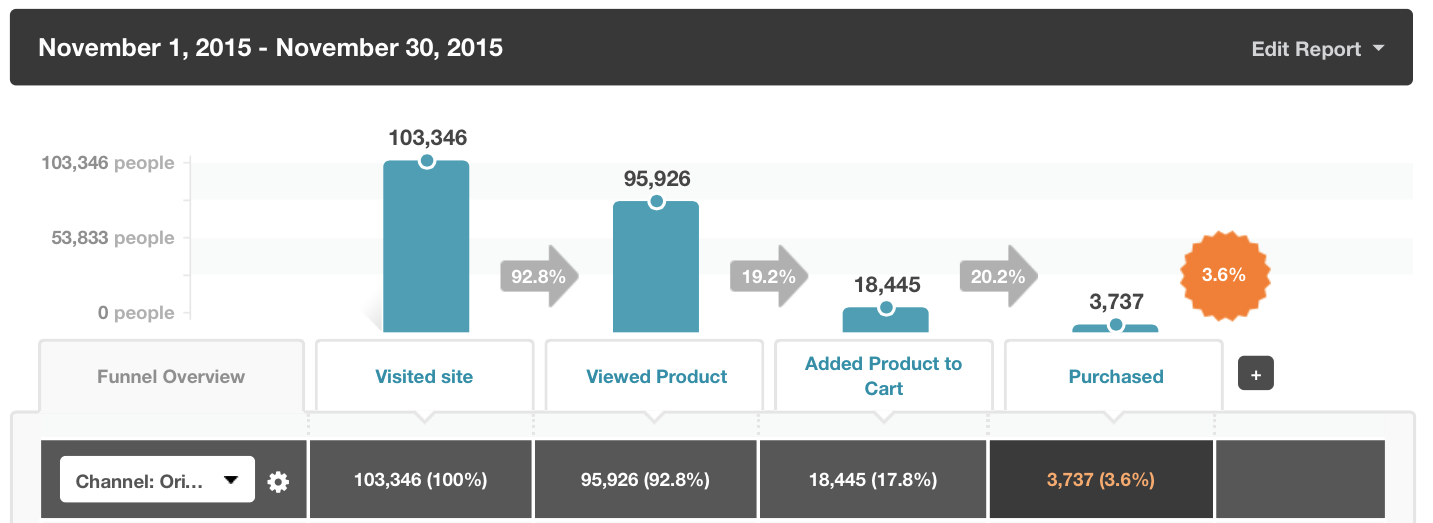
Let’s load the Funnel Report and get a view of last month’s performance.

ecommerce-purchase-funnel-kissmetrics

Looks like about 103k people visited our store during the month, and a little over 3,500 ended up purchasing.

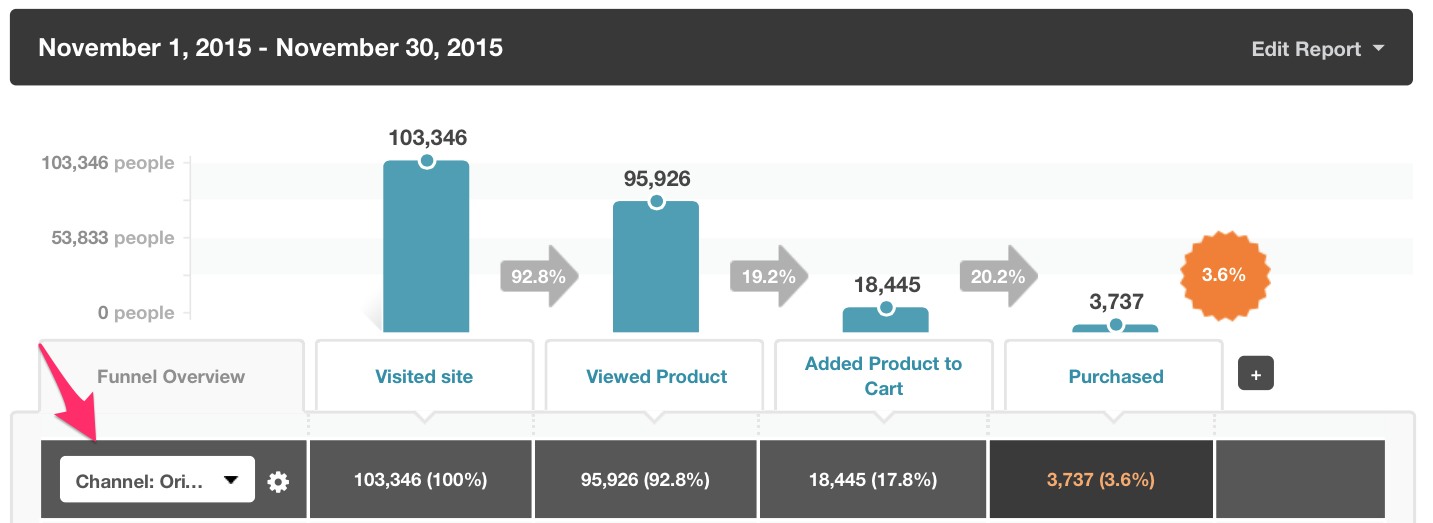
Keep in mind that this is traffic from all devices. Since we’re interested in seeing funnel performance for each device, we’ll segment (group) the data by device type. To do that, we’ll just click the dropdown shown below:

funnel-report-property-dropdown

Then, we will have two choices:

  • KM Device Type: This breaks down into computer, smartphone, or tablet.
  • KM Device Category: This shows whether the visitor came from a computer or mobile. It does not display smartphone or tablet, only mobile.

Both of these are automatically tracked in Kissmetrics.

We’ll choose KM Device Type.

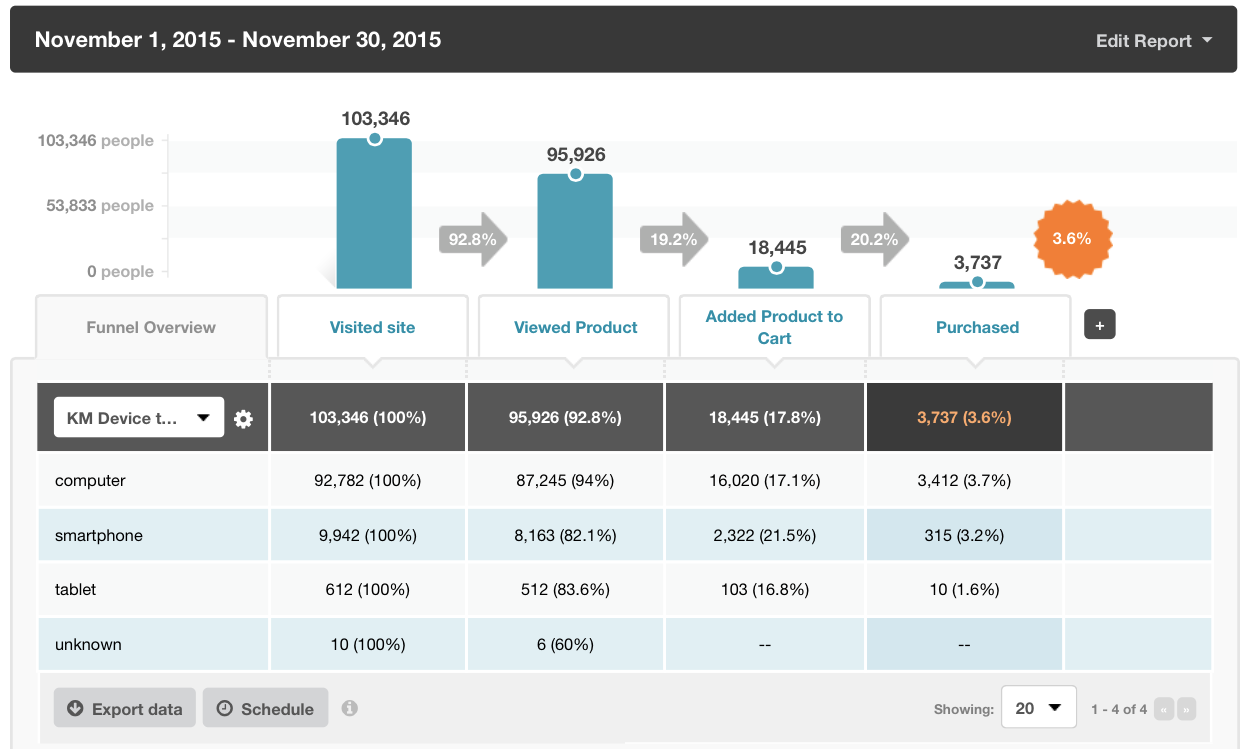
Then, we’ll get a breakdown of traffic by the type of device a person was using.

kissmetrics-funnel-segmented-by-device

We have three types of devices we’re tracking:

  • Computer – Visitors who came from a laptop or desktop computer.
  • Smartphone – Visitors who came from a smartphone running Windows, Android, iOS, etc.
  • Tablet – Visitors who came from a tablet, such as Surface, iPad, etc.
  • Unknown – Visitors who came from a device, the type of which cannot be detected by Kissmetrics.

Here are some insights we can learn from this data:

  • The vast majority of traffic and purchases came from a laptop or desktop computer.
  • Conversions were highest on laptop and desktop computers.
  • Conversions from mobile (especially tablet) were much lower than from laptop and desktop computers. There appears to be a roadblock in proceeding from step 3 to 4. This is the checkout funnel where users enter their credit card information, shipping address, etc. We can create a micro funnel to see the specific step where visitors are dropping off.

Next, we can create a micro funnel and find the exact pages where would-be customers are dropping off. We’ll create some alternate pages and A/B test them till we find winners across the board (computer, smartphone, and tablet).

Summary

Here is a summary of the process:

  • More people are browsing and buying from mobile devices than ever before.
  • Websites must be optimized for optimal viewing on mobile devices. This is important not just for SEO, but also for UX and conversions.
  • With the Kissmetrics Funnel Report, marketers can track their funnel performance and get a breakdown of how specific groups of traffic convert along the funnel.
  • Kissmetrics automatically tracks which devices visitors are using. Marketers can use the data to see how the groups of people coming from computers, smartphones, and tablets convert at each step in the funnel.
  • Marketers will learn where there are drop-offs (if any) and how well each type of device converts.

About the Author: Zach Bulygo (Twitter) is the Blog Manager for Kissmetrics.

Tuesday, 22 December 2015

Why Account-Based Marketing Is a No-Brainer

In my first post on account-based marketing (ABM), I went over its history in the 20th century, from its humble, unsophisticated beginnings to its modern day automation.

Today, I want to go over its benefits, and why—if you’re a B2B marketer—it’s essentially a no-brainer.

Are You Already Doing ABM?

If you work for a B2B brand, chances are you’ve done a fair bit of account-based marketing without even knowing it.

By their very nature, B2B companies are forced to prospect and sell to a narrow list of prospects. They use a combination of inbound, outbound, and account-based marketing techniques to make the magic happen. But most B2B marketers probably aren’t marketing to accounts the right way.

Marketing agencies (like Sterling Cooper Draper Pryce of Mad Men) are a great example of this. Most agencies have a very long list of one-off, once-in-a-while clients, and very short list of recurring “whale” clients that provide the bulk of their revenue (the 20:80 rule). They know that account-based marketing is the answer—they want to turn more of their “80” clients into “20”s—but they don’t know how to properly implement it.

Instead, they run campaigns against target lists the same way the ad execs of Sterling Cooper Draper Pryce did it in the 60s: create a proposal over a week or two, land a target exec at the account in question, work for that exec, take him or her out to dinner, nudge them into introducing their colleagues, get in with those colleagues. Rinse and repeat.

It’s a very reliable but unsophisticated process that takes a long time to bear fruit. And it’s very risky. New account managers and projects managers have to be hired on for every new contact at the account, new vendors have to be corralled, new risks taken. If any given client bails, changes jobs, or gets fired, the agency is left to deal with the fallout.

The obvious solution to this problem? Automation. By implementing marketing automation and customizing it for account-based marketing, B2B marketers will have a technology stack that can scale with their new business. Fewer account managers will be able to handle more accounts. Target list prospecting happens automatically. Forecasting and goal setting actually becomes realistic.

Automated account-based marketing really is a no-brainer. The question is whether it’s right for your company.

The New Reality of B2B Marketing

Megan Heuer at SiriusDecisions gave a great presentation on ABM in April in which she went over the “new reality” of B2B marketing. She profiled the companies already using ABM as well as those thinking about starting this year.

Company size:

  • 45% less than $100 million
  • 18% between $101 million and $1 billion
  • 36% more than $1.1 billion

As you can see, the vast majority of companies using ABM have revenue below $100 million, and another large segment had revenue over $1.1 billion.

Yet it seems like companies making between $101 million to $1 billion underutilize ABM. That’s a massive range, and it tells us that most companies are interested in ABM to either scale their early growth, or streamline their expansion beyond the ten-figure mark.

This suggests that companies making between $101 million and $1 billion could be running their operations much more effectively than they realize. Perhaps they simply don’t realize that scalable account-based marketing is the right move—yet.

Customer type:

  • 75% enterprise (more than 1,000 employees)
  • 21% medium (101 to 1,000 employees)
  • 11% small (100 or fewer employees)

But regardless of revenue, the vast majority of ABM-practicing companies are enterprise-level brands with more than 1,000 employees. This makes sense—ABM is easier to implement and scale once you already have a larger client base and staff in place.

But it also means that B2B companies with between 10 to 1,000 employees are not taking advantage of ABM. Perhaps they feel their employees are overworked, and don’t have the time to learn yet another system. Perhaps ABM is an unproven, “new” concept and they are too busy with old methods and strategies. Maybe they don’t think they have enough clients to justify such an investment.

Is ABM Right for Your Company?

But I think they’re missing the point a bit. ABM works best for B2B companies that sell to:

Situation A: a few large, key accounts, or
Situation B: accounts of a certain size in a specific industry.

If you’re targeting Fortune 500s to 1000s, for example, ABM can help you unlock the full potential of each target account and effectively double or triple your client base. Who wouldn’t want that?

Great candidates for ABM also include companies with ineffective sales models:

  • 82% sell with direct sales force
  • 13% with inside sales
  • 4% with third-party channels

If your advertising isn’t working, or if you feel like sales is always complaining about a lack of alignment with marketing, maybe it’s time to try something new. ABM can help you accurately measure marketing ROI, button up marketing-to-sales alignment, and reduce or maintain the size of the sales force you need.

The Clear Benefits of ABM

Of course, none of this is convincing unless account-based marketing boasts clear and observable benefits. Fortunately, in my experience, it does.

Benefit #1: ROI is Much Clearer

According to the 2014 ITSMA Account-Based Marketing Survey, ABM delivers the highest ROI of any B2B marketing strategy or tactic. And according to Alterra Group, 65% of B2B marketers agreed that ABM provided significant benefits for attracting new clients.

This isn’t surprising—ABM is the sniper’s way of marketing. It’s incredibly precise, targeted, personalized, and accurate compared to general inbound and outbound strategies, which also makes it easier to measure ROI. Here are some more stats to back up those claims:

  • Response rates from ABM accounts: 47%
  • Online activity from ABM accounts: 39%
  • Number of new contacts in ABM accounts: 36%
  • Internal stakeholder feedback: 36%
  • Participation in all marketing activities: 25%

Benefit #2: There’s less waste and less risk

This all means that unnecessary waste—and risk—are greatly reduced. By scaling ABM marketing strategies, B2B marketers can do more with less. A smart ABM technology stack helps the same number of account managers target, market to, convert, and upsell a much larger number of contacts at each account before another account manager has to be hired.

Which means there’s much less risk involved. You don’t have to hire and fire talent based on how well an account is doing. With ABM properly set up, accounts become revolving doors—even if one contact is lost, another one will walk right in.

Benefit #3: Clients like it because it’s personal

According to Aberdeen, 75% of customers prefer personalized offers. This has been shown time and again to be true. It’s why email marketing remains so successful compared to other forms of inbound and outbound marketing. And it’s why solutions that aim to stop cart abandonment are so popular with retailers.

ABM is implemented with the needs of a specific target prospect at a specific target account in mind. The research required to get this type of marketing up and running means that your prospects will know you’ve done your homework—and they’ll love you for it.

Benefit #4: Goal-setting and analytics are easier

When you analyze campaign effectiveness, it’s easier to draw conclusions. Not only are you looking at a smaller set of targeted accounts, you also have well-drawn battle plans for each account that let you easily compare end-of-quarter results to forecast goals. Which brings me to the last big benefit…

Benefit #5: Sales alignment is much easier

ABM marketers speak the same language and have the same knowledge as the salespeople they work alongside. They have to work closely with sales to accurately identify target accounts, map them out, and align on sales initiatives. This type of tag teaming between marketing and sales is what ultimately leads to the powerful, predictive marketing and turnkey targeted advertising that unlocks accounts.

But how do you set it up?

In the next and last post in this series, I’ll go over several resources you can use to set up ABM the right way and keep your accounts coming back for more.

About the Author: Alp Mimaroglu is a Marketing Luminary. He specializes in marketing automation, demand generation, analytics, and marketing technology. Alp has extensive experience with both business and consumer marketing. He’s passionate about how technology is rapidly becoming the key to success in both the corporate sales and marketing landscapes. Follow Alp on LinkedIn and Twitter.

Monday, 21 December 2015

5 Free Market-Research Tools to Read Your Audience’s Minds (And Create Content to Delight Them)

Have you ever read something that made you think the person who wrote it was reading your mind?

They were speaking your language. It almost felt like they knew exactly what you were thinking…

And they probably did. They probably did the research to find out what their target audience was thinking, and then created the content they knew would resonate with them.

When you resonate with your audience you sell more product, build your email list more quickly, and connect with them on a deeper level.

So what’s the secret sauce? How can you, as a business owner, read your audience’s minds so you can create content to delight them?

We’ve found five free tools to help you do just that:

1. The Front Page of the Internet

As far as free market research tools go, reddit is among the best.

And reddit isn’t called the front page of the internet for nothing.

Reddit reaches over 200 million unique visitors each month with over 208 countries, which means that your target audience most certainly spends time on that platform.

Since reddit is completely free and powers communities called subreddits where a group of people discuss common topics, reddit is ripe with opportunity for any marketer.

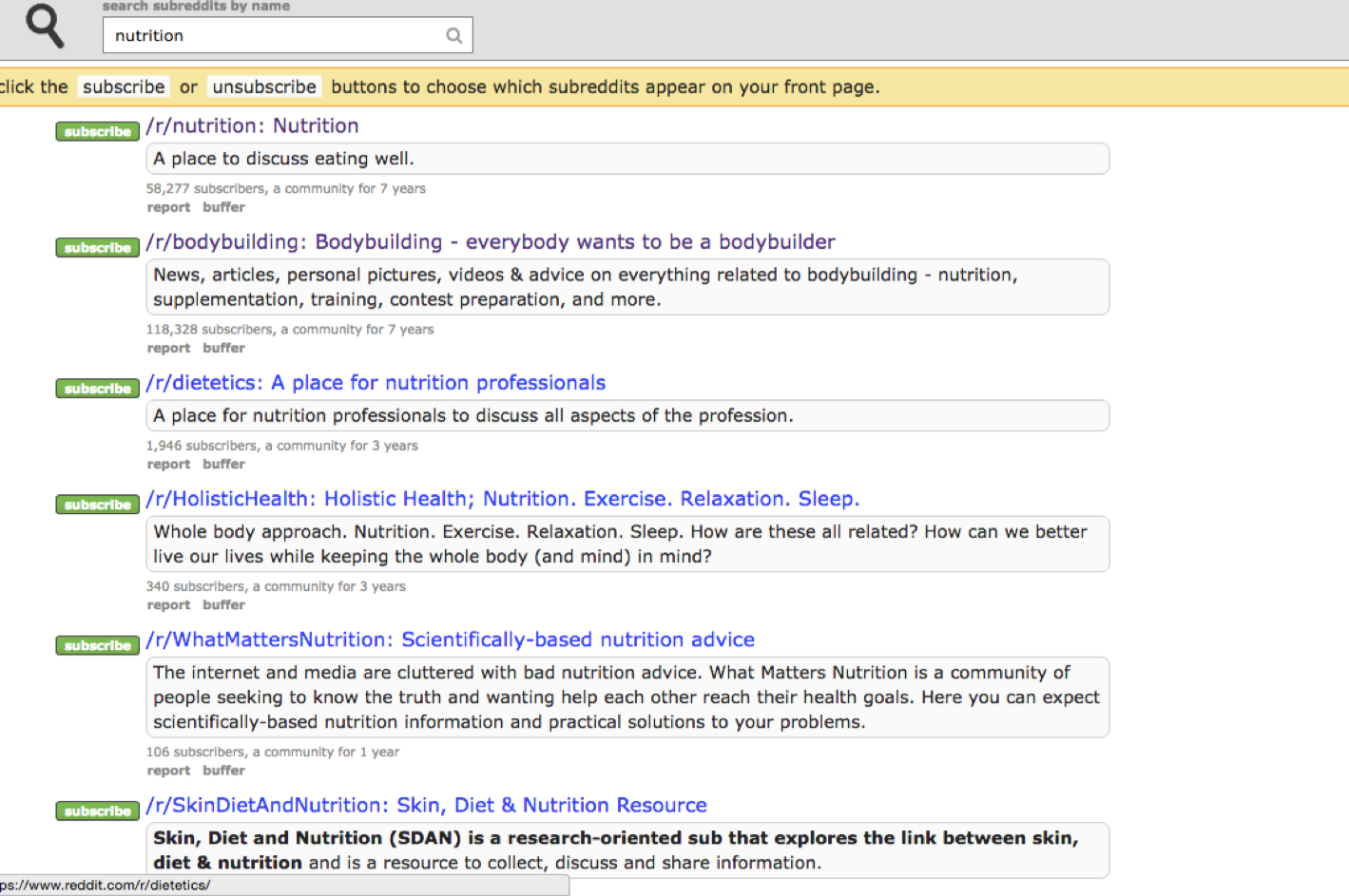
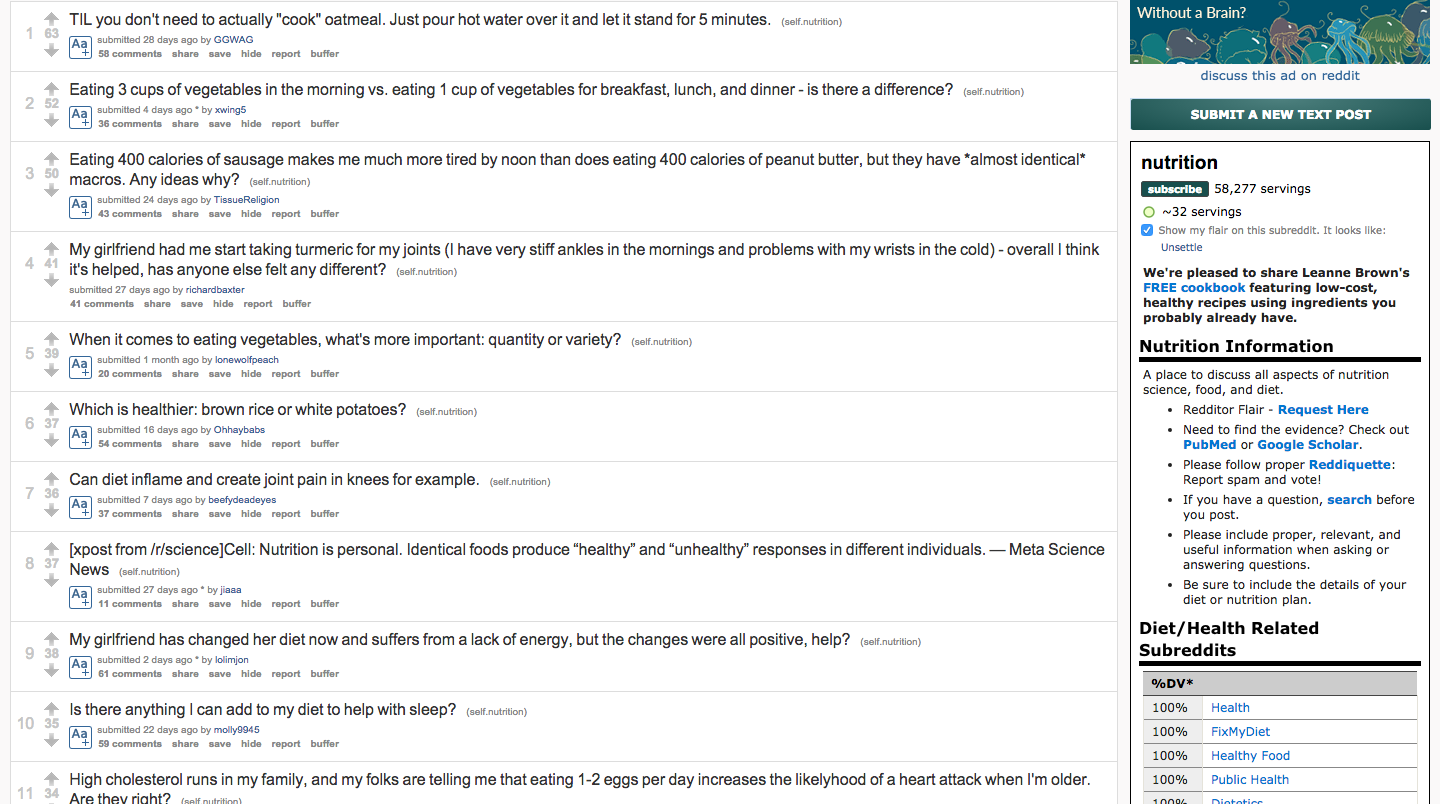
To find your audience on reddit, search your keywords in the subreddit search tool to find conversations about your topic. For example, if you were in the nutrition industry, you might type in “nutrition” to bring up a list of subreddits related to that topic.

reddit-nutrition-search

Then, start combing through the “top” results in the subreddit.

You can see the amount of “upvotes” between the arrows on the left-hand side of the post, which gauges the popularity of the post.

nutrition-subreddit

In the example above, you’ll note that of the top ten posts in this subreddit, two of those top spots are taken up by talk of energy and nutrition.

With this data, you can create content that will delight your audience by helping them achieve the results they want. What would be more compelling to you as somebody struggling to get enough energy during the day – a headline that the content creator obviously guessed at, or a piece of content that actually addresses what you’re struggling with?

Reddit is magic for any content marketer.

2. The Question and Answer Tool

One of the best ways to create content to help your audience with the exact challenges they’re experiencing is to discover what type of questions they have about your topic.

This is what makes Quora such a great free tool for market research. Quora is a platform on which your audience is actually asking the questions they want answered.

How’s that for reading their minds? Think of Quora like a sophisticated Yahoo! Answers. People ask questions, and other people – experts, content creators – answer them.

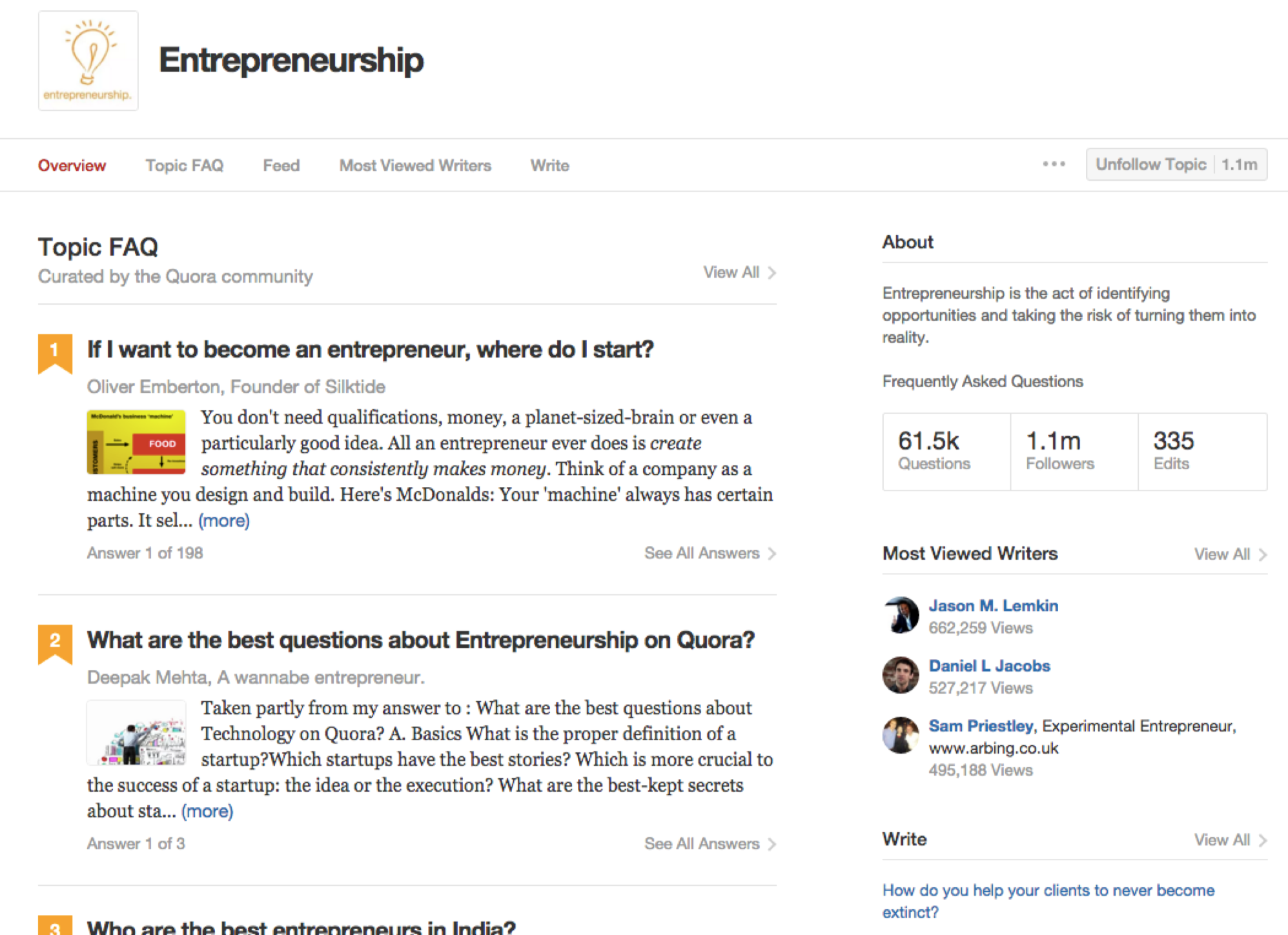
Use the search tool on Quora to search keywords for your industry. Let’s say you were in the business-to-business industry and helped new entrepreneurs start their businesses. You might type “entrepreneurship” into the search bar:

quora-entrepreneurship

Begin to read through the Topic FAQ; these are questions that others have upvoted, shared, and re-asked over and over again.

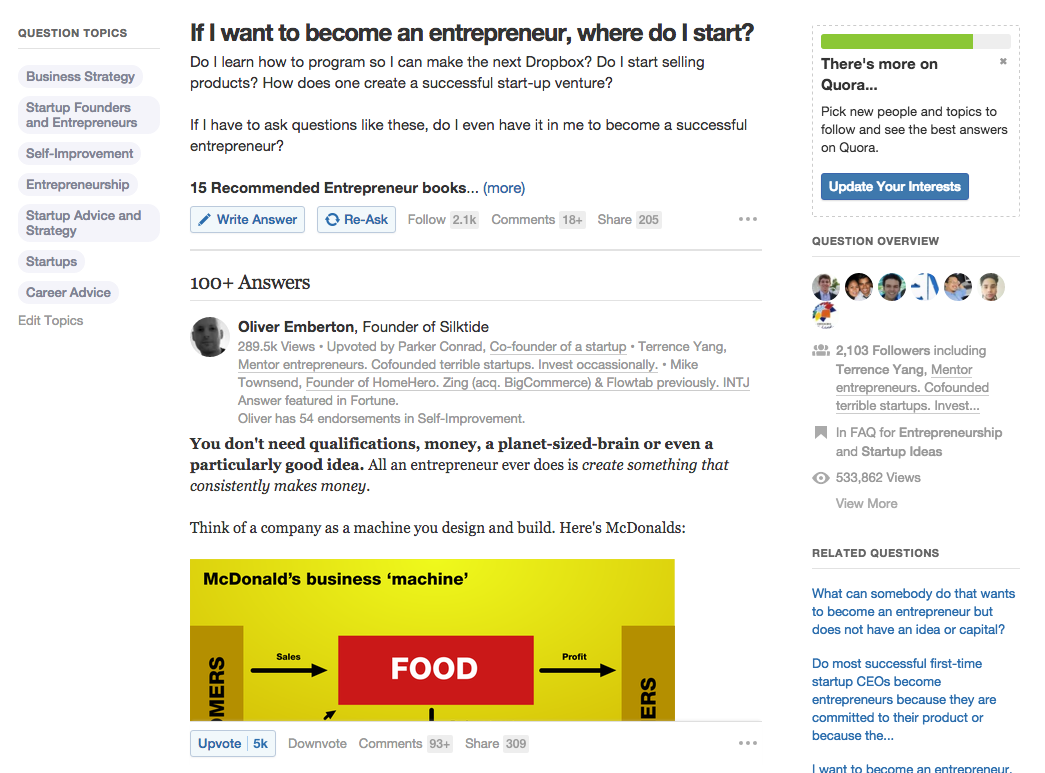
You can use the exact language and concerns the asker uses to create content that gives them exactly what they want (and makes them think you read their mind – because you did!):

entrepreneurship-quora-question

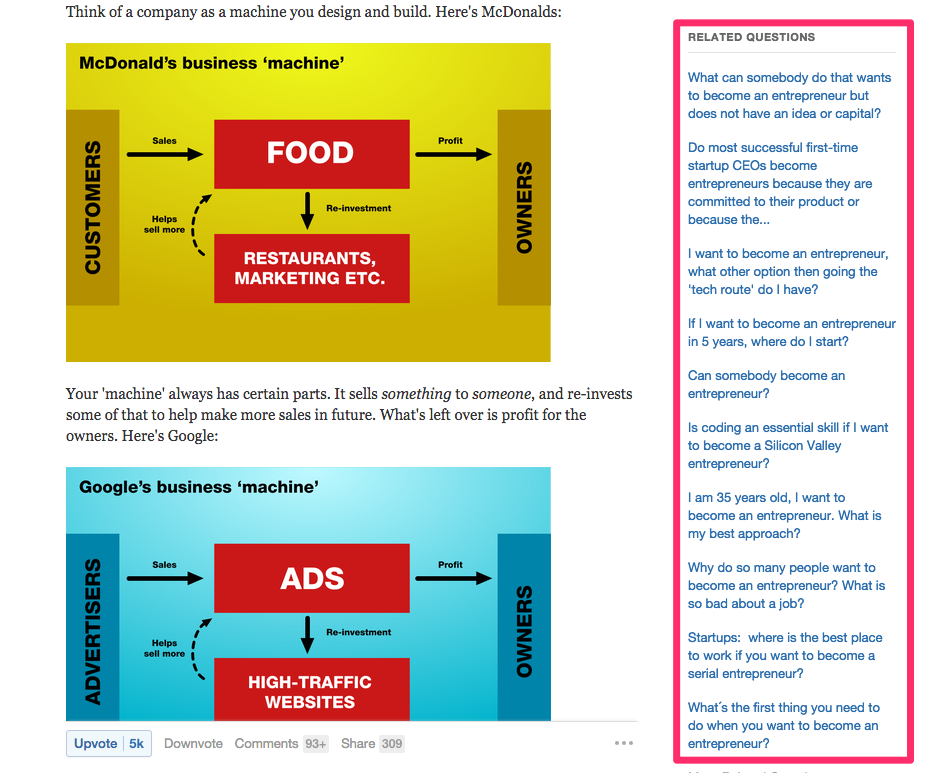
Then, Quora does a lot of the work for you by listing related questions (on the right hand side):

quora-related-question

How’s that for being handed content ideas that will delight your audience on a silver platter?

3. The World’s Biggest Retailer

A market research tools list wouldn’t be complete without mentioning the world’s biggest retailer:

Amazon.

Amazon is marketing gold for reading your target audience’s minds, because almost your entire market buys from Amazon, and because they’re actively reviewing their purchases and providing detailed feedback.

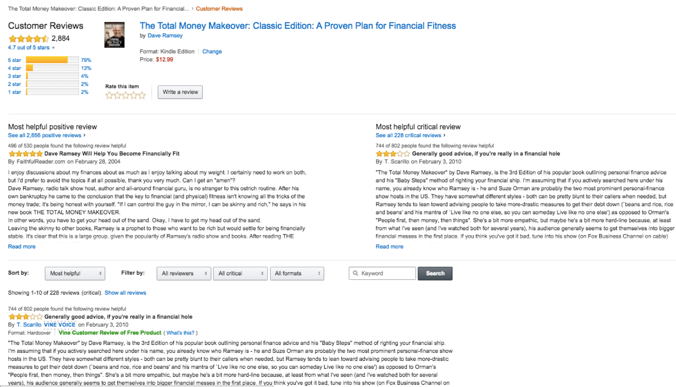
Start by searching popular book titles in your industry. For example, in the personal finance industry, you might search Total Money Makeover by Dave Ramsey.

Then, sort by “critical reviews”.

total-money-makeover-amazon-reviews

Amazon reviewers can be very detailed, so you’ll get insight into the language they use, the gaps in the book, and the information they need.

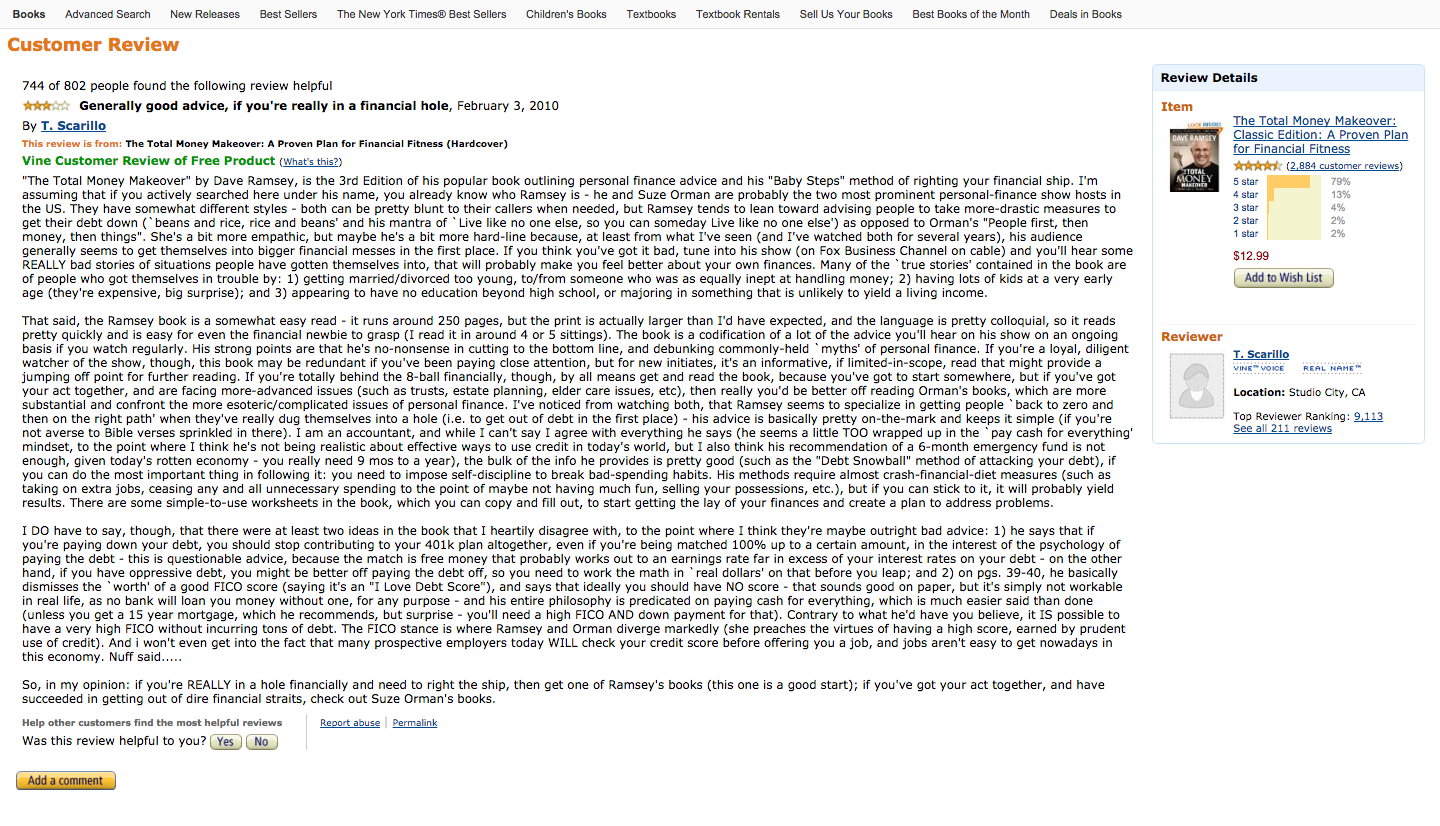
In this detailed review of Total Money Makeover, for example, the reviewer says:

“…You need to impose self-discipline to break bad-spending habits. His methods require almost crash-financial-diet measures (such as taking on extra jobs, ceasing any and all unnecessary spending to the point of maybe not having much fun, selling your possessions, etc.), but if you can stick to it, it will probably yield results.”

total-money-makeover-review

If you served this audience, how powerful could it be to provide them with the exact, step-by-step strategies that actually work to build up self-discipline and stick to financial goals?

4. The Social Platform Marketers Love to Hate

As frustrating as Facebook can be for marketers, it’s difficult to argue that Facebook has a reach that few other social platforms have.

Almost everyone you know uses Facebook, which is why Facebook is mind-reading gold.

But don’t just stick to Facebook pages or profiles. Facebook groups are where the action happens.

Facebook groups are gathering places for people who are interested in a specific topic, and if you focus on targeted groups, you can eavesdrop on your audience’s conversations so you can create content to provide massive value.

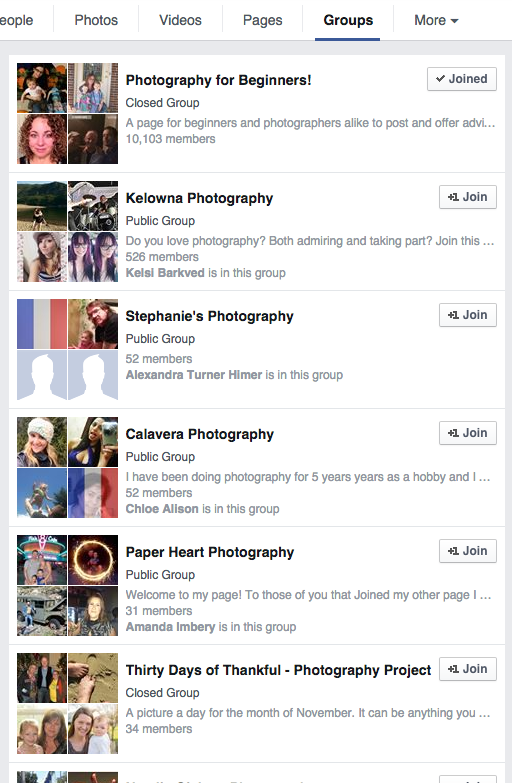
For example, if you taught photography for beginners, you could search photography in the search bar and sort by groups:

photography-for-beginners-facebook-group

This will lead you right to the water; this is marketing gold, a place where thousands of your target audience is congregating. In this case, over 10,000 members!

When your membership is approved, start combing through the posts and taking note of the language your target audience uses and the types of questions they ask:

facebook-photography-group-question

You can create content to help them exactly where they are.

5. Where Your Audience is Already Having Conversations

One of the best ways to create content to delight your audience is by filling in the gaps.

Have you ever tried to find information that just didn’t seem to be out there? It’s frustrating and when you finally find it, it’s a huge relief.

Your audience feels the same pain when they can’t find the information they need, and you can find what those gaps are by going where the gaps exist and your audience is having conversations around your topic:

Blogs.

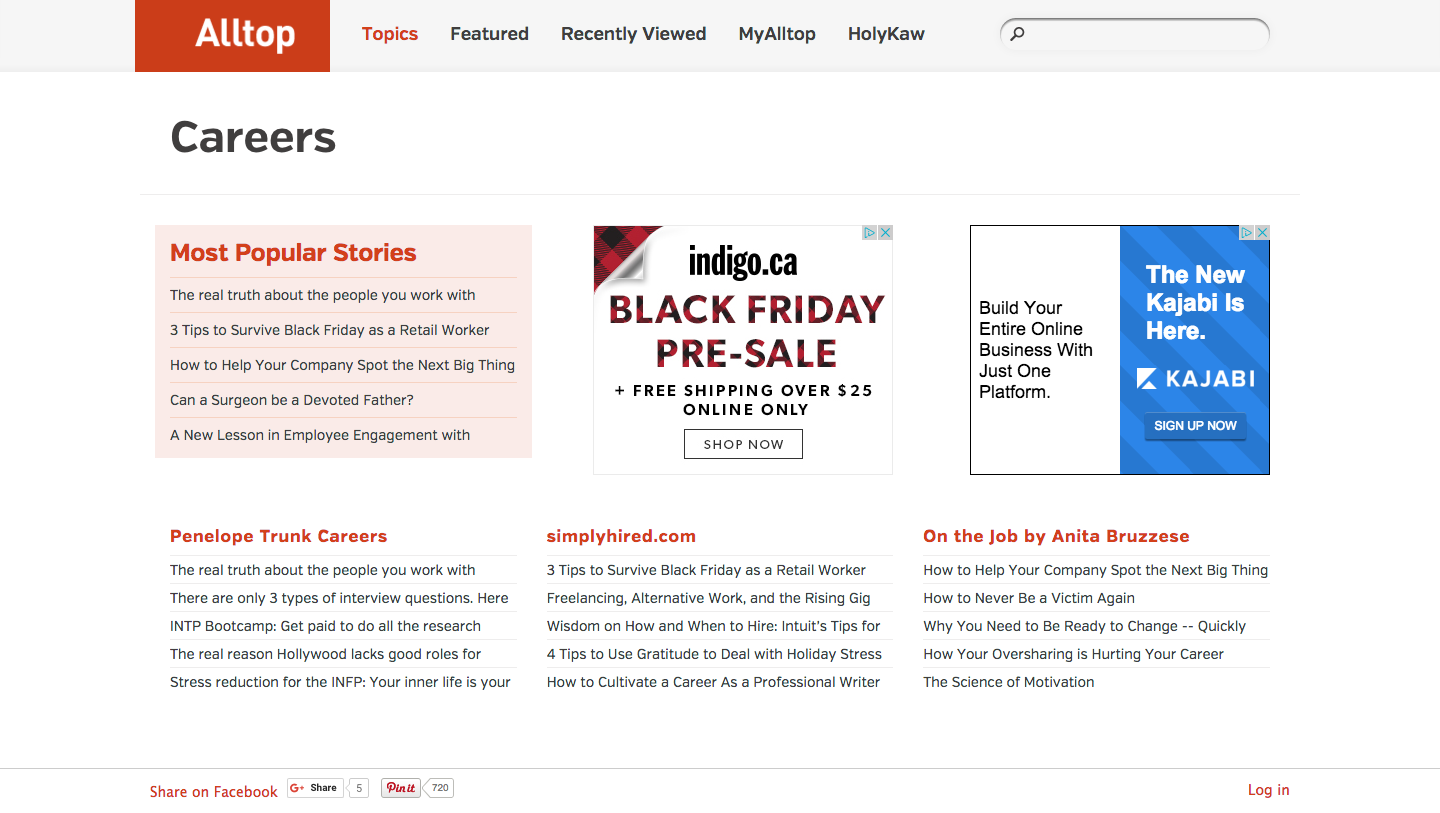
If you aren’t familiar with any blogs about your topic, use a tool like Alltop.com to find popular blogs in your industry. For example, if you’re a career coach, you might choose “Careers”:

alltop-careers

You could choose any of these blogs, but the best blogs to focus on are large, popular, single-authored blogs. These tend to drive the most comments.

When you’ve found a blog that fits the bill, read through a couple of the most popular blog posts and take note of what the blogger isn’t saying, and what the readers are in the comments sections.

Read through the comments, and take note of the trends in the type of questions people are asking.

This will help you fill in the gaps and give your audience the information they need rather than competing with the information they’ve already been given.

When it comes to market research, many businesses think they need to shell out money and resources on focus groups and research.

However, these tools are under-appreciated, free, and powerful platforms for that will save you a lot of cash and time.

As you dig through these platforms, you’ll begin to pick up content ideas, sales copy wording, and even your next product idea to help your audience with their exact challenges, desires, and needs…

Creating a truly irresistible value for your business.

About the Author: Nathan Chan is the Publisher and CEO of Foundr magazine. He is extremely passionate about entrepreneurship and has interviewed some of the most successful entrepreneurs on the planet today (Richard Branson, etc). He shares all of these interviews at www.foundrmag.com.

Five Business Predictions for the Coming Year

Looking ahead, 2016 may turn out to be the most challenging year for middle-market companies since the 2008 to 2010 recession.

The U.S. economy has continued to exhibit remarkable resilience despite the many economic and political challenges that threatened to derail it in 2015: the looming presidential elections, threats of global terrorism affecting many countries, slowing growth in China, and rock bottom commodities prices pulling down world economies and stock markets. However, a greater degree of economic, political, regulatory, and capital market volatility is to be expected in the coming year for the U.S. economy and middle-market companies.

Despite the headwinds ahead of us in 2016, the U.S. economy grew at a 1.5 percent GDP growth rate in Q3 of 2015 and is expected to end 2015 at 2.9 percent. Most economists do not expect this growth to continue, with predictions for GDP growth to be slightly to significantly lower for 2016.

In PricewaterhouseCoopers’ most recent Trendsetter survey, U.S. private companies reported that they expect to grow their revenue by an average of 8.7 percent over the next 12 months, with over one-third of private companies expecting double-digit growth. The question is how to achieve these levels of growth in an uncertain economy.

2016 holds a lot of challenges for business growth and expansion, and smart CEOs and investors should position themselves for a highly volatile year.

Here are my five top business predictions for 2016:

1. Expect gradually increasing interest rates and tougher credit for business.

U.S. employers are continuing to hire new workers at a healthy clip, keeping the economy on target to add 2.5 million jobs in 2015. Continuing payroll gains and upward changes will likely remove the final obstacle to the Federal Reserve making its move to increase interest rates. Future moves in the central bank’s tightening campaign will remain dependent on further improvements in the U.S. economy and progress toward reaching the Fed’s targeted level of inflation.

Despite the economic recovery, securing expansion financing remains an ongoing challenge for many small and medium-sized businesses that lack the level of consistent positive cash flow and asset-based security that lenders look for when lending to private companies.

According to a report published by the National Small Business Association, nearly a third of small businesses are without the capital they need. Many businesses don’t even apply for financing because they believe they will be turned down. Expect tighter capital markets for small business in 2016 and higher borrowing costs for those companies that are able to get credit. And look for emerging companies to continue to develop business models that minimize demands on their working capital. Converting costs from fixed to variable, such as employing outsourcing solutions so that they increase only as revenue does, is an example of such a strategy.

KEY TAKEAWAY: Secure your capital needs for 2016 now!

2. Lower oil prices into mid-year followed by gradual increases in the cost of oil.

Oil has slumped to levels last seen in the global financial crisis in 2009 amid a global supply glut. While the prices of benchmarks West Texas Intermediate and Brent currently hover in the $30s, some categories of crude are already pricing in the $20s for a barrel of oil—clearly not a sustainable economic model for oil companies and oil-producing countries. Anticipation of Iran’s return to the global energy market is also suppressing prices.

Expect massive consolidation of smaller U.S.-based oil exploration and production companies, and a decrease in worldwide production to match demand, thereby stabilizing oil prices about mid year. Although low oil prices are great for consumers, they can cause a worldwide recession as countries heavily dependent on oil production edge near loan defaults. Big buyers such as China and the United States will look to lock in low oil prices and drive demand, resulting in gradually increasing prices.

Commodities including iron, aluminum, and other metals are at historically low prices. With production companies closing down mines and production facilities, expect gradual price increases in raw materials as the global oversupply is reduced.

KEY TAKEAWAY: Consider purchasing forward futures on raw materials and energy early in 2016.

3. This will be the year of the mega-merger.

Excess cash and relatively low stock prices of non-technology companies will drive mega-mergers similar to the one recently proposed by DuPont and Dow Chemical. That merger may be a harbinger of things to come, inasmuch as the parties intend to combine and then break up the new company into two or more newly reconfigured businesses.

Auto mergers may finally happen as margins continue to be a problem in an industry ripe for consolidation of production and research. The prospect of “smart” cars loaded with technology may produce some unexpected mergers between technology companies and automakers and suppliers.

Consumer products and drug company mergers are already in process, and this will accelerate in 2016. At the same time, big companies with faltering prospects will continue to face pressure from activist investors, who last year as a group made a run at some 200 companies and replaced a number of prominent CEOs.

Smaller companies will also be attractive as add-on acquisitions to larger companies and to private equity firms. With the recovery of the U.S. economy and with record-setting amounts of capital in the hands of large corporations (“strategic buyers”), Private Equity firms (“PE”) and hybrid buyers (neither strategic nor PE; for example, wealthy individuals and family offices), private business owners contemplating a sale are fortunately faced with a myriad of options. Smaller companies that have demonstrated a track record of profitable innovation and have a compelling brand that a larger acquirer could scale are particularly in demand. As a CEO, you might consider the following: Is this the right time to position my company for a near-term sale? To whom should I sell? Should I sell at all? (Be sure to read 4 Strategies for a Successful Business Sale.)

KEY TAKEAWAY: It might be the time to sell your business or seek an outside investor.

4. It will be a challenging growth year for middle-market companies.

Despite middle-market company predictions for growth, 2016 will be more challenging than 2015. New sales and revenue are going to be harder to come by as the U.S. economy begins to parallel the slowdown in the global economy. Larger companies, a source of demand for middle-market suppliers, will begin to cut purchases and work off inventory. The trend to rationalize procurement and decrease the number of suppliers will continue. Mergers of large customers will also take a toll on middle-market companies as will higher interest rates and declining available credit. (Be sure to read Prepare Your Company for the Coming Recession.)

KEY TAKEAWAY: Now is the time to “batten down the hatches” of your business.

5.  It will be politics as usual—and the gap widens!

Always hard to predict but always entertaining, this year should be especially interesting as we approach the presidential elections. But equally as important will be the congressional elections: 34 of the 100 seats in the Senate are being contested in regular elections, whose winners will serve six-year terms. In addition, elections will be held to elect representatives from all 435 congressional districts across each of the 50 U.S. states.

The gridlock over the last eight years has taken its toll on the credibility of our legislative and executive branches as well as on our economy, with no expectation of change on the horizon. Our political system and our politicians will play a significant role in creating economic volatility and uncertainty throughout 2016. The divergence and gap between the two political parties feels wider than ever and compromise will be increasingly difficult. One positive coming out of our politics: Growing bipartisan consensus on the need to address the deferred maintenance of our physical infrastructure, which could be a boon for construction and contracting companies.

KEY TAKEAWAY: Keep your eye on the elections as a barometer of the U.S. economy. Congressional elections will be as important as the presidential election in terms of determining the direction of the country. A sharing of power generally means a more stable economy. Single party power lends itself to greater extremes in social legislation and economic policies.

Consider early 2016 to be a time for extensive strategic planning for your business and market positioning. Prepare your business to survive and prosper through what may be a very challenging year.

The post Five Business Predictions for the Coming Year appeared first on AllBusiness.com

The post Five Business Predictions for the Coming Year appeared first on AllBusiness.com.