Friday, 27 May 2016

How to Make Analytics Work for Your Videos

When the word “analytics” comes up, most content owners immediately gravitate toward viewership counts. However, though views are important, they're only part of the larger picture. Truly comprehensive analytics help content creators ensure the videos they produce are providing real ROI.


Without proper analytics, businesses have no way of knowing whether their videos are just popular or are actually converting viewers into buyers. A video that has lots of views but doesn't lead to sales is little more than a money pit.


With a well-built analytics tracking system, companies can see exactly where their leads come from, how they convert through the funnel, and where their marketing dollars have the greatest impact.


Real Data and Deceptive Views


Most companies recognize how important good data is to their revenue streams. New marketing technologies allow even the smallest companies to get a firm understanding of how their programs are performing across various demographics.


In the recent past, view counts were king. Businesses understood that more viewers equaled more brand recognition and more sales. Views are helpful, true, but they're one of the easiest metrics to acquire and interpret. Anyone can go to YouTube and see how many views a video has, but that number only reveals how many people started the video - nothing more.


Views don't tell you whether users left five seconds in, bailed halfway through, or made it to the bitter end. View count could be double or triple the actual engagement figures, but without other indicators, companies have no way of knowing. Engagement is difficult to measure on the whole, but if one video has 10 percent of viewers watching to the end and another has 90, that's an excellent place to start.


Additionally, view counts don't say who is watching a video. A video geared toward Baby Boomers in Texas with an actual audience made up almost exclusively of Millennials in New York probably isn't accomplishing what the content creator intended. Fewer views within the right audience are worth much more than tons of views in the wrong one.


What You Should Measure


If view count isn't the end-all of video analytics, what is? Predictably, no single statistic is the answer. A comprehensive analytics strategy should include:


Engagement


Measure engagement with both average and time-based metrics. These numbers will show you what percentage of your video viewers are watching and where in your video they're leaving. You can tell whether people rewatch a specific part several times or whether one particular lame joke or long-winded section is leading people to lose interest and close the tab.

wistia-video-engagement-metrics
Monitor how far into your video viewers are watching to identify where you are losing them. Using heatmaps, you can see which sections of a video a viewer is watching more than once.


Play rate


Play rate refers to the percentage of users who encountered your video on a landing page or website and clicked the play button. In short, it tells you how much appeal your video has before engagement begins. More than a simple view count, this ratio can help you identify ways to optimize your video splash screen and where you locate your player.


average-engagement-wistia
Understanding where your viewers are watching from helps identify that you're hitting the markets you want.


Call-to-action response rate


If your video includes a call to action - such as “Click here for more information!” - your analytics should tell you how many viewers answer that call. This number is the most closely tied to ROI because it directly correlates with lead conversions.


Demographics


Look at where in the world your viewers are located. Are you hitting the markets you want? Are there opportunities arising in markets you didn't consider before? The more specific your demographic information is, the better prepared your marketing and sales teams will be to develop targeted programs and campaigns for different groups.


demographics-countries-wistia
Understanding where your viewers are watching from helps identify that you're hitting the markets you want.


Unique views


Yes, views is still one of the metrics that, when taken as part of a larger whole, can help you form a better strategy regarding the content and placement of your videos. If you have 100 percent of your target demographic fully engaged and completing your call to action but there are only three of them, you might want to figure out a way to get your video in front of more people.


Used properly, analytics will quickly tell you things about your business that would take years to learn without them. A comprehensive analytics strategy will allow you to make better data-based decisions, save time using automatic forecasting models, view and analyze real-time trends, and save money, as all the wasted man-hours you used before can now be spent boosting your ROI.


Start Measuring the Right Way


You know what works, what doesn't, and what to measure. Now what? Follow these five steps to kick-start your analytics strategy and get better results from your videos:


Choose the right platform to host and track your videos


You have several great options available. YouTube and Vimeo provide the most cost-effective solutions and work well for most businesses, but they don't provide some of the more advanced analytics that other platforms do. Vidyard and Wistia cost a bit more, but they're worth the investment thanks to their great analytical tools and integration capabilities with most CRMs and marketing automation platforms, tracking viewers from first click to conversion.


Set monthly and quarterly tasks to analyze your analytics reports


Compare the results with previous numbers to see what changed to determine whether you need to alter your strategy, placement, or content.


Spend time reviewing engagement, total views, and play rate


Many views with little follow-through could indicate that your call to action is weak, while strong results on low numbers could mean your placement isn't optimal. If your play rate is low, the placement of your video on the page could be poor or your chosen splash screen might not be attracting an ideal amount of attention.


ABC: Always be creating


Marketing is about consistency, and video marketing is no different. Produce high-quality video content on a regular basis to keep people engaged and your message fresh. Analytics allow you to fine-tune your approach with each passing month to maximize your impact by seeing what worked well and what fell flat. Every new video - success or failure - is an opportunity to gather data and learn how to do better next time.


Too many companies mistake sparse analytics for good data or neglect the analytical approach entirely, leading to millions of dollars in lost potential revenue every year.


Don't leave money and customers on the table. Use analytics to gather and act upon the information you need to boost your ROI, broaden your brand appeal, and grow your company.


About the Author: Brandon Houston is the CEO of Switch Video, a video animation company that produces simple videos that “explain what you do” in an engaging and compelling format. Switch Video has produced more than 800 videos for clients, including LinkedIn, IBM, HP, Bayer, and American Express. Reach out to Brandon on Twitter.


4 Ways to Launch Just Another Mediocre E-Commerce Store (And How to Avoid Them)

Launching an online store is cheap and simple.


Just think about it. You choose a clever domain name, pick a beautiful theme, get a membership on your favorite e-commerce platform, and voila!…You can launch.


But here's the thing: anyone with half-a-brain can start an e-commerce…but only a few can do it successfully.


A 2013 study by ReferralCandy – a Singapore-based referral program software – revealed there were 23,587 established online retail stores in the United States alone at that time (and that number might be even higher now, considering how fast the ecommerce industry is growing).


And when I say “established,” I mean those companies were making at least $100,000 a year.


Just picture this image in your mind:


The Staples Center in Los Angeles at its full capacity (which is 18,118 people, by the way), but instead of seeing a legion of basketball fans, you see thousands upon thousands of entrepreneurs who own a successful ecommerce (and, some of them, might be your direct competitors).


Anyways, my point here is: you can't just launch, pray, and hope to succeed; you can't take a mediocre approach nor do what everyone else is doing – you need to stand out.


But how? You ask.


Well, you can start by avoiding the common (and sometimes fatal) mistakes most startups make. In this post, you'll find 4 of them. Take a look through them, and see if any describe you:


Mistake #1: Sell a Product That Doesn't Harmonize With The Market


The late Claude Hopkins once said that most marketers fail because they try to sell something people don't want.


God's truth.


Now, this might sound obvious at a first glance but make no mistake, it's really easy to get tricked by your instincts and take a fatal decision. In hopes of “being innovative,” you can spend thousands of dollars on a project that's bound to fail from the beginning.


The entrepreneurial graveyard is full of “original ideas,” hunches, and dreams.


Take Bobby Darin – the singer – as an example. Back in the 1950s – when he was an unknown young singer in New York – Bobby had a dream: He wanted to make an album of old popular standards, even though the “hottest” genre at that time was old rock and roll.


So he went from company to company, trying to “convince” them to record his music.


Every single music company in the city rejected him, of course. Nobody would take the word of a “nobody,” especially if his idea didn't harmonize with the market.


Anyways, Bobby finally threw his idea away and focused on what people really wanted – rock and roll. So, he recorded a song called “Splish Splash” (you might have heard of it), and a few months later he had sold over a million records.


All because he understood the importance of harmony.


What's that? You say Bobby Darin is just a weird case?


Well, you couldn't be more wrong.


Bobby isn't an isolated case. Dozens of products have failed because they didn't harmonize with their markets – The Ben-Gay Aspirin, Intellivision, The Laserdisc, Crystal Pepsi, and The Zune, to name a few.


crystal-pepsi
Image Source


No, there's nothing wrong about being original, but instead of trying to reinvent the wheel, find what people already want and then create a product that satisfies that desire.


In other words, start with the prospect, not the product.


You need to become a student of markets. This way, your chances of succeeding will increase exponentially.


Now the question is: How can you study your market?


Three tips:


  • Become a social media “listener” – you don't need to survey thousands of people to know what they want. More often than not, the information you're looking for is already out there, you only need to “listen.” Tools like Mention.net and Google Alerts allow you to track keywords and intercept relevant conversations. This way, you can be up to date about your market's desires.

  • Study the SRDS (Standard Rate & Data Service) publications – these publications provide you with a database of all the media buyers and sellers in the U.S. This means you can easily figure out the size of your market and its earning potential. You should be able to find an SRDS in your town's public library, but in case you can't, you can get one on this website.

  • Trust the numbers, not the words – when you interview or survey people, they tend to give you the answers they think you want to hear. So instead of relying on that data, you should always focus on the numbers – what are people really buying? Here's where an SRDS will come in very handy because you can see what kind of products are performing well in the market. Another option is to create an MVP (Minimum Viable Product) and measure performance based on actual sales.


Note: By no means am I saying interviews, questionnaires, and surveys don't work. When used right, they can give you valuable insights. However, numbers never lie. Better rely on them.


Mistake #2: Design Your Website Without Your Buyer Personas in Mind


If you design your store based on what you “think” will work, you're likely to fail. Why? Because you and your prospective customers think very different.


For example, it's proven that colors affect buying decisions, right? So let's say you're going to launch an online electronics store and your target market is Latin America.


Let's also assume that you decided to use a red color scheme because “you like red.” However, you didn't know that Latin Americans correlate the red color with religion and blood, so thanks to that dumb mistake many of your visitors will feel very anxious and will decide to leave your website without completing the purchase.


This example might seem silly for the experienced marketer, but it happens very often.


And there's another problem:


Not only you and your visitors think different, but your visitors' worldviews will always differ from each other, too.


Let's emphasize that point:


If you have children, I'm sure you know you can't educate them all with the same methods. The same way, you can't treat all your prospects equal.


Instead, you need to segment your audience into subgroups and, then, personalize your marketing message to each subgroup. It's the most effective way to strengthen your offer.


For instance, if you're running a vitamins and nutritional supplements store, you might target two different subgroups of people: Fitness enthusiasts and people who don't have time to cook.


So instead of marketing to those people with the same message, you should personalize it to fit each sub group's worldview.


groups-of-people-colors
Image Source


And you don't need to take my word for this. Recent studies suggest that 56 out of 100 people prefer to buy from stores that offer a personalized experience.


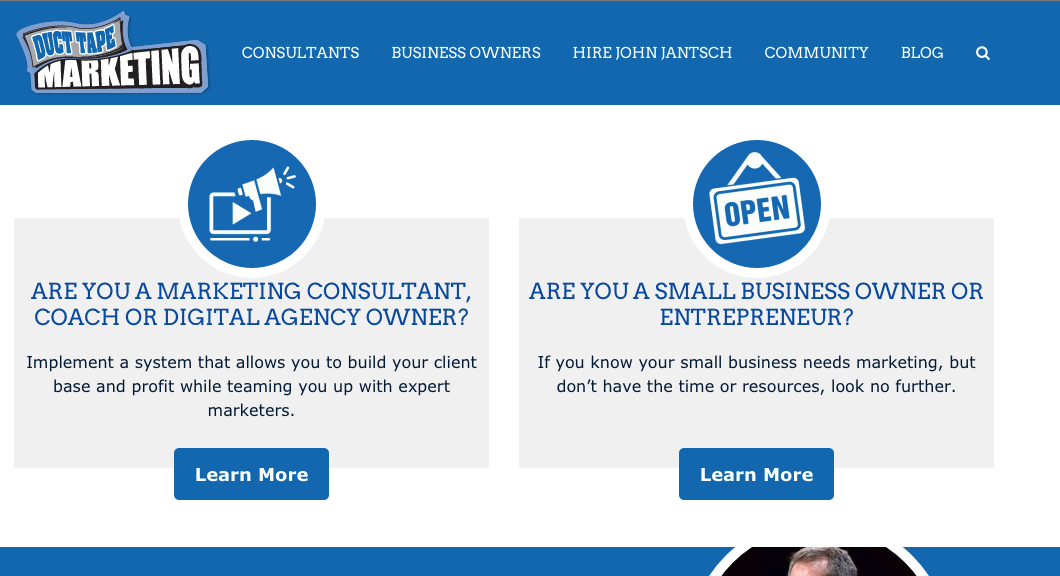
John Jantsch of Duct Tape Marketing understands this concept very well. When someone visits the site, he or she can self-select their persona choosing from Duct Tape Marketing's main buyer personas: Agencies, Coaches and Consultants, and Small Business Owners and Entrepreneurs.


duct-tape-marketing-personas


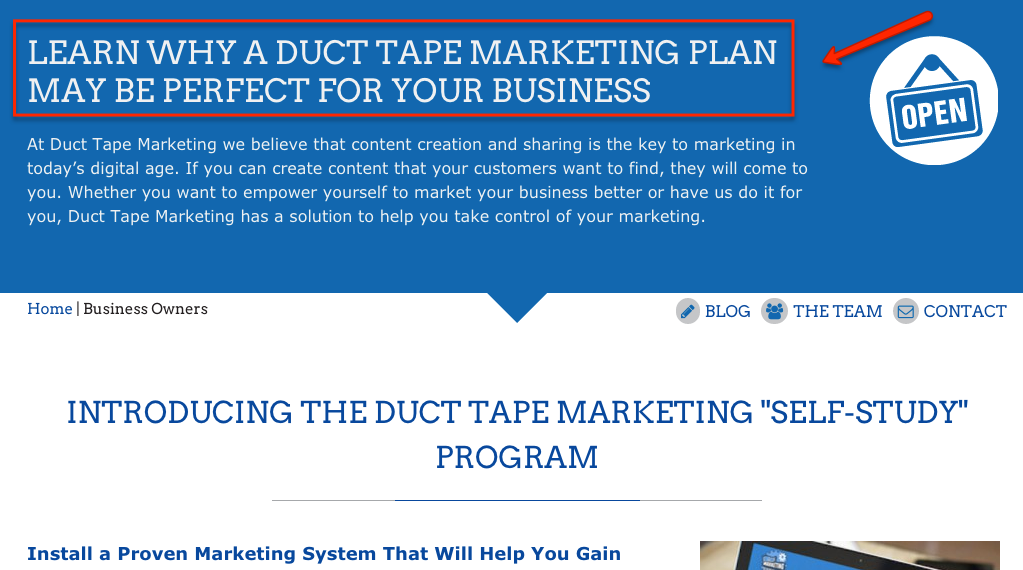
After people click one of the buttons, they'll see information that's relevant to their specific needs.


duct-tape-marketing-headline


This is obviously a smarter approach than displaying the same information to all your prospective customers, don't you think?


On average, marketers see a 20% increase in sales when they start providing personalized web experiences.


Now, there's no one-size-fits-all method for web personalization. However, here are a couple of guides that will get you on the right path:


Mistake #3: Neglect Customer Service


Tell me…what's the most valuable asset of any business?


Hint: Without it, your entire business would fall down in less than a New York minute.


Have you guessed?


It's your customer base, of course.


However, many companies don't seem to understand that. They focus on acquisition, spend thousands of dollars on conversion rate optimization, and even hire an in-house SEO guy, but they forget what is, without question, one of the pillars of any successful e-commerce:


Customer service.


And I'm not exaggerating. No. I brought with me a couple of stats to back that up:


  • Some studies have revealed that 84 out of 100 customers have bailed on a transaction or not made an intended purchase because of a poor service experience.

  • In 2011, 7 in 10 Americans said they were willing to spend more with businesses they believe provide excellent customer service, according to research by Help Scout.

  • Some companies – like The PIG – have even seen a 250% increase in their annual revenue after improving their customer service.


I'm going to be straight with you:


If this doesn't help you understand the importance of an outstanding CS, you're…beyond all help!


So here are four effective ways to improve it:


  • Reduce customer effort – it's all about making your customers' life easier, not the opposite. Make sure they can get support fast and avoid unnecessary steps. For example, instead of just having a dedicated page for customer service, you could add a widget that follows users all over your site, so at the moment they have any problem, they would be able to reach out to you very quickly.

  • Offer Multichannel support – 9 in 10 people expect to receive a consistent experience across multiple customer contact channels.

  • Provide online chat – as human beings, we tend to be desperate; we hate waiting. Well, online chat is one of the fastest mediums your customers can use to get help. Also, it's very simple to use. It's not surprising why 77% of customers prefer to buy at retailers that provide online chat.

  • Take care of social media complaints – people tend to complain about products and services through social media. Make sure to intercept those conversations and try to fix the problem as quickly as you can – social media conversations spread like butter on hot bread.


Mistake #4: Rely On The “Popular” Marketing Channels


I know you think this is obvious and simple, and that you aren't that “stupid” to make this mistake, but I'd say…don't be too sure.


Listen. The majority of retail stores are built upon three main traffic channels:


  • SEO

  • Social Media

  • PPC


It's not rare that a startup focuses 100% of its resources on one or more of the above channels in hopes of acquiring new customers, and it's ok. But, to be honest, there are plenty of other channels to focus on.


No, I'm not saying that SEO or PPC aren't good nor that you shouldn't focus on them. What I'm saying is that, maybe, you need to start thinking outside the box and look for ways that allow you to grow faster, and I mean, really faster.


To help you put your creative juices to work, here are two proven ways to start:


a) Start an affiliate program


Companies like Kiyonna and AbesMarket.com are crushing it with affiliate marketing, not to mention Amazon, Ebay, and Walmart.


Just think about it for a second. When you run an affiliate program, you only pay your affiliates for every new customer they bring to your company. It's like advertising but your affiliates take all the risk.


You literally have little to lose and much to win (especially in this day and age). With companies like OMNISTAR – The Voted #1 Affiliate Software for Ecommerce – and LeadDyno in the market, now it's really straightforward to start your own affiliate program.


b) Embrace word of mouth


Did you know that 65% of new business comes from referrals?


Not only that, according to a study made by Ogilvy, Google, and TNS, 74 out of 100 consumers identify word-of-mouth as a key influencer in their purchasing decision.


If that doesn't sound interesting to you, I'm sure that nothing will.


Now you might be thinking:


Awesome, but, how can I leverage word of mouth to grow my business? I'm glad you asked. Here are three tips:


  • Start a referring program – people are 4 times more likely to buy when referred by a friend, says Nielsen. And the best way to encourage those referrals is by giving away incentives. Dropbox is a famous example. They offered 500MB additional free storage space for every friend you referred. Evernote, on the other hand, offered premium accounts. Amuze's – a women's clothing store – gives you and your friends $25 off your next flash sale purchase. The point here is to give users a reason to share your company. This guide from Shopify will guide you step-by-step through the process of creating your own referring program.

  • Provide an awesome experience – Texas Tech says that 83% of consumers are willing to refer after an outstanding experience. That's why you need to spend some time improving your customer journey maps, perfecting your customer service, and a/b testing your platform's key elements.

  • Stand for something – HBR says people aren't loyal to companies at all. No, they are loyal to what the company stands for. TOMS' famous “One for One” campaign is a great example of this concept in action. TOMS said: “For every pair you purchase, TOMS will give a pair of new shoes to a child in need.” This campaign created a natural referring environment by triggering one of the most powerful needs in human nature: Altruism.


The Bottom Line


The e-commerce industry is insanely competitive. To get good performance, you need to start off on the right foot and keep the momentum without squandering the opportunity.


The best way to do it is avoiding all the mistakes you can.


And now you know 4 ways NOT to start.


Just remember the words of the late Sam Levenson:


“You must learn from the mistakes of others. You can't possibly live long enough to make them all yourself.”


What are some good stories you can share about launching an online store?


About the Author: Josue Valles is a content marketing evangelist, strategist and die-hard entrepreneur. He constantly blogs about Inbound Marketing, SEO and Social Media Marketing at Engagebit. You can also follow him on Twitter.


Monday, 23 May 2016

7 Questions to Consider Before Developing In-House Technology for Your Business

By Dr. Evans Baiya


Embracing the latest technology can help companies advance their processes, expand to new markets, improve customer experiences, and even attract younger employees.


But what do you do when even the best technology on the market doesn't quite meet your company's needs? Many CEOs are opting to transform their organizations by developing new technologies in-house.


Companies that develop their own technology have more control over their strategic direction and can better respond to the needs of the market. This can mean a significant competitive advantage when a company develops a compulsory technology before the competition.


It has become easier than ever for companies today to develop their own in-house technology as access to resources and platforms have increased. Yet, developing technology is not a simple task. In fact, for companies without tech as part of their core business, it takes significant time and resource investments, the cost of which must be measured against the ROI of the new product.


Here are seven questions to ask before developing a proprietary technology in-house:


1. How can we incorporate tech into our existing strategy?


Technology is a means to achieving a business goal, similar to the way companies hire people to help meet specific business objectives. They don't hire people just for the sake of hiring; they hire after establishing clear roles and responsibilities.


This should be also the case when developing technology. Your goals should be clear and aligned to your core business strategy. This strategic intent is the key to identifying the what and how of the new technology.


2. What should the specs be?


This is where bringing in an expert can be very helpful. Someone with tech experience can help you understand which of the different computing frameworks and languages will best fit your product, as well as whether the technology should be hosted locally or remotely.


You also need to consider where customers will use your technology (mobile or desktop), the availability and cost of the required technology stack, the development sequence that should be followed, and the time needed to develop the product.


3. Who should own adoption and development?


This can go several ways. Often the team that will benefit most from the technology advancements, or will be responsible for using the technology, may want to own the technology. In other cases, the IT department owns all technology in the organization. In some cases, the development is shared between the groups that are using the technology, and then one group is responsible for its maintenance.


4. How much expertise do we need internally?


Even if outside experts are brought in to help with development, there will be a certain amount of internal expertise needed. Tech development should be treated as a startup, meaning that there should be a clear funding and support strategy, as well as a dedicated team in place.


The level of expertise and manpower requirements will depend on the capital investment available and the complexity of the product. If you don't have the in-house expertise, you must decide whether to bring in a temporary employee or a contractor for the development phase, or whether you will need to add other permanent employees to fulfill both development and operations roles.


5. How much will it cost, financially and culturally, to develop and adopt?


The budget for the new technology should include strategy, development, testing, support, training, equipment, and manpower. Regardless of the financial investment needed, a cultural adjustment will be required as well. Starting an internal technology team can introduce cultural and team dynamics issues that must be addressed along the way–not to mention the cultural adjustments of adapting to using the new technology, especially by employees who may be adverse to the new way of doing things.


6. How long will it take to see ROI?


One common mistake that companies make is trying to go to market too quickly, ultimately coming out with an invalidated product that leaves customers dissatisfied or has too many bugs to fix efficiently after the launch. There is also the timing of customer education and the rate of adoption to consider. Taking the time to make educated and realistic projections on both time-to-market and positive market momentum will increase the chances of a successful product.


7. How can we minimize risk?


While tech development can create positive strategic value for an organization, it also represents a significant risk. There are multiple risk management strategies available, such as training, outsourcing, hiring consultants, and leasing-to-acquire an existing technology.


One common method is rolling out a plan-build with testing by stakeholders. This significantly reduces the risk of developing an inadequate product, while at the same time increasing accountability between the development team and the rest of the organization.


Developing Your In-House Technology


Companies must create their own unique strategies to address technology-driven disruptions. There is no one-size-fits-all methodology. One thing is clear: as customers continue to adopt digital technologies, companies must keep pace to stay relevant.


About the Author


Post by: Dr. Evans Baiya


Dr. Evans Baiya is a technology and innovation strategist with Price Associates; he facilitates technology development, inventions, and commercialization of ideas for his clients. He has published more than 30 peer-reviewed publications and holds several patents. Dr. Baiya is also a faculty member for The Complete Leader.


Company: Price Associates

Website: www.price-associates.com

Connect with me on Twitter.


The post 7 Questions to Consider Before Developing In-House Technology for Your Business appeared first on AllBusiness.com

The post 7 Questions to Consider Before Developing In-House Technology for Your Business appeared first on AllBusiness.com.


Sunday, 22 May 2016

Don't Allow Corporate Politics to Derail Your Sales Success: 3 Fundamental Strategies

Corporate politics exists whether you like it or not. And your sales success is dependent on how you deal with others. So why not use political strategies to help you succeed in sales?


1. Recognize it's not a corporate ladder, but a Ferris wheel.


Most sales and business professionals want to climb the corporate ladder. The only problem with that image is that succeeding in business isn't always a straight upward climb. I want you to consider your career as a ride on a Ferris wheel.


Sometimes you'll be up and sometimes you'll be down. You may have great sales numbers and be the leader of your sales team, and then a new sales manager comes in with a different strategy. You may be given a new sales territory or experience other changes in your business. You were up before, and now you're not.


New leaders oftentimes bring in their own teams. It's not fair, but it happens. Be ready for change.


2. When you have it, use your power wisely.


When you do find yourself at the top of that wheel, it's important to plan for that day when you won't be. One way is to not misuse your power through petty and not so petty actions. I clearly remember one manager who abused his power. He played favorites with his staff. He ignored simple requests of some, and he made life difficult for others. Then policies changed.

Management instituted an anonymous 360 feedback program. Customers provided input about each manager, and subordinates were asked to evaluate this manager's performance. Not only did subordinates tell their customers how awful this manager was, but the subordinates didn't hold anything back.


A meeting facilitator was asked to give feedback to this manager. He met with the subordinates before the meeting. The facilitator said, “This is the worst 360 feedback I have seen in twenty years.” The session was brutal for this manager. I have never seen someone so crushed at a meeting.


Remember, when you're down you are going to be reaching out for help from as many people as you can who know and like you. Misuse your power and there will be far fewer sources of help for you. This manager had no one to turn to.


You may want to start a business one day; you may be selling to some of the people you work with now. Be nice-you might need their help one day.


3. Don't take the bait from your rivals.


I wish I could tell you that all human resources departments do their job and remove inappropriate staff, but it's impossible to do. I predict that you'll have to work with some unsavory people at some point in your selling career. They may be argumentative, impolite, difficult, or have some other characteristic that bothers you.


You have a choice. You can confront them each time they pick a fight with you, or you can't refuse to take the bait. I am not talking about standing up to a bully. I'm talking about the many conversations you will have in meetings where you have a choice of taking the bait or not. Don't take the bait.


When you hear an offensive statement that others know to be untrue, don't take the bait. What you do privately in a one-on-one situation could be a different choice. Publicly, all the angst and drama just isn't worth it. George Bernard Shaw was right when he said, “Never wrestle with pigs. You both get dirty and the pig likes it.”


Making these choices in my corporate career have served me well. I hope they lead you on your Ferris wheel ride to success.


The post Don't Allow Corporate Politics to Derail Your Sales Success: 3 Fundamental Strategies appeared first on AllBusiness.com

The post Don't Allow Corporate Politics to Derail Your Sales Success: 3 Fundamental Strategies appeared first on AllBusiness.com.


Friday, 20 May 2016

7 Smart Steps to Protect Your Small Business

Whether you are just starting your new business, or have been up and running for a while, protecting the business you worked so hard to build is a critical step. Unfortunately, it's one that many entrepreneurs neglect in the rush of launching a startup and operating day-to-day. Here are seven steps you can take now to protect your small business.


1. Choose the right form of business. Operating as a sole proprietorship-the default business structure for a one-person business-may be easy, but it's not necessarily the best choice to protect your business. For one thing, the sole proprietorship structure doesn't protect your personal assets. That means if a customer decides to sue you or a vendor demands payment that your business can't afford, your savings, home and other assets could be fair game.


2. Hire an attorney. You may not need to use a lawyer that often, but when you need one, you need one fast. Ask other entrepreneurs, business colleagues and friends for recommendations to attorneys who are familiar with small business issues. Take the time to compare attorneys by scheduling an interview with each before you hire them. Discuss payment options-most attorneys have affordable solutions for even the smallest business. Find an attorney to answer your questions.


3. Find an accountant. Even if you plan on doing the bookkeeping yourself, a good accountant is worth the price. Who has time to keep up to date on tax law changes? You sure don't-but accountants do. Not only can they save you money on your taxes, they can also provide valuable advice on how to structure your business, the best way to finance expansion, and how much to pay yourself. At my company, we consult our accountant before making any big decision.


4. Be smart about new customers. Before taking on a new B2B customer, always conduct a credit check. This helps protect you against unpaid invoices. Never do business without a contract-no matter how confident you are in the customer's word. If something goes wrong, a written contract may be the only thing that ensures you get paid for your hard work.


5. Buy business insurance. Most businesses need general liability insurance, and if you provide advice or professional services to customers, you may also need professional liability insurance, also known as E&O (errors and omissions) coverage. Depending on which state you operate in, you may be required to have workers' compensation insurance. Other insurance products to consider include key man insurance on your life and the life of other key employees, business interruption insurance (which protects your income if your business has to shut down due to a disaster) and cyber insurance.


6. Protect your employees. Disaster can strike any time, so it's important to have a disaster plan for what you will do in case of emergency to protect your business. Create a plan and assign responsibilities for how to get employees and customers out of the building safely, what to do if a disaster keeps you and employees from getting to your business, and how you will keep running even if you can't get to your location. Learn more about creating an emergency disaster plan.


7. Protect your business data. Back up your company data and documents with a cloud storage and sharing solution so you can access files anywhere. When your information is stored in the cloud, you don't have to worry about a crashed hard drive or fire on your premises wiping out precious data. To protect your small business from cyber crime and hackers, install appropriate firewalls and, more importantly, train your employees in cyber security measures, such as creating using strong passwords.


The post 7 Smart Steps to Protect Your Small Business appeared first on AllBusiness.com

The post 7 Smart Steps to Protect Your Small Business appeared first on AllBusiness.com.


Thursday, 19 May 2016

Using Dimensions & Segments in Google Analytics to Propel Your Content Marketing

As online marketers, we all have great web metrics at our fingertips….or do we?


Using hard facts to support business decisions requires two things: reliable data and knowing the key performance indicators of the business in an online context.


I have been using Google Analytics for 10 years (since just months after the Urchin acquisition), and I have seen some great customizations of this massively popular web metrics tool. However, it is common for organizations to not even scratch the surface of what Google Analytics can offer.


Using mere headline engagement statistics, like bounce rate, without a web metrics strategy can lead to some bad decisions.


While I'm sure some of you Kissmetrics readers are already champions of Google Analytics, in this post, I will cover some tips that might help you create your own analytical setup in A/B testing, social media, AdWords, and content marketing, as well as some of the slightly newer Google Analytics features.


So, let's get into it.


Measure User Engagement and Transactional Revenue with A/B Testing


User engagement and transactional revenue can be measured with A/B testing.


For the free version of Google Analytics, get yourself an Optimizely account (also free – up to 50,000 monthly unique visitors) so you can build variations for A/B and multi-variate testing. You can set up a “custom dimension” integration with your Optimizely experiments within Google Analytics to view traffic sliced and diced as you please.


Once the “custom dimension” integration is set up for you, you can build custom reports within Google Analytics. Instead of navigating into Reporting, start with Customization from the top navigation.


google-analytics-customization-link


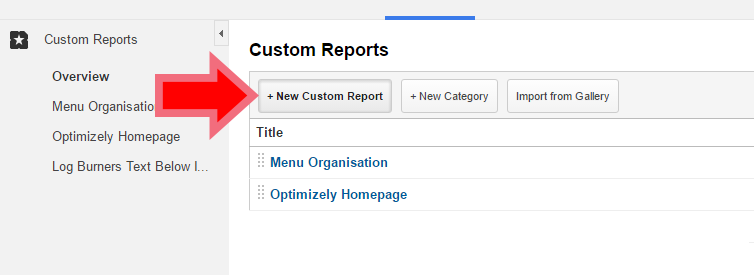
Create a new custom report.


create-new-custom-report-google-analytics


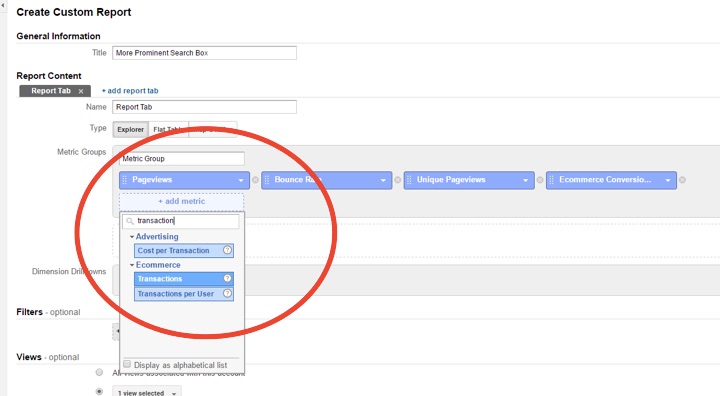
Then, build your report to include whatever Metric Groups you are interested in – user engagement and/or transactional data. Click on “+ add metric,” and type in your metric.


adding-metric-custom-report-google-analytics


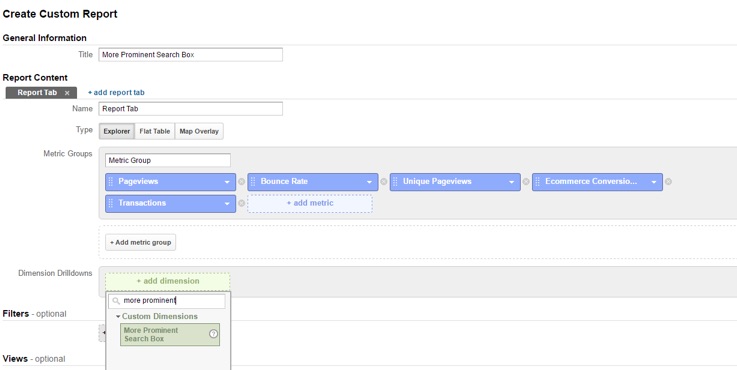
It's key that you select the right dimension for Dimension Drilldowns and Filters and apply a regex that is the experiment ID from Optimizely.


dimension-drilldowns-google-analytics-custom-report


Once you have saved your custom report, you can view the buckets of session data against the A/B tests.


custom-report-ab-test-google-analytics


This is powerful data. You can have up to 20 Google Analytics integrated tests running at any one time providing you with classic user engagement statistics as well as “the sharp end” of conversion-led data.


In the test results below, we see major improvement from enhancing the design of a shopping cart “search” function to make it more prominent. Check out how the variation wins on conversion rate:


google-analytics-report-results


Measure the Popularity of Web Content at a Page Level


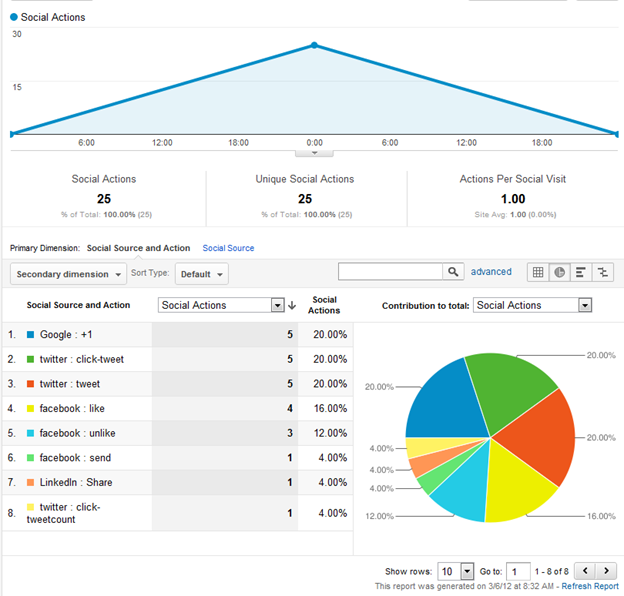
The popularity of web content can be measured in visitors and shares. For social media gurus and content strategists, it's great to measure key social actions at a page level.


With this information (tracked as events), you can review a blog section more effectively, understanding the visitor/share picture instantly to support the direction of future blogging or content creation. View the data within social plugins once you have everything set up.


social-actions-report-google-analytics


Optimize AdWords for the Highest Quality Visits with Smart Goals


Google AdWords provides some great tracking options, including dynamic call tracking where a unique number is displayed down to the keyword level.


Introduced by Google in December 2015, Smart Goals is a useful new addition for online marketers who strive to put together the whole picture of online and offline conversions. Using machine learning, Google Analytics cleverly combines a number of technological and user metric factors to identify the highest quality visits and define them as Smart Goals.


For many e-commerce and digital managers, this is a much more straightforward way of understanding the true value of their website's tracked sessions. Assuming you have Analytics and AdWords linked up, goal conversions can also be imported into your AdWords account to assist your paid search optimization efforts. In fact, this linkage is a prerequisite to using Smart Goals, which indicates that the primary reason for this recent addition is to assist AdWords management.


How to Set Up Smart Goals


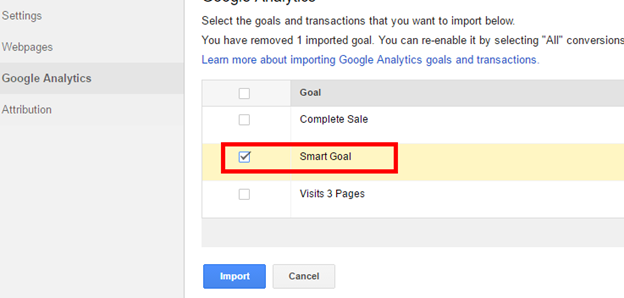
Once Smart Goals is set up in Google Analytics, you can access it within your Google AdWords account by going to Tools > Conversions > Google Analytics.


Simply select Smart Goals, which will then allow you to optimize your AdWords performance toward the highest quality visits.


smart-goal-google-analytics


Build Remarketing Lists with Smart Goals


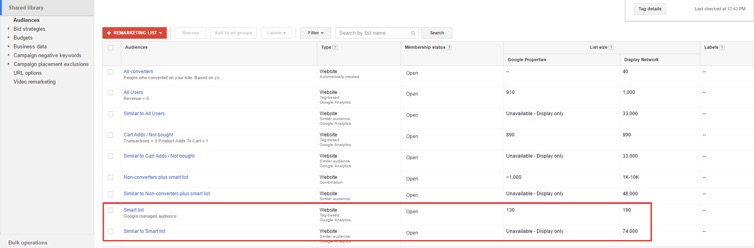
You can build remarketing lists (called smart lists) with Smart Goals. This could seriously improve your remarketing conversion efforts and potentially your AdWords results overall. Smart lists are built within your AdWords Shared library > Audiences and will appear along with a “lookalike” audience, which could be useful if your website is lower than 10,000 pageviews / 500 e-commerce transactions per month (the threshold for using the smart lists).


remarketing-lists-smart-goals-google-analytics


Note: your Google Analytics account and script will need to be modified for these lists to work (here's how).


Measure Audience Engagement with Google Analytics


Google Analytics has always been an SEO's best friend, slightly less so when Google's move to https screened out the vast majority of organic keyword data. But, with sales, traffic, and even Google Search Console data, there is plenty to work with.


Focusing in on the Hummingbird (released 2013) and RankBrain (released 2015) algorithms makes for more progressive SEO these days.


These areas of machine learning are getting stronger at understanding the semantics and intent of search engine users. We don't know how far along Google is in understanding user engagement, but we know Google is moving in the direction of ranking content based on reputation, content quality, and usability. So here are some nice and simple analyses to run with 2 simple segments that I've created and am making available to you to import into your Google Analytics account.


Low Engagement Segments – Pages per User


Analyze “low page view per user engagement” SEO traffic with this Google Analytics segment.


This basic segment looks at traffic from Google (organic) where unique pageviews are equal to or less than 1. You could run this over a time frame, like 3 months, to understand which pages are being accessed the least. Then pop into Behavior > All pages pageviews, and filter by your /blog/ directory or /products/.


If your blog area URLs do not have a distinct pattern, then you could use content grouping for this type of analysis. It's important to weigh this segment next to something like “new users” because, over a longer date range, you can see what percentage of users were “low engagement.”


Here is an example where we examined a homepage:


seo-love-traffic-segments


Only 2.48% of users to this website's entrances are looking at only one pageview, but the average time on page is nearly 7 minutes. This analysis would give a thumbs-up for this homepage.


Now see which pages aren't getting the SEO love. In this example, we can see that this page has 97% of its entrances equal to or less than 1:


low-engagement-traffic-segments-analytics


The website's dwell time on average is nearly 5 minutes so we know these visits are below average, suggesting there is a problem with the relevancy of organic search terms creating the visits and/or the landing page quality. This is a basis for an interesting discussion past this point.


Generate a list and see if they're indexed on Google with the “site:” command. If they are, see if Google's cache date is recent or not.


Make a call as to whether you update the web page's content, work harder in general at optimizing it, or delete off server/301 redirect to a similar page.


Bounce Rate and Low Average Session Time Segments


Look at organic search traffic that resulted in a bounce with this Google Analytics segment.


Backlinko's recent study of 1m Google search results suggests that there is a correlation between low bounce rates and higher Google rankings. Other studies suggest that average session duration plays an important part in search ranking so why not cross-analyze by this factor, too, with this segment.


google-analytics-segments


In this example, we've applied the 2 segments from the main “reporting” area of Google Analytics and isolated a page that has a low engagement issue. Here, 42% of users leave straightaway and 44% dwell on the page for an average of only 4 seconds.


This analyzes Google SEO traffic that is low engagement in terms of average session duration – set at 60 seconds. Needless to say, each website will have a different average session duration, so you might want to copy a segment like this and amend what you deem as a positive figure for your website. As Google's RankBrain gets cleverer, this is the type of SEO-led web metric that is getting increasingly popular.


Looking to Move Off White Belt for Content Marketing?


Analyze your blog performance over the years. I have learned a lot in this area from Skip Besthoff, a pragmatic content marketer who has a great understanding of where the content game meets search engine optimization in a harmonious manner. There is a simple, common, but potentially crippling, pattern that the vast majority of blog traffic is driven by a tiny number of blog posts.


How many websites that have blogs actually do this type of analysis? If you've done it before, do you review on a frequent basis? The “meat” of such analysis can be formed on basic Behavior > All pages pageviews and then filtering web pages from there:


  • For your filter, use the directory that all blogs appear within (e.g., /blog/, /news/, or /articles/).

  • If the blog posts aren't in one easily identifiable directory, this may be a bit of a blocker. In this case, you'll want to use content grouping.


Here is an example where we filtered for any URL with “guide” in it:


google-analytics-search-box


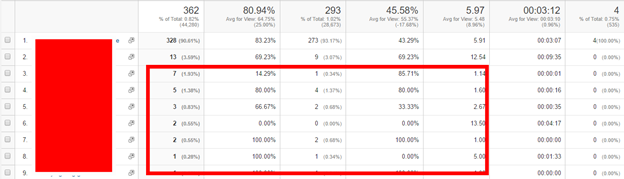
…which then shows us a common picture arising out of many blogs:


traffic-segments-google-analytics-data


Here 94% of the blog pageviews are coming from just 2 posts. On average, we see around 80% coming from 2-3 posts/articles, but this information then allowed us to focus in on the numerous pages highlighted above.


Conclusion


The beauty of web metrics is that you can translate what is important in your marketing strategy into buckets of vital data. There are lots of interesting things you can integrate within Google Analytics, but you need to prevent yourself from going around in circles not finding what you're looking for because you didn't determine your KPIs in the first place.


Start with your implementation plan, move on to the technical setup and requirements, and remember that you will need to continuously evaluate your setup and measurement accuracy to establish Google Analytics as a key business tool at the top level.


About the Author: Duncan Colman is Founder and Inbound Marketing Strategist at Spike Digital. Spike specialise in ecommerce & international SEO, pay-per-click advertising management and conversion rate optimisation.